
Grace Therapeutics Q2 2026: FDA CRL Challenges and Pipeline Restructuring Impact Near-Term Outlook
Grace Therapeutics faces regulatory delays for its lead candidate GTx-104 and shifts focus away from other pipeline assets amid strong liquidity.
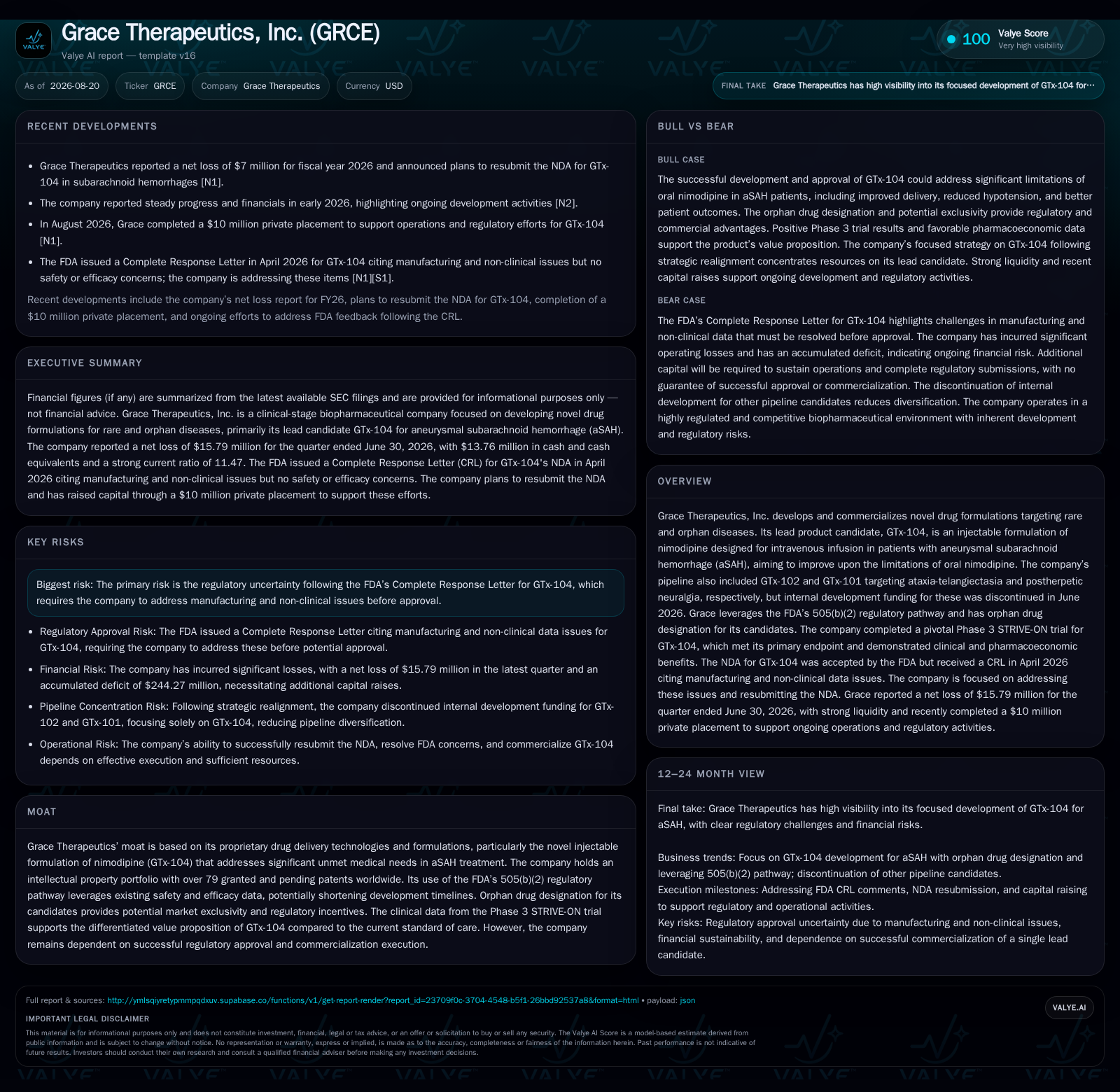
In Q2 2026, Grace Therapeutics reported ongoing remediation efforts following an FDA Complete Response Letter (CRL) for GTx-104, citing manufacturing and non-clinical deficiencies. The company discontinued internal development funding for pipeline candidates GTx-102 and GTx-101 to concentrate resources on GTx-104 commercialization readiness. Despite these challenges, Grace maintains a strong liquidity position with $13.76 million in cash and a current ratio of 11.47 as of June 30, 2026, providing a financial buffer for remediation activities. Regulatory and operational risks remain significant near-term uncertainties.
Grace Therapeutics, Inc. reported its Q2 2026 operating and financial results highlighting significant regulatory and strategic developments that shape its near-term outlook [S1][S2]. The company continues to address a Complete Response Letter (CRL) issued by the FDA in April 2026 for its new drug application (NDA) of GTx-104, its lead injectable intravenous nimodipine formulation targeting rare and orphan diseases such as aneurysmal subarachnoid hemorrhage. The CRL cited manufacturing deficiencies and non-clinical issues requiring remediation before approval can be granted.
The FDA's CRL specifically identified gaps in manufacturing controls and quality systems at Grace's contract manufacturing organization (CMO), as well as additional data requirements related to leachables and toxicology risk assessments. The company has scheduled a Type A meeting with the FDA to clarify the path forward and determine next steps for NDA resubmission. However, remediation efforts may entail costly and time-consuming corrective actions, including potential facility upgrades, equipment requalification, and additional validation studies. Failure of the current CMO to timely resolve these deficiencies could necessitate transferring manufacturing operations to an alternative facility, further delaying approval and increasing regulatory risk [S1][S2]
Concurrently, Grace Therapeutics discontinued internal development funding for two other pipeline candidates, GTx-102 and GTx-101, as of June 2026 [S2]. The company may consider out-licensing or selling these discontinued assets, but under the current operating plan, no internal development funding will resume for these candidates [S2].
As of June 30, 2026, Grace Therapeutics held $13.76 million in cash and cash equivalents and total current assets of $14.33 million against current liabilities of $1.25 million, resulting in a current ratio of 11.47 [F1][S2]. This working capital position could provide a financial buffer to support ongoing remediation activities and operational expenses in the near term. However, the company remains in a pre-commercial stage with no reported product revenue, and operating losses continue due to research and development (R&D) and general and administrative (G&A) expenses related to clinical development and regulatory compliance [S2].
Grace Therapeutics’ business model focuses on developing proprietary formulations of existing pharmaceutical compounds for rare and orphan diseases. The company leverages the FDA’s 505(b)(2) regulatory pathway, which can potentially shorten approval timelines by relying on existing safety and efficacy data, and orphan drug designation (ODD) to secure market exclusivity and incentives such as tax credits and NDA fee waivers [S1]. GTx-104, if approved, would benefit from orphan drug exclusivity, which grants seven years of market protection in the U.S., potentially enhancing pricing power and competitive positioning.
Margins and cash conversion currently remain negative due to ongoing development and manufacturing remediation costs [S1][S2]. The proprietary drug delivery technology and orphan drug status provide a competitive advantage, but the regulatory setback from the FDA CRL introduces significant uncertainty. The reliance on third-party CMOs for manufacturing adds operational risk, as failure to remediate deficiencies promptly could delay approval or require costly manufacturing site changes
The FDA CRL represents a material regulatory hurdle that delays potential commercialization and revenue generation, increasing near-term operational risk [S1][S2]. The need for manufacturing remediation and possible CMO replacement introduces uncertainty regarding the timing and cost of approval. Discontinuing internal funding for GTx-102 and GTx-101 concentrates risk on GTx-104's success but may limit future pipeline options.
Looking ahead, one plausible scenario is that Grace successfully remediates the FDA-identified deficiencies within 12 to 18 months, leading to NDA resubmission and eventual approval of GTx-104. This outcome would be supported by positive FDA communications, effective remediation by the CMO, and maintenance of liquidity to fund these efforts [S1][S2][F1]. Conversely, failure or significant delays in remediation could prolong regulatory uncertainty, potentially forcing the company to seek alternative manufacturing arrangements or partnerships, which could further delay or jeopardize approval [S1][S2].
Key watchpoints for investors and stakeholders include the outcomes of the upcoming FDA Type A meeting, progress in manufacturing remediation and CMO compliance, trends in cash burn and liquidity in subsequent quarters, and any announcements regarding partnerships or out-licensing of the discontinued pipeline assets. Additionally, further regulatory communications or additional CRLs related to GTx-104 will be critical indicators of the company’s near-term prospects.
In summary, Grace Therapeutics faces significant near-term challenges due to the FDA CRL for GTx-104 and the strategic pipeline reprioritization. As of June 30, 2026, the company held $13.76 million in cash and equivalents, with a current ratio of 11.47, reflecting a solid working capital position [F1]
Disclaimer: This is research-only, informational analysis and not investment advice. It may include AI-generated interpretation and general industry context. Always verify important details using primary sources.

Comments