
Goldman Sachs' Strategic Pivot: From Market Strength to Structural Challenges
Goldman Sachs posted a strong net income surge in 2025 while grappling with cash flow weaknesses and regulatory pressures during a major business realignment.
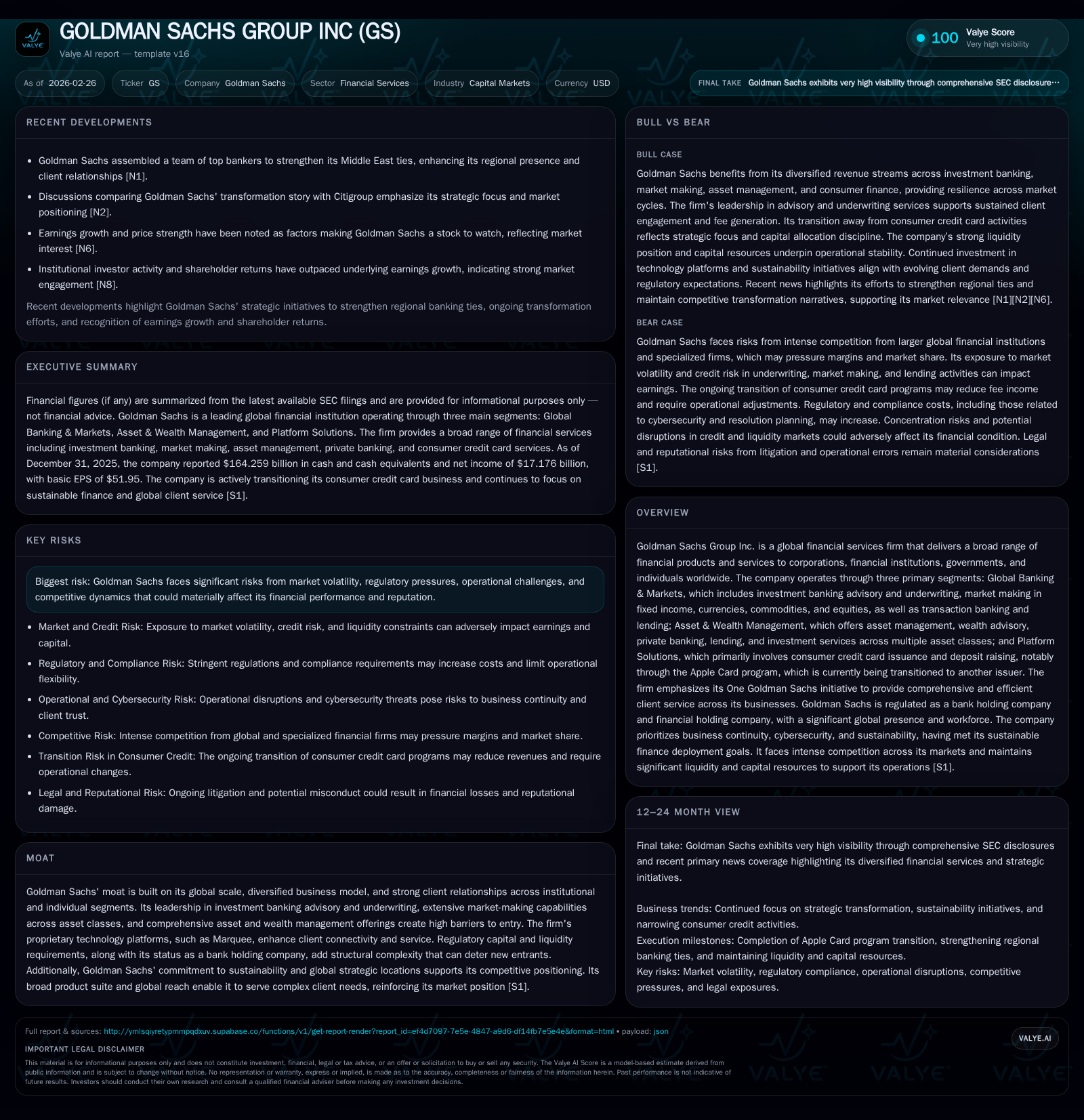
Goldman Sachs reported a 20.3% increase in net income for fiscal 2025, driven by gains in market making and underwriting activities within its Global Banking & Markets segment. However, operating cash flow deteriorated sharply, reflecting underlying non-cash earnings and changes in working capital. The firm strategically consolidated transaction banking into its institutional segment while winding down consumer credit card issuance in Platform Solutions. Despite robust capital returns via dividends and share repurchases, the bank faces amplified risks from market volatility, liquidity constraints, and intensifying regulatory scrutiny. Its One Goldman Sachs technology initiative remains a key competitive advantage, but future growth will hinge on navigating evolving regulatory landscapes and maintaining operational resilience.
Financial Momentum: Historical Growth and Key Income Drivers
Goldman Sachs demonstrated significant financial momentum across the recent four-year period ending 2025. Net income advanced notably by 20.3% year-over-year to $17.18 billion in fiscal 2025 from $14.28 billion in 2024 [F1]. This marks a rebound from $8.52 billion in 2023 and $11.26 billion in 2022, underscoring the resilience and recovery post-pandemic market disruptions.
The primary drivers contributing to this earnings surge were concentrated within the Global Banking & Markets segment, particularly from robust investment banking advisory fees and underwriting activities combined with strong market-making performance across fixed income, currency, commodity (FICC), and equity products [S1]. Underwriting fee appreciation was fueled by relatively higher deal volumes enabling Goldman Sachs to solidify its leadership position despite competitive pricing pressures noted industry-wide [S9].
However, a contrasting narrative emerges within operating cash flow metrics (CFO). CFO plunged from +$8.71 billion in 2022 to negative territory starting in 2023 (-$12.59 billion), further deepening markedly to -$13.21 billion in 2024 before collapsing to -$45.15 billion in 2025 [F1]. This degradation suggests a growing disconnect between accounting profits and actual cash generation, possibly driven by non-cash mark-to-market gains on derivatives inventories (a hallmark of market making), movements in working capital including receivables/payables timing, or increased collateral requirements amid volatile trading conditions [S1][S4].
Capital expenditures remained stable around $2 billion annually since 2023 after higher investments in previous years — declining marginally by 1.3% to $2.06 billion in 2025 [F1]. Shareholders’ equity showed moderate growth from $117.19 billion in 2022 to $124.97 billion in 2025 [F1], aligning with prudent capital management under Basel III/IV mandates.
Return on equity (ROE) approximated at about 13.7% for FY25 (net income divided by equity), indicating effective use of capital despite regulatory constraints [F1].
Historical performance (annual)
| FY | Net ($bn) | CFO ($bn) | Capex ($bn) | Net YoY |
|---|---|---|---|---|
| 2025 | 17.2 | -45.2 | 2.1 | +20.3% |
| 2024 | 14.3 | -13.2 | 2.1 | +67.6% |
| 2023 | 8.5 | -12.6 | 2.3 | -24.4% |
| 2022 | 11.3 | 8.7 | 3.7 |
Source: SEC companyfacts cache [F1].
Capital returns and efficiency (annual)
| FY | Div ($bn) | Buybacks ($bn) | FCF ($bn) |
|---|---|---|---|
| 2025 | 5.3 | 12.4 | -47.2 |
| 2024 | 4.5 | 8.0 | -15.3 |
| 2023 | 4.2 | 5.8 | -14.9 |
| 2022 | 3.7 | 3.5 | 5.0 |
Source: SEC companyfacts cache [F1].
Table source: Goldman Sachs annual SEC filings and companyfacts data [F1]
Shifting Business Focus: Strategic Segment Realignment
In late 2025, Goldman Sachs undertook meaningful strategic reclassification of its business segments reflective of its evolving priorities toward institutional markets and away from broader consumer finance initiatives [S1][S2].
The Global Banking & Markets segment absorbed the results of the firm's transaction banking business previously housed under Platform Solutions activities categorized as "Other." This repositioning signals an intensified focus on scaling institutional relationship banking that provides end-to-end solutions including liquidity management alongside classic advisory and underwriting services.
Within Global Banking & Markets itself, there has been internal shifting of primary loan facilitation—especially syndication activities—and structured letters of credit provision into the FICC financing classification that captures secured lending products closely tied with structured financing transactions [S1]. This aligns reporting with the operational reality as these products leverage the firm's commodities and fixed income expertise.
Conversely, the Platform Solutions segment is being strategically narrowed with a conscious move away from consumer lending exposure exemplified by the decision to transition out of Apple Card credit card issuance to another issuing bank partner [S1]. This wind-down suggests Goldman Sachs is deprioritizing lower-margin consumer finance propositions requiring heavy regulatory compliance burdens under consumer protection frameworks encountered by deposit taking and consumer credit services [S12].
Supporting this narrative is the continued allocation of community reinvestment-related Urban Investment Group activities across appropriate segments consistent with CRA obligations tied to GS Bank USA operations [S1][S12]. These adjustments further emphasize Goldman Sachs' intention to consolidate its competitive moat around high-complexity institutional services versus broad retail consumer offerings.
Risks Amplified: Market Volatility and Regulatory Overhang
Goldman Sachs operates within an environment laden with multifaceted risks that have been magnified amid recent global economic uncertainty and geopolitical tensions [S1][S4][S6].
Market-related risks include potential deterioration in asset values where the firm holds long positions or bases fees on assets under management—a vulnerability exacerbated during periods of low investor confidence or pronounced economic slowdown impacting mergers & acquisitions activity critical for investment banking revenues.
Market making faces margin compression risks as bid-ask spreads narrow under intense electronic trading competition while volatility spikes unpredictably affecting inventory valuations [S9]. The firm's derivative exposures introduce counterparty credit risk proliferation especially if settlement delays or documentation discrepancies occur during turbulent times [S1][S10].
Liquidity risk is persistent given dependency on debt market access which may be restricted or more expensive amidst widening credit spreads directly driving up funding costs; prolonged liquidity disruptions can adversely restrict operational flexibility forcing curtailment of profitable but capital-intensive businesses like proprietary investing or prime brokerage financing arrangements [S5][S7][S8][S14][S18]. Regulatory capital minimums under Basel III/IV regimes together with mandated recovery and resolution planning impose structural limitations reducing capital redeployment agility across subsidiaries hindering consolidated liquidity pooling efficiency [S16][S21][S24].
Operationally, increasing sophistication of cyber threats presents significant concerns relating to potential breaches compromising sensitive client information or disrupting critical systems leading to loss events or reputational damage which materially affect business continuity [S1][S12]. Alongside are legal risks from litigation exposure spanning antitrust claims to employment disputes; settlements may follow patterns established by peer institutions elevating potential financial penalties or reputational costs challenging earnings stability [S4][S6][S15][S19][S28][S29].
These intersecting risks necessitate heightened vigilance over credit exposures amid counterparty defaults probability shifts as well as continuous compliance enhancements given evolving multi-jurisdictional regulations including anti-bribery (e.g., FCPA), money laundering controls, sanctions enforcement regimes—with missteps triggering severe penalties limiting business scope or resulting in reputational impairment globally [S6][S11].
Capital Management: Shareholder Returns and Cash Flow Dynamics
Despite weakening operating cash flow fundamentals highlighted earlier (-$45B CFO vs positive net income), Goldman Sachs maintained an aggressive stance on capital return policies through dividends and large-scale share repurchases throughout FY25 [F1][N4]. The firm disbursed $5.28 billion in dividends while repurchasing shares worth $12.36 billion—up meaningfully compared with prior years ($4.50B dividend / $8B buybacks in FY24) demonstrating commitment to rewarding shareholders even where free cash flow was highly negative (~-$47B) due mainly to adverse working capital movements not reflected directly within profitability metrics.
This strategy underscores confidence management places on ongoing profitability sustainability balanced against short-term liquidity demands inherent from marked-to-market accounting volatility common within investment banks' trading book activities [N4]. However, investors should note that deteriorating operating cash flow warrants continued scrutiny regarding funding sources underpinning payouts—specifically intercompany dividends constrained by regulatory restrictions among subsidiaries limiting upstream availability coupled with potential incremental external funding needs at Group Inc level [S5][S7][S16][S21].
Furthermore, rising CEO compensation (+20% year-over-year reaching $47 million) reflects alignment incentives driving operational performance but also highlights increased governance attention on total remuneration expenses relative to earnings quality considerations [N6].
One Goldman Sachs Initiative: Integrating Technology and Client Solutions
A key cornerstone underpinning Goldman Sachs’ competitive edge resides within its One Goldman Sachs strategy which seeks holistic integration of client-facing capabilities leveraging proprietary technology platforms exemplified by Marquee—an advanced digital portal offering comprehensive access to analytics, risk management tools, electronic execution capabilities and market insights across all asset classes handled by the firm [S1].
This initiative facilitates seamless cross-segment client intermediation improving product distribution effectiveness while enhancing operational efficiency through automated processes replacing legacy manual workflows prevalent among competitors less digitally equipped.
Moreover, the platform supports structured finance solutions customized for sophisticated institutional clients where layered derivatives overlay basic instruments allowing complex hedging or yield enhancement strategies executed electronically minimizing latency—a distinct differentiation point reinforcing margins amid fierce competition predominantly enacted via alternative trading systems offering narrow-spread commission models [S9].
Client onboarding digitalization coupled with scalable cloud-based infrastructure investments reduce time-to-market for new products helping maintain brand loyalty essential for maintaining price discipline advantageous versus peers competing primarily on volume or scale without equivalent technological moats.
Outlook and Market Expectations: What to Watch in 2026
While explicit forward guidance remains limited within publicly available disclosures for FY26 thus far, several barometers exist that merit close observation regarding Goldman Sachs’ near-term trajectory.
Consensus earnings forecasts point toward sustained growth but lower double-digit cadence dependent largely upon sustained momentum within transaction banking integration into core Global Banking & Markets revenues as well as successful execution managing Phase-out impacts within Platform Solutions reflecting residual run-off losses or cost rationalizations [N2]. Geopolitical expansion efforts notably assembling senior bankers focusing on Middle East relationships signal efforts to capture incremental dealflow opportunities aligned with regional diversification strategies mitigating traditional U.S./Europe market cyclicality concentration risks [N5].
Liquidity cushion comparisons against comparable peers such as Morgan Stanley suggest relative capital returns may face constraints if liquidity buffers tighten due to stressed funding environments potentially compressing buyback flexibility absent offsetting profitability gains thus warranting monitoring quarterly liquidity disclosures alongside macro-financial conditions influencing credit spreads dynamics impacting cost-of-capital calculations integral for pricing new issuance versus legacy debt refinancing at Group Inc level [N1].
Additionally, ongoing regulatory evolution remains pivotal including anticipated adjustments related to CRA supervisory ratings impacting deposit-taking units along with clarifications concerning fintech-embedded compliance obligations particularly important given Goldman’s selective retreat from consumer-facing products [N10].
Legal proceedings updates represent a wildcard given historically material litigation expenses; effectiveness of enhanced compliance frameworks deployed post-prior regulatory settlements bear watching alongside reputational impacts arising from social media speed amplifying negative publicity risks requiring continuous proactive risk management safeguards internal control optimizations designed to prevent costly enforcement actions undermining future earnings power.
In sum, Goldman Sachs enters FY26 at an inflection point balancing operational transformation toward core institutional strengths with structural challenges posed by external environment complexities necessitating disciplined execution around risk mitigation measures coupled with measured capital deployment attuned carefully to resilient cash flow generation dynamics.
Disclaimer: This is research-only, informational analysis and not investment advice. It may include AI-generated interpretation and general industry context. Always verify important details using primary sources.

Comments