
Globalstar Constellation Expansion Drives Operating Recovery Despite Net Loss
Globalstar advances its satellite network and ground infrastructure, transitioning to operating profitability even as net losses persist due to capital investment.
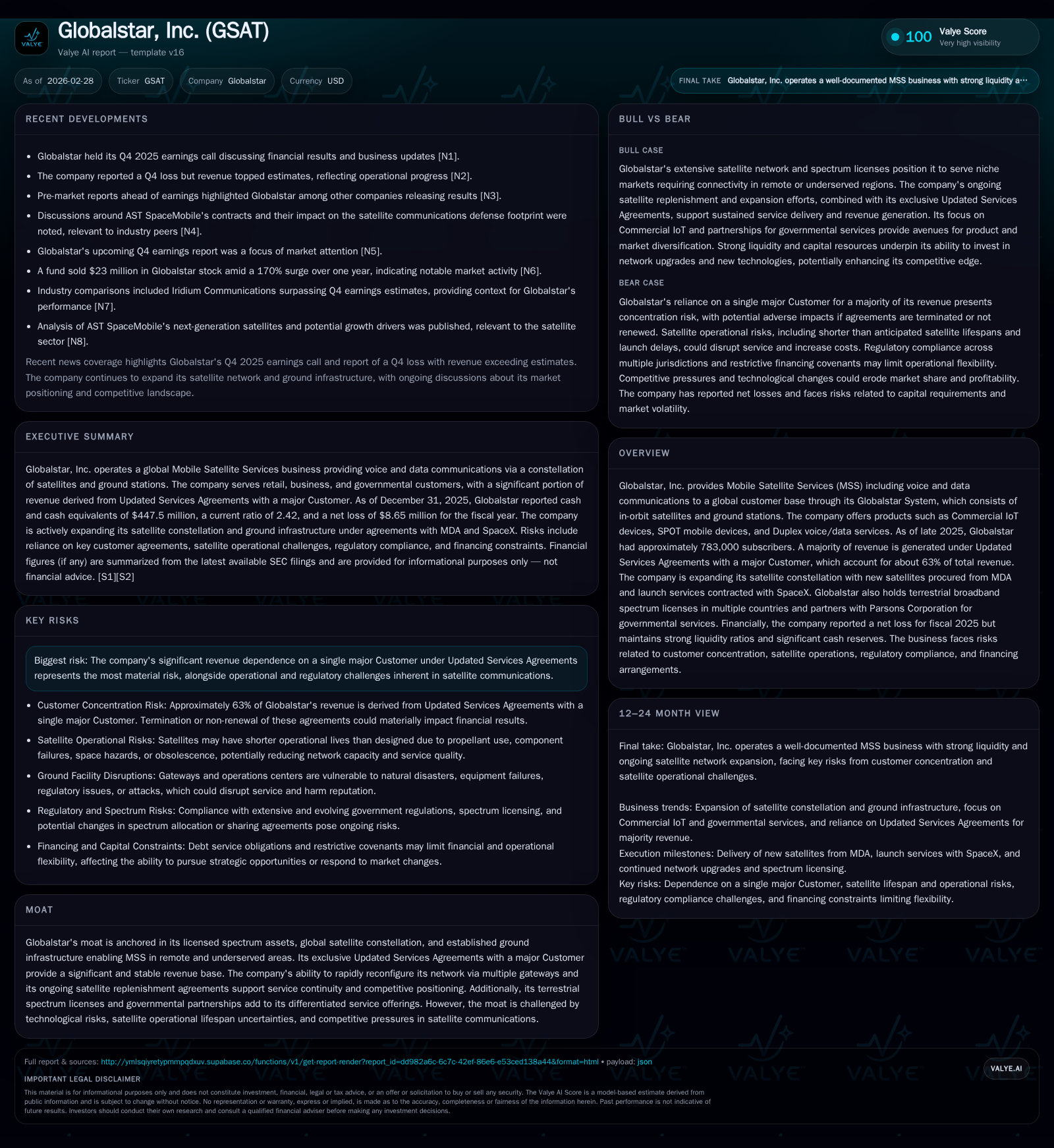
Globalstar, Inc. reported a notable shift to positive operating income in fiscal 2025, reflecting improved operational efficiency amidst stable revenues. This recovery comes amid an ongoing capital-intensive satellite constellation replenishment program anchored by agreements with major suppliers and critical Updated Services Agreements with a dominant customer driving over 60% of revenues. While the net loss remains, solid cash flow generation and a substantial cash position underpin the company’s financial resilience. Key challenges include the concentration risk from reliance on a single major customer and regulatory as well as operational uncertainties common in MSS deployments.
Tracing Growth: From Revenue Stability to Operating Profitability
Globalstar's revenue trajectory from FY2019 through FY2025 reflects remarkable top-line stability with minor fluctuations—a reported $31.8 million in revenue for FY2019 remaining largely unchanged into FY2025 ([F1]). Year-over-year revenue declined marginally by approximately 0.3% in the latest fiscal year, consistent with its position servicing specialized MSS markets rather than pursuing rapid top-line growth.
While revenue stayed flat, operating results displayed a pronounced turnaround: the company moved from small operating losses in prior years to positive operating income of $7.43 million in FY2025, an increase of nearly 883% year-over-year ([F1]). This operational improvement stems chiefly from stringent cost controls—including a notable reduction in stock-based compensation costs—combined with steady service revenue derived largely from long-term service contracts ([S1],[N1]).
Despite this operational recovery, Globalstar reported a net loss of $8.65 million for FY2025 ([F1]). This apparent paradox arises primarily from elevated interest expenses linked to significant debt obligations and currency effects impacting other income components ([S1]).
Historical performance (annual)
| FY | Net ($mm) | CFO ($mm) | OpInc ($mm) | Net YoY |
|---|---|---|---|---|
| 2025 | -9 | 622 | 7 | +86.3% |
| 2024 | -63 | 439 | -1 | -155.5% |
| 2023 | -25 | 74 | 0 | +90.4% |
| 2022 | -257 | 64 | -221 |
Source: SEC companyfacts cache [F1].
Capital returns and efficiency (annual)
| FY | Div ($mm) | ROE% |
|---|---|---|
| 2025 | 11 | -2.4 |
| 2024 | 11 | -17.6 |
| 2023 | 12 | -6.5 |
| 2022 | -81.6 |
Source: SEC companyfacts cache [F1].
Table shows key annual financial metrics with available historical data from [F1].
Satellite Constellation Refresh and Gateway Expansion: Impact on Service Continuity
Integral to Globalstar's operational restoration is its capital-intensive satellite replenishment program executed under the Updated Services Agreements ([S2],[N12]). The company signed an agreement in 2022 with Macdonald, Dettwiler and Associates Corporation (MDA) to acquire seventeen replacement satellites with an option for nine more to supplant its HIBLEO-4 U.S.-licensed system ([S2]). These replacements are scheduled for delivery beginning early 2026 and boast similar technical specifications to existing second-generation satellites ensuring service continuity.
Launching will be facilitated by contracted services from SpaceX applying familiar orbital deployment techniques assuring robust orbital lifespan management — key terminology underscoring Globalstar’s focus on maintaining longevity of its constellation assets within low Earth orbit (LEO). Accompanying hardware upgrades include plans for an Extended MSS Network comprising approximately ninety new antennas across thirty-five global gateway stations spanning twenty-five countries ([S2],[N12]). These gateways feature multiple six-meter tracking antennas arranged with appropriate spatial separation enabling line-of-sight connectivity vital for continuous satellite-to-gateway communication.
Network design enhances fault tolerance allowing rapid reconfiguration such that coverage lost due to satellite or gateway outages is compensated by adjacent gateways expanding coverage volume seamlessly ([S2]). Such redundancy combined with ground infrastructure upgrades blends technical resilience with cost efficiencies — notably through predominant ground-based software/hardware control allowing faster maintenance compared to fully spaceborne systems.
Updated Services Agreements: Revenue Dependence and Contractual Highlights
A defining feature of Globalstar’s business model is its reliance on Updated Services Agreements (USAs) consummated initially in late 2024 which underpin nearly sixty-three percent of total revenue as of fiscal late-2025 ([F1],[S1],[N2]). These contracts grant a major Customer stable priority access to satellite capacity within the Extended MSS Network while compensating Globalstar through fixed service fees augmented by incremental payments reflecting capital expenditures tied to constellation expansion and ground infrastructure enhancements.
Simultaneously, these agreements incorporate performance bonuses subject to service criteria milestones providing incentive alignment but attaching substantial concentration risk given dependency on one Customer accounting for over half the firm’s top-line revenue ([S7],[S10],[S20]). Nonetheless, this revenue concentration simultaneously functions as a moat element due to exclusivity on updated global spectrum licenses managed via a Special Purpose Entity (SPE) jointly owned partially by the Customer (~20%)—embedding intertwined operational dependencies that underscore contract significance ([S1],[S21]).
Financial Health: Assessing Cash Flow, Capital Expenditures, and Debt Constraints
Globalstar demonstrates robust cash flow capabilities notwithstanding its net losses: operating cash flow reached $621.7 million in FY2025 reflecting an impressive increase of roughly 41.5% year-over-year aided by favorable working capital changes particularly linked to accelerated upfront payments pursuant to the Updated Services Agreements ([F1],[S6],[N1]).
Capital expenditure levels have moderated after peaking during earlier phases of constellation development—total capex decreased by about thirty-seven percent compared to previous periods yet remain substantive reflecting ongoing investment needs associated with the MDA satellite procurement and ground station expansions ([F1],[S6]).
At year-end December 31, 2025 Globalstar held approximately $447 million in cash and equivalents evidencing ample liquidity alongside current assets comfortably exceeding current liabilities (Current ratio ~2.4x), implying strong near-term solvency ([F1],[S4],[S13]).
Debt obligations aggregate around $410 million consisting mainly of amounts under agreements related to funding constellation upgrades including a significant $221 million balance classified under the "2024 Debt Repayment" secured via dedicated collateral structures ([S4],[S9],[S19]). These financing arrangements impose restrictive covenants limiting additional leverage capacity and constraining operational flexibility despite potential refinancing efforts underway or considered—a nuanced balancing act between growth investments and debt management featured throughout the filings ([S4],[S13]).
Risks on the Horizon: Spectrum Licensing, Satellite Longevity, and Competitive Pressures
Multiple risks permeate Globalstar’s operating landscape: foremost among them is dependency on continued performance under the Updated Services Agreements where default events might materially constrain asset utilization disrupting operations profitably ([S1],[S8]). Technical risks inherent in satellite constellations include potential premature failures or shorter-than-expected orbital lifespans impacting coverage continuity requiring costly replacements or reconfigurations.
From a regulatory standpoint extensive compliance demands span numerous jurisdictions regulating MSS operations including FCC mandates in the U.S., plus European bodies like ARCEP/ANFR influencing spectrum usage rights which are themselves subject to potentially adverse modifications or non-renewals affecting service license viability ([S8],[S15]). Additionally competitive pressures intensify as alternative providers innovate or expand their constellations—pressuring pricing models especially given Globalstar’s cost-sensitive clientele.
Spectrum volatility also threatens monetization prospects related directly or indirectly to government policy changes or evolving technology standards within terrestrial broadband segments licensed by Globalstar across twelve countries covering nearly one billion population equivalents via Band53/n53 allocations ([S12],[S20]).
What To Watch: Milestones in Satellite Launches and Government Partnerships
Looking ahead analysts should monitor sequential milestones signifying tangible progress on constellation refreshes including MDA delivery timelines anticipated early in calendar year 2026 following contractual terms ([N12],[N1]). Launch status updates via SpaceX deployments will indicate schedule adherence critical for maintaining MSS service levels.
Progression of terrestrial spectrum license commercialization particularly leveraging Band53/n53 across multiple targeted geographies offers avenues for portfolio diversification beyond traditional MSS applications potentially yielding new wholesale or enterprise client opportunities.
Furthermore strategic alliances such as partnerships with Parsons Corporation targeting governmental contract bids set platforms for differentiated market penetration complementary to commercial offerings warrant close observation given their prospective revenue implications albeit presently nascent ([N12],[S2]).
Capital Allocation Review: Dividends, Buybacks, and Return on Equity
Despite net losses sustained through recent fiscal cycles including FY2025 (-$8.65 million), Globalstar maintained dividend distributions amounting close to $10.6 million suggesting an emphasis on shareholder income continuation amid challenging profitability conditions ([F1],[S1]). This action reflects confidence supported by substantial operating cash flows though raises questions about sustainability considering underlying negative return on equity standing near -2.4% indicating capital inefficiency persisting since losses lag operating income improvements ([F1]).
There are no recent disclosures regarding share repurchase programs; absent buybacks coupled with moderate dividend payouts might signal cautious balance sheet stewardship focusing primarily on capex funding requirements and debt servicing over aggressive shareholder return initiatives at present stage.
This analysis synthesizes publicly disclosed financial data, SEC filings, and market reports up through early calendar year 2026 without projecting investment recommendations or speculative forecasts beyond documented guidance or explicit company statements.
Disclaimer: This is research-only, informational analysis and not investment advice. It may include AI-generated interpretation and general industry context. Always verify important details using primary sources.

Comments