Greenwave Technology Solutions: Bold Real Estate Expansion Amid Deepening Financial and Regulatory Challenges
An incisive look at Greenwave’s strategic property acquisitions intertwined with escalating liquidity issues and regulatory uncertainties.
Greenwave Technology Solutions, Inc. has embarked on aggressive real estate acquisitions aimed at augmenting its asset base. However, these expansion efforts clash with elevated liquidity constraints and recurring net losses, leading to substantial doubt about the company’s viability as a going concern. Concurrent regulatory risks and market headwinds add complexity, while insider trading activity offers nuanced signals on leadership conviction. The company’s capacity to translate asset growth into a sustainable competitive moat remains uncertain in light of mounting financial fragility.
Greenwave’s Latest Real Estate Gambit: Scope and Ambitions
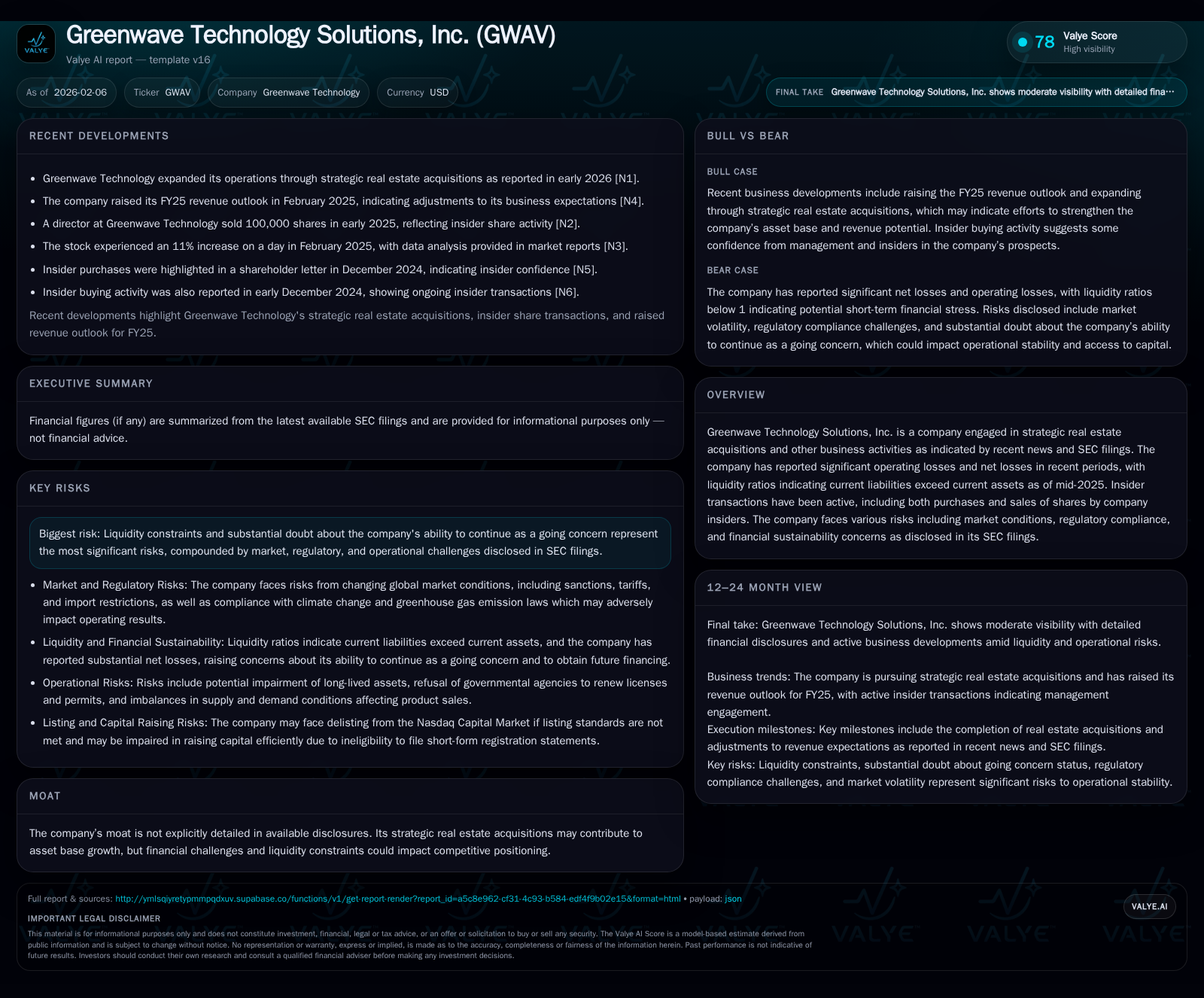
Greenwave’s strategic focus on expanding its real estate footprint stands as a central pillar of its recent corporate narrative. According to a Nasdaq report dated February 5, 2026 [N1], the company has pursued multiple property acquisitions signaling an intent to bolster its tangible asset portfolio. This is corroborated by the latest SEC filing (Form 10-Q dated February 5, 2026) [S2], which shows property and equipment net values growing to approximately $27 million as of June 30, 2025, up from roughly $25.6 million at the end of 2024. Moreover, related-party property assets remain sizeable around $11 million.
This scale of property acquisition could mark a pivot toward leveraging hard assets as collateral or revenue generators. Yet this move raises critical questions about whether these investments are strategically transformative or carry outsized risk exposure given the company's fragile financial footing. Expanding a capital-intensive asset base amid recurring operating losses and tight cash flow constraints risks exacerbating liquidity tensions if not matched by stable income streams.
Navigating Financial Straits: Liquidity Challenges Under the Microscope
The balance sheet landscape paints a stark picture of financial fragility. As per the June 30, 2025 filing [S2], Greenwave reported total current assets just under $10 million juxtaposed against current liabilities exceeding $19.5 million—a nearly twofold disparity that translates into a distressingly low current ratio of approximately 0.51 [F1]. Cash holdings improved modestly to around $5.3 million but remain insufficient relative to short-term obligations.
Simultaneously, the company sustained an operating loss culminating in a net loss nearing $4.9 million for the period ending June 30, 2025 [F1]. Such persistent negative profitability underlines difficulties in generating operational cash flow necessary to service debts and fund ongoing activities without external capital inflows.
This imbalance directly impacts strategic flexibility and raises red flags regarding Greenwave's capacity to maintain operations without refinancing or asset liquidation under increasingly adverse market conditions.
The Weight of Risk: Regulatory and Market Headwinds Identified
Greenwave confronts multifaceted risk vectors detailed extensively in its SEC filings [S2]. Market dynamics such as shifts in global trade policies—sanctions, tariffs, import quotas—threaten cost structures and revenue potential. Raw material price volatility further clouds top-line visibility while steep declines in scrap metal prices adversely affect underlying operating margins.
On the regulatory front, risks compound through the potential refusal or non-renewal of essential licenses and permits vital for operations. Compliance with evolving climate change statutes imposing greenhouse gas emission limits introduces additional cost burdens that could materially erode profitability.
Furthermore, Greenwave’s precarious public listing status looms due to possible Nasdaq Capital Market listing standard failures and its concurrent inability to efficiently access capital markets via Form S-3 short-form registration exemptions. These intertwined challenges amplify financial strain and operational risk concurrently.
Leadership Moves: What Insider Trading Reveals About Confidence
The company’s insider trading activity presents subtle yet important signals worth unpacking. Recent SEC disclosures indicate both insider purchases and sales amid these challenging conditions [S2][N1]. While insider buying might signal belief in long-term value appreciation or anticipated turnaround prospects, concurrent insider selling could reflect personal risk mitigation strategies or liquidity needs.
This ambiguity in management’s market participation complicates straightforward interpretations but underscores the complexity executives face balancing confidence with caution against a backdrop of existential uncertainties.
Asset Portfolio Deep Dive: Valuations and Impairment Risks
Beyond real estate, Greenwave holds considerable intangible assets including licenses ($13.3 million), customer lists ($1.4 million), intellectual property (~$759k), along with other equipment [S2][F1]. Notably, these values have declined modestly from prior periods hinting at possible amortization or impairment considerations.
The SEC warns explicitly about impairment risks tied to long-lived assets which could impose further hits on operating results should carrying amounts exceed expected recoverable values [S2]. Given existing financial duress juxtaposed with volatile external markets, prudent scrutiny is warranted regarding fair value assessments of these assets—and their true contribution toward the company’s earning power.
Outlook Uncertainty: Going Concern Doubts and Capital Access
A particularly sobering disclosure emerges around Greenwave’s substantial doubt about its ability to continue as a going concern [S2]. This caveat reflects skepticism about near-term survival absent successful recapitalization or turnaround initiatives.
Such an acknowledgment carries profound implications: it likely restricts access to fresh funding due to heightened lender apprehension; it may erode counterparty confidence; and it places additional pressure on management to expedite corrective actions amid deteriorating fundamentals.
Compounding this is Greenwave’s impaired ability to raise capital efficiently owing to restrictions on filing short-form registration statements under Form S-3 [S2], hampering timely equity financing options critical for shoring up liquidity.
Strategic Moat Analysis: Is Greenwave Building Sustainable Competitive Advantage?
The company itself does not delineate any concrete moat in available disclosures [valye_report_excerpt]. The recent real estate acquisition strategy could be viewed either as an attempt to anchor competitive advantage through tangible asset control or merely as increasing leverage without guaranteeing stable returns.
Given uneven financial performance alongside regulatory complexities and asset impairments risks outlined earlier, the premise that these moves establish a durable strategic moat remains speculative at best. The absence of clear proprietary technology dominance or scalable operational efficiencies further clouds prospects for sustainable differentiation.
Investor Takeaways: Balancing Opportunity Against Existential Risk
Synthesizing all available data yields a portrait of a company caught between ambitious growth aspirations through strategic property accumulation and significant headwinds rooted in liquidity deficits, regulatory hurdles, asset valuation uncertainties, and going concern shadowing.
While asset growth harbors latent upside should management effectively monetize or leverage holdings amid market recovery scenarios, persistent net losses alongside near-term solvency doubts constitute considerable counterweights. Insider trading signals offer mixed interpretative cues rather than decisive endorsements.
Potential investors would need to calibrate their appetite accordingly—acknowledging that while incremental asset accumulation might form parts of a longer-term recovery blueprint, immediate existential risks appear elevated given documented financials and disclosed uncertainties.
This analysis is provided for informational purposes only based on publicly available documents as referenced; it does not constitute investment advice or recommendations.
Disclaimer: This is research-only, informational analysis and not investment advice. It may include AI-generated interpretation and general industry context. Always verify important details using primary sources.

Comments