
GXO Logistics Leads With Tech-Driven Contract Distribution Growth
GXO’s integration of proprietary automation and analytics, alongside its diverse global footprint, fueled revenue gains while labor cost pressures and fixed pricing constrained net income.
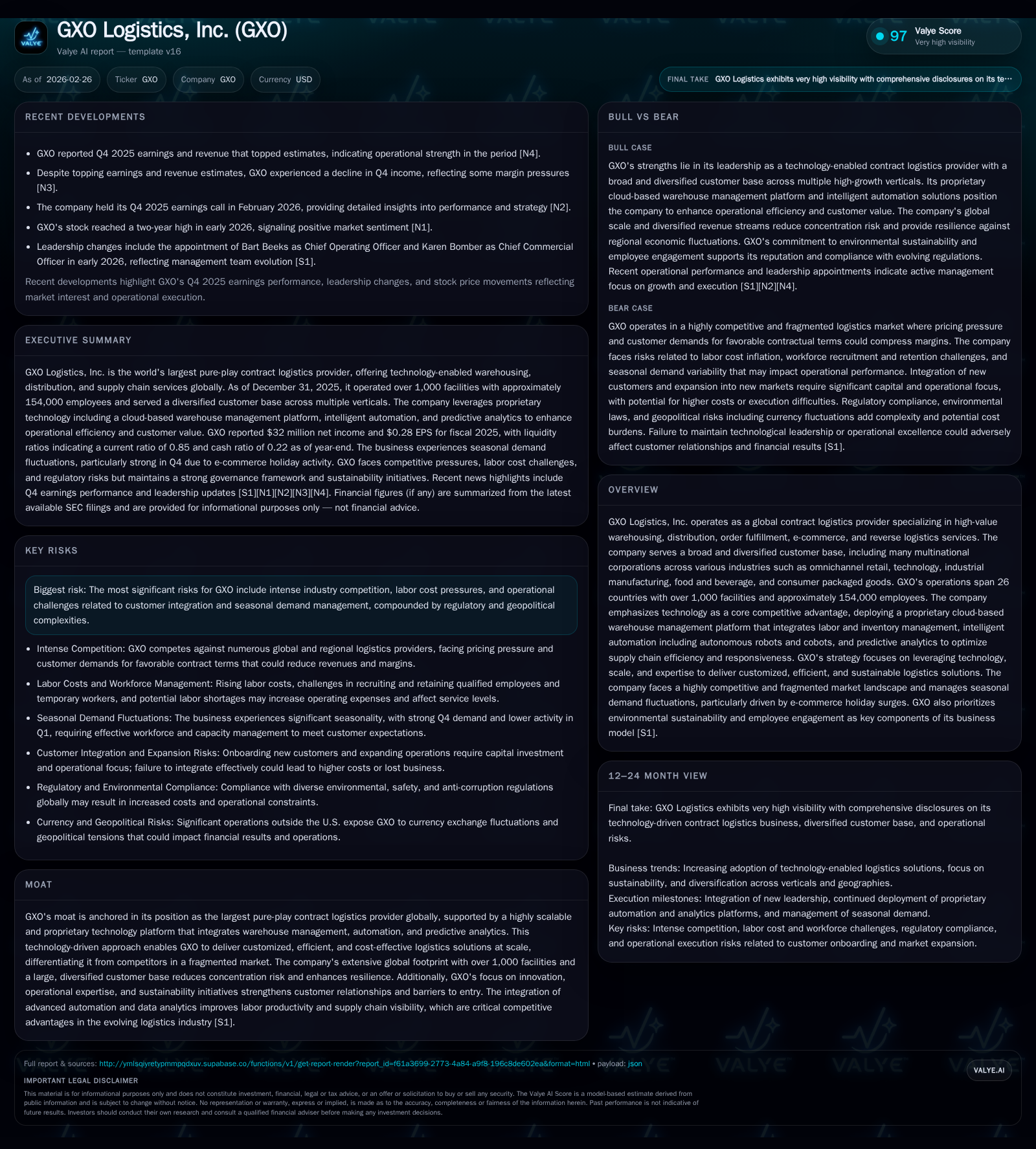
GXO Logistics has leveraged its position as the world’s largest pure-play contract logistics provider to deliver steady revenue and operating income growth from 2022 through 2025, driven by its technology platform that integrates warehouse management, automation, and predictive analytics. Despite a 12% rise in operating income in FY2025, net income plunged by over 75%, reflecting margin compression from escalating labor costs and fixed-price contract challenges. Capital allocation remains disciplined, with $200 million in buybacks in 2025 and positive free cash flow, though returns on equity remain low near 1.1%. Market seasonality in e-commerce and evolving regulatory risks pose ongoing operational complexities. Investors should monitor the pace of technology deployment and margin recovery as key future mileposts.
Scaling Up: Historical Performance and Profitability Trends
Since its incorporation in February 2021 and listing on the NYSE under ticker GXO later that year, GXO Logistics has charted consistent growth as the largest pure-play contract logistics provider worldwide. Between fiscal years 2022 and 2025, operating income advanced from $242 million to $245 million with a peak at $318 million in FY2023 before moderating due to margin pressures [F1]. However, this topline expansion masked a precipitous fall in net income starting from $197 million in FY2022 down to only $32 million in FY2025 — a drop of over three-quarters year-over-year.
Operating cash flow followed a similar pattern with robust generation near $550 million earlier but descending about twenty percent to $434 million by FY2025. Capital expenditures were managed downward from $342 million in FY2022 to $324 million most recently. The net effect yields free cash flow around $110 million in the latest period [F1]. Despite scale expansion and revenue diversification across sectors like omnichannel retail (49%), technology (12%), industrial manufacturing (12%), food & beverage (10%), and CPG (10%) [S4], these profitability trends signal significant operational challenges acting on margins.
Historical performance (annual)
| FY | Net ($mm) | CFO ($mm) | OpInc ($mm) | Capex ($mm) | Net YoY |
|---|---|---|---|---|---|
| 2025 | 32 | 434 | 245 | 324 | -76.1% |
| 2024 | 134 | 549 | 218 | 359 | -41.5% |
| 2023 | 229 | 558 | 318 | 274 | +16.2% |
| 2022 | 197 | 542 | 242 | 342 |
Source: SEC companyfacts cache [F1].
Capital returns and efficiency (annual)
| FY | FCF ($mm) | ROE% |
|---|---|---|
| 2025 | 110 | 1.1 |
| 2024 | 190 | 4.5 |
| 2023 | 284 | 7.9 |
| 2022 | 200 | 7.4 |
Source: SEC companyfacts cache [F1].
Note: Operating income YoY percentages calculated vs prior year.
Return on equity is low at approximately 1.1%, reflecting the net income contraction relative to shareholders’ equity at ~$3 billion at end-2025 [F1]. The disconnect between scale growth and profitability indicates margin compression primarily due to cost inflation pressures discussed below.
Technology as a Differentiator: Proprietary Platforms and Automation
GXO’s moat relies heavily on its investment in technology—the company’s proprietary cloud-based warehouse management platform offers scalable deployment across over a thousand facilities globally [S5][S7]. This platform integrates several modules including labor management tools that leverage predictive analytics and machine learning for dynamic workforce allocation. Autonomous mobile robots (AMRs), collaborative robots (“cobots”), automated guided vehicles (AGVs), wearable tech for workers, and stationary robotic arms enhance picking precision and speed while improving overall labor productivity [S13].
Integration across automation systems creates synchronized fulfillment environments causing ripple effects on operational efficiency that competitors struggle to replicate given the fragmented industry landscape [S6]. Rapid innovation rollouts benefit from the ability to transfer automation tools developed for one vertical or geography seamlessly to others—yielding economies of scale uncommon among peers.
This investment also extends to predictive analytics capabilities specifically tailored for high-volume e-commerce logistics during seasonal surges where demand volatility is acute—services including reverse logistics where up to 30% of online purchases are returned [S4][S13]. These technological assets underpin GXO's differentiated value proposition positioned as an end-to-end tech-enabled logistics partner.
Customer Base Diversification and Vertical Focus
GXO serves over one thousand customers worldwide with no single client exceeding a six percent revenue concentration; top five customers aggregate about twenty percent of total revenues providing risk mitigation via broad industry coverage [S4]. The key verticals are:
- Omnichannel retail (49%)
- Technology & consumer electronics (12%)
- Industrial/manufacturing (12%)
- Food & beverage (10%)
- Consumer packaged goods (10%)
- Other sectors account for remaining shares
This diversification reduces client concentration risk while benefiting from secular trends pushing customers toward outsourcing logistics solutions for core operations agility [S4][S5]. Blue-chip multinational customers include Fortune Global companies relying on GXO’s tailored solutions encompassing warehousing, order fulfillment KPIs optimization, distribution, e-commerce flows, and reverse logistics.
Rising complexity—faster delivery expectations compounded with increasing return volumes—positions GXO well as a consolidator capturing incremental spend from customers shifting away from insourcing or smaller providers.
Labor Cost Pressures and Contract Pricing Challenges
Labor forms the lion’s share of expenses within contract logistics—and GXO’s predominantly hourly workforce presents ongoing cost control hurdles facing the company [S1]. Increased minimum wage legislations across North America and Europe, amplified union activities particularly prevalent among European staff covered by collective bargaining agreements versus North American non-union workers pose elevated wage inflationary pressure [S8][S14].
Notably many GXO contracts are fixed-price which impairs direct pass-through of heightened labor costs to clients; this contractual rigidity exerts downward pressure on margins when wages inflate faster than prices can adjust [S1][S8]. Moreover, regulatory compliance demands around employment rights such as overtime pay calculations, family leave policies increase administrative burdens adding further costs.
Temporary labor utilization during seasonal peaks adds complexity since quality variability and labor supply tightness can disrupt service levels leading potentially to penalties under performance-based contracts [S23]. Persistent macroeconomic uncertainty exacerbates difficulties retaining skilled warehouse personnel creating recruitment challenges amidst tight labor markets.
Capital Efficiency: Cash Flow, Capex, and Shareholder Returns
Operating cash flows have softened recently declining roughly twenty percent in FY2025 compared with previous years (~$434 million vs >$540 million), partly reflecting margin compression effects alongside elevated working capital needs associated with growth [F1]. Capital expenditures trimmed modestly (-9.7% YoY) suggest careful capex discipline focusing on incremental automation deployment rather than large-scale facility expansions.
Repurchase programs authorized up to $500 million remain active—with $200 million executed through FY2025 indicating management’s commitment to shareholder returns balanced against liquidity preservation given earnings volatility [S11][F1]. Dividend discussions appear absent consistent with reinvestment focus though free cash flow positive at approximately $110 million allows flexibility.
Yet ROE near just over one percent reflects ongoing earnings strain requiring capital allocation strategy improvements aimed at driving profitability enhancements alongside volume growth.
E-commerce Seasonality and Demand Volatility Management
E-commerce surges during fourth quarter holidays create pronounced seasonal demand spikes; up to thirty percent product return rates amplify inbound logistics complexity substantially increasing handling volumes for reverse logistics services [S4]. This leads to tighter operating leverage periods with peak labor demands requiring temporary workforce scaling often costing more per unit output.
GXO employs sophisticated predictive analytics leveraging historical data combined with customer forecasts enabling proactive resource allocation matching labor supply dynamically mitigating costs arising from uneven seasonality [S13][S4]. Competitors lacking such integrated forecasting technologies face higher operational expense variability jeopardizing contract profitability.
Nevertheless managing these fluctuations remains a critical operational risk impacting quarterly earnings consistency demanding agile planning capabilities supported by automation investments that smooth throughput peaks.
Regulatory and Geopolitical Risk Environment
Operating across twenty-six countries exposes GXO to diverse legal frameworks governing employment law compliance risks especially around wage laws, union rights expansions, classification disputes affecting contractor versus employee statuses—all potential sources of increased labor costs or litigation exposure [S8][S15][S20].
Environmental regulations add further complexity as GXO pursues aggressive ESG initiatives aiming for a thirty percent reduction in greenhouse gas emissions by decade-end requiring investments spanning energy efficiency upgrades like LED lighting conversions through renewable electricity sourcing strategies [S19][S26]. Compliance costs could rise amidst evolving mandatory ESG disclosures mandated across jurisdictions including California state laws and EU reporting standards.
Geopolitical risks including international trade disruptions or tariffs represent potential headwinds affecting cross-border operations contributing uncertainty regarding supply chain continuity reflected in cautious credit market access discussions around debt refinancing risks noted by the company’s recent filings [S25].
Legal proceedings exist but no material developments disclosed beyond routine contingencies highlighting importance of strong governance controls guarding reputation and contract performance integrity [S20][S24].
Forward Trajectory: Strategic Growth Initiatives and What to Watch
Investor attention should center on several pivotal developments unpacked during recent earnings releases showing revenue beats yet margin erosion continuing due to persistent cost inflation alongside competitive pricing environments [N1][N2][N3]. Key milestones include:
- Continued rollout velocity of new robotics platforms enhancing throughput efficiency;
- Expansion of AI-driven predictive analytics refining demand forecasting accuracy improving fixed contract profitability;
- Successful integration execution post-Wincanton acquisition ensuring synergy realization without disruption;
- Ability to contain labor cost inflation or renegotiate contracts incorporating price escalators;
- Achievement of environmental sustainability targets aligning with customer ESG expectations;
- Mitigation strategies handling geopolitical supply chain risks affecting global footprint stability.
Balancing these will dictate whether GXO can restore higher net earnings growth consonant with expanding operating margins sustaining its premium tech-led market leadership stance amidst intensifying industry competition from multinational firms like DHL Group or DSV who pursue similar innovation agendas.
This analysis is prepared solely for informational purposes based on publicly available filings as of February 26, 2026. It does not constitute investment advice or recommendations regarding GXO Logistics securities or any other investment decisions.
Disclaimer: This is research-only, informational analysis and not investment advice. It may include AI-generated interpretation and general industry context. Always verify important details using primary sources.

Comments