
Huntington Bancshares Strengthens Regional Scale with Acquisitions Amid Steady Credit Quality
Recent quarterly results highlight Huntington’s integration progress and maintain focus on net interest income amid expanding footprint.
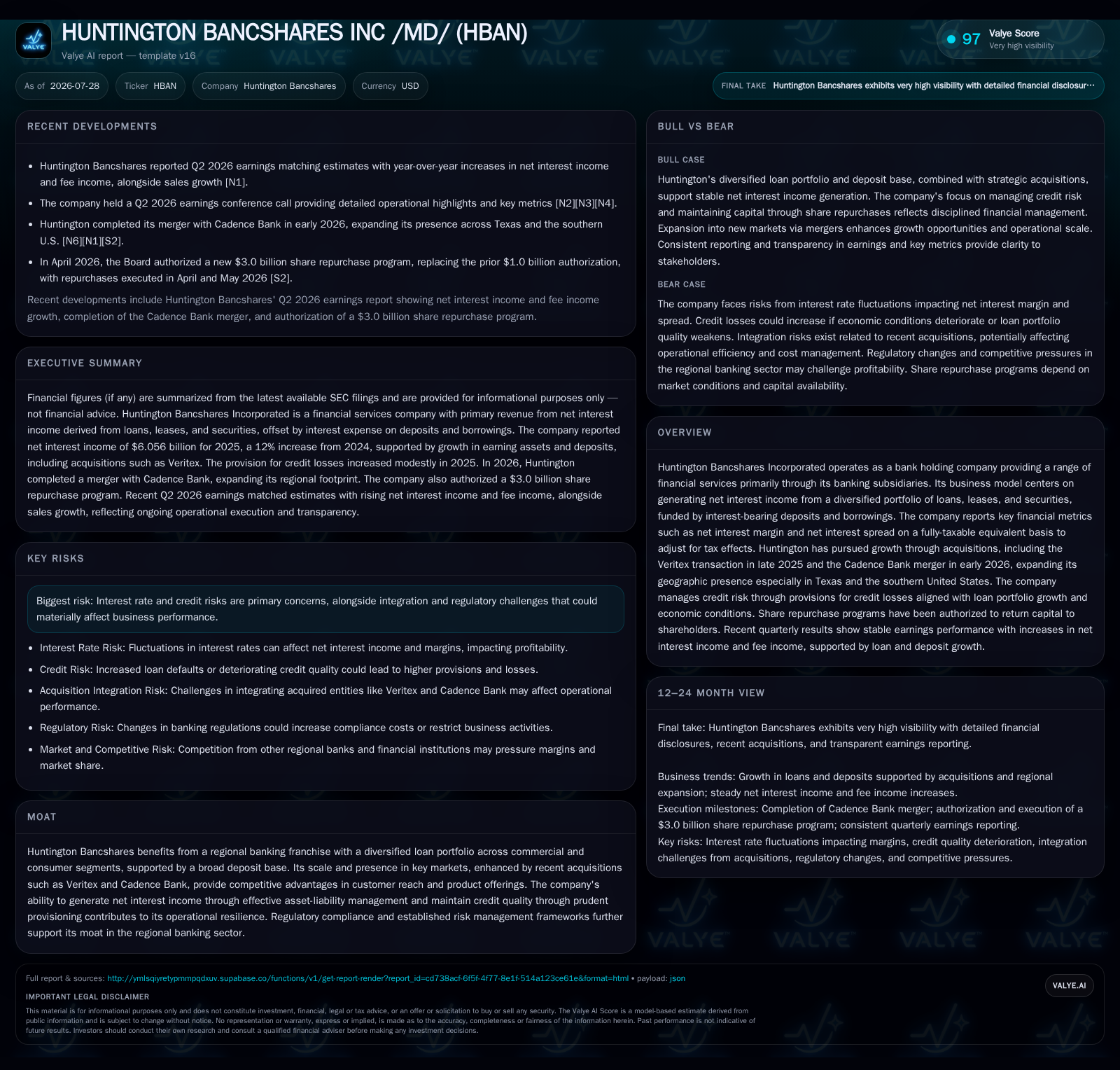
Huntington Bancshares Incorporated reported solid second-quarter 2026 performance, with net interest income (NII) and fee income rising year-over-year consistent with recent acquisitions of Veritex and Cadence Bank. The company’s business model centers on generating NII from a diversified loan portfolio funded primarily by deposits while managing credit risk prudently. Huntington’s expanded geographic footprint in Texas and the southern U.S. positions it well against regional bank peers, though integration execution and interest rate sensitivities remain key watchpoints. Share repurchase authorization increases underscore disciplined capital allocation amid stable regulatory capital ratios.
Recent Operating Update
Huntington Bancshares’ latest quarterly report for Q2 2026 confirms ongoing momentum following its transformative acquisitions of Veritex in late 2025 and Cadence Bank in early 2026. Both net interest income (NII) and fee income showed solid year-over-year growth, reflecting expanded loan balances, enhanced deposit mix, and a favorable interest rate backdrop supported by recent Federal Reserve policy actions [S2][N1]. The company continues to integrate these acquisitions operationally, emphasizing cross-selling opportunities and cost synergies while maintaining underwriting discipline.
Provision for credit losses tracked proportionally with balance sheet growth and economic conditions without significant deterioration in asset quality metrics. This showcases Huntington’s calibrated credit risk management approach during a period of portfolio scaling [S2][S1]. Importantly, the company successfully secured board approval in April 2026 to raise its common stock repurchase authorization from $1 billion to $3 billion, underlining confidence in capital generation and return strategies amidst macroeconomic uncertainties [S2].
Business Model Overview
Huntington operates as a classic regional bank holding company generating most revenue through net interest income—the spread between yields on loans, leases, securities portfolios, and interest costs on deposits and borrowings. Its diversified loan portfolio spans commercial loans, real estate lending including commercial real estate (CRE), consumer loans, and equipment financing. Funding stability primarily derives from a robust deposit base composed of both low-cost demand deposits and interest-bearing deposit products.
The firm calculates net interest margin (NIM) on a fully taxable equivalent basis to normalize yield comparisons across taxable and tax-exempt investments. Asset-liability management is critical in balancing loan growth ambitions with the cost of funding sources during fluctuating interest rates. Noninterest income supplements earnings through ancillary banking services such as treasury management fees, wealth services, mortgage origination fees, and transaction-based charges.
Growth through mergers—particularly with Veritex and Cadence—has expanded Huntington's regional footprint into Texas and the southern United States, aligning its product breadth with enhanced geographic diversification. The business model relies heavily on efficient credit loss provisioning aligned with portfolio quality controls to maintain an aggregate moderate-to-low risk appetite characteristic of stable regional banks [S1]
Industry Structure and Competitive Positioning
Huntington sits within the regional banking sector where peers like PNC Financial Services, Regions Financial Corporation, and Fifth Third Bancorp operate similar lending-deposit models focused on defined geographies. Such banks compete intensely on deposit product pricing, commercial loan origination capabilities, customer relationship depth, and technological enhancements for client experience.
The company’s recent acquisitions reflect industry consolidation trends aimed at achieving scale economies in operations while extending market coverage. Huntington’s enhanced presence in Texas post-Cadence merger targets one of the highest-growth U.S. banking markets characterized by robust commercial activity. The combined entity also benefits from broader product distribution channels enabling cross-selling financial services advantages that smaller community banks lack.
Peer banks balance operational efficiency ratios (operating expenses relative to revenue) alongside capital adequacy ratios such as Common Equity Tier 1 (CET1) requirements to comply with Basel III regulations [S1]. Huntington highlights risk management rigor through multilayered frameworks including independent credit administration, embedded segment risk officers reporting to the Chief Risk Officer, internal audits focused on problem asset resolution processes—benchmarking well within peer standards
Growth Drivers
Loan growth remains a primary driver fueled by proven uptake in commercial lending segments boosted by economic activity across Huntington’s expanded markets. The company is also cultivating consumer loan volumes supported by secured products including residential real estate lending.
Deposit growth is underpinned by stable core deposits exhibiting low beta qualities—meaning that deposit costs don’t rise immediately with market rates—supporting net interest margins even amid volatile funding environments. Fee income streams from wealth management services, transaction fees, mortgage banking activities contribute incremental diversification supporting earnings stability.
Another key growth lever is active deployment of technology platforms enhancing customer experience which supports client retention and volume expansion. Continued efforts at integrating recently acquired banks are expected to unlock operating leverage improving future efficiency ratios.
Interest rate dynamics currently favor widening net interest spreads due to higher earning asset yields relative to funding costs; however this requires continued agility in asset-liability management to preserve margins as rates fluctuate further.
Risks and Watchpoints
Interest rate risk remains a predominant concern as rapid shifts could compress net interest margins if funding costs accelerate disproportionately or earning asset yields reset slower than liabilities [S1]. Huntington uses derivatives such as swaps for hedging purposes but remains sensitive pending market cycles
Credit risk from economic downturns or borrower defaults also necessitates vigilant monitoring; an uptick in nonperforming loans or reserve shortfalls could pressure earnings given the enlarged portfolio base post-acquisitions.
Integration risks associated with Veritex and Cadence remain relevant; failure to achieve cost synergy targets or retain core customers across regions could dampen prospective returns from these deals.
Regulatory scrutiny including heightened capital adequacy requirements under Basel III reforms adds compliance complexity and potential earnings impact related to capital allocation decisions.
Competitive pressures from larger super-regional banks as well as fintech disruptors targeting portions of deposit bases or small business lending create ongoing challenges requiring differentiated service delivery.
What To Watch Next
Key upcoming indicators include subsequent quarterly loan growth rates particularly within new geographic markets attributable to acquired entities. Monitoring provision for credit losses relative to any economic stress signals will illuminate risk trajectory.
Improvements in operating efficiency measured via expense-to-revenue ratios will reveal progress on merger integration performance.
Capital position development—especially tangible book value per share—and execution of share repurchase programs will shed light on management’s capital allocation philosophy amid evolving market conditions.
Management commentary during future earnings calls may provide insights into deposit beta behavior responding to rate changes and updates on product innovation pipelines supporting diversified fee incomes.
Financial Profile Discussion
In April 2026 Huntington increased its share repurchase authorization up to $3 billion from $1 billion prior levels emphasizing shareholder return amidst strong earnings fundamentals [S2]. Quarterly repurchases aggregated nearly $9.8 million shares purchased at an average price around $16.32 per share during Q2 illustrating active buyback engagement aligned with capital availability [S2].
Overall capital ratios remain within regulatory minimums maintaining strategic flexibility for organic growth or future M&A initiatives without undue leverage escalation risks.
This analysis synthesizes evidentiary details drawn exclusively from SEC filings dated through July 28, 2026 (), news sources () per company announcements and financial disclosures ([F1]). It contextualizes Huntington Bancshares within prevailing regional banking industry frameworks without extrapolating beyond supported data or offering investment guidance.
Disclaimer: This is research-only, informational analysis and not investment advice. It may include AI-generated interpretation and general industry context. Always verify important details using primary sources.

Comments