
Hubilu Venture Corp Updates Operational Milestones Amid Financial Constraints
Latest quarterly filings reveal recent property acquisitions integral to Hubilu's growth against ongoing capital and liquidity challenges.
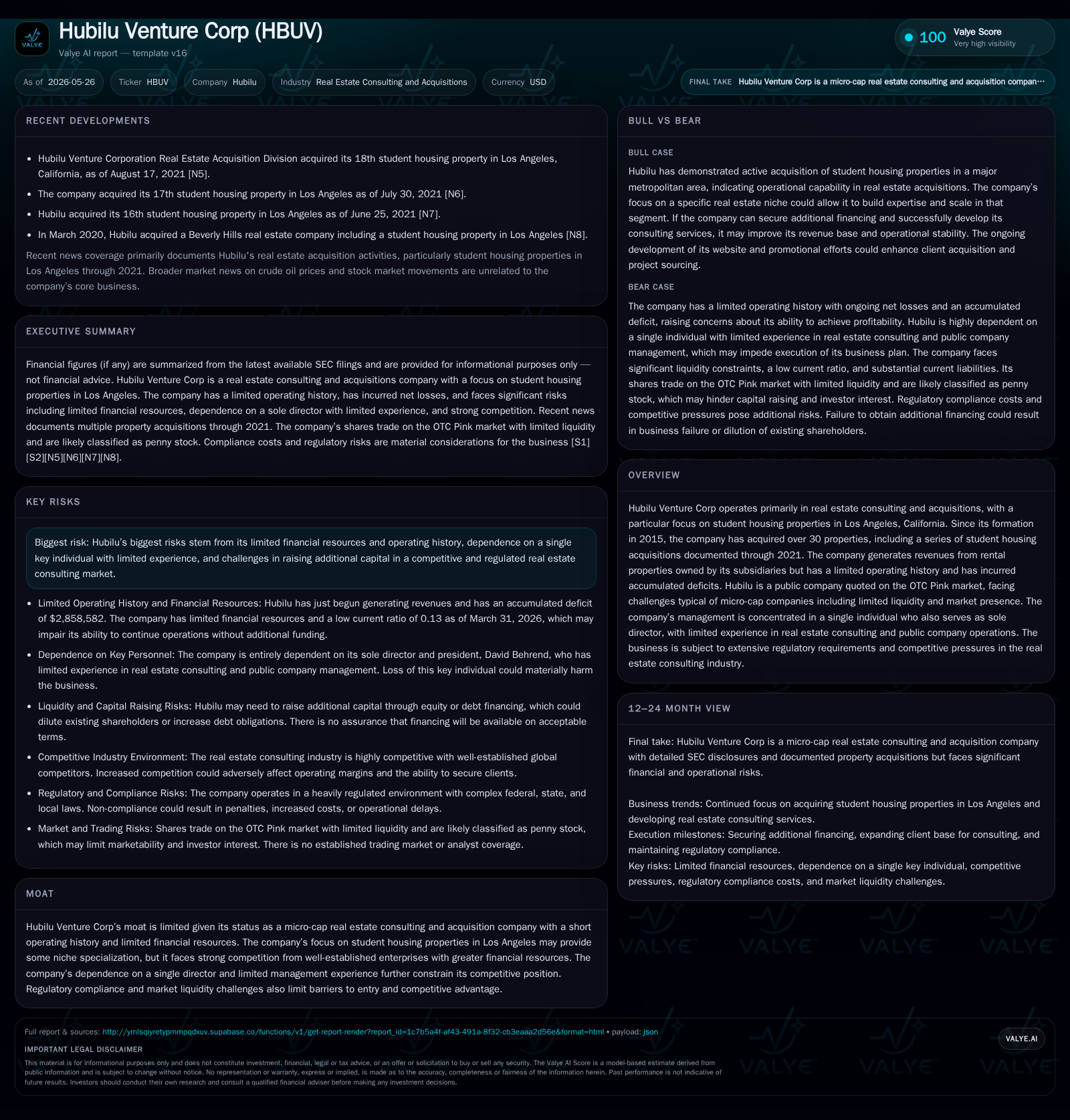
Hubilu Venture Corp continues to expand its footprint in the Los Angeles student housing market through targeted property acquisitions, as detailed in its Q1 2026 filing. The company’s business model centers on real estate consulting services complemented by rental income from acquired student housing assets. However, its micro-cap status, limited management experience, and stretched financial profile constrain scalability and competitive positioning. Key near-term growth drivers include further asset accumulation and tenant leasing progress, while significant risks arise from capital needs, regulatory burdens, and governance concentration.
Latest Quarterly Operating Update: Highlights from Q1 2026
Hubilu Venture Corp's latest quarterly filing dated May 26, 2026 ([S2]) outlines continued expansion through real estate acquisitions primarily focused on student housing assets in Los Angeles. Notably, the company closed on the purchase of a vacant property located at 417 W 52nd Place in August 2025 for $525,000 ([S9]). This acquisition was financed mostly via a $482,500 first position note bearing an annual interest rate close to 10%, requiring monthly interest-only payments commencing October 1, 2025.
This transaction fits within a series of similar purchases completed throughout mid-2025 targeting undervalued or vacant student housing facilities. The strategy aims to establish a foundational rental portfolio to drive operating revenue. However, the financing terms underscore ongoing liquidity constraints, as evidenced by the reliance on relatively expensive loans with near-term balloon payments.
No other significant operational developments or new event filings were noted in the latest quarter beyond these acquisitions. The company remains dependent on ramping property leasing activity to generate meaningful rental income.
Business Model Overview: Real Estate Consulting and Student Housing Focus
Hubilu operates through two intertwined business lines: real estate consulting services and rental income generation via owned student housing properties ([S1], [F1]). Revenue arises when clients retain Hubilu for advisory roles typically related to property acquisitions or development projects, complemented by cash flows collected from tenants occupying acquired units.
The consulting arm aims to provide expertise grounded in local real estate market nuances but is hampered by management's limited industry consulting experience ([S1]). Meanwhile, acquisition-driven rental revenue depends heavily on securing suitable investment-grade properties within demand-rich urban submarkets.
Student housing in Los Angeles represents a niche with structural renter demand driven by nearby universities; however, historically Hubilu's operating history remains brief with accumulated deficits totaling approximately $2.86 million as disclosed at year-end 2025 ([S1]). Losses are expected to continue near term due to overhead costs tied to maintaining compliance as a public company plus acquisition-related expenses.
Financially, revenues remain modest compared to operational costs; reported top-line figures have been sparse but incremental improvements are linked directly to expanding the asset base where rents can be collected ([F1]).
Industry Positioning: Competitive Landscape and Niche Dynamics in Los Angeles
Within Los Angeles' student housing market, Hubilu competes against well-established real estate entities possessing vast capital resources and developed leasing platforms ([S1], analysis). As a micro-cap issuer traded over-the-counter with limited liquidity and market recognition ([S15]), Hubilu’s ability to compete aggressively is constrained.
Pricing power within this segment is moderate due to regulatory rent controls applicable locally and competitive supply from both purpose-built developments and converted residential units serviced by major operators. Barriers to entry remain relatively low given existing regulatory frameworks, meaning competition remains intense from incumbents.
The company's geographic concentration limits diversification but also allows some focused specialization tailored towards university-adjacent properties. Nonetheless, Hubilu's small scale combined with limited operating history tempers competitive differentiation amid more experienced peers capable of scaling consulting offerings alongside large-scale property management.
Operational Quality and Management: Leadership Constraints and Service Efficacy
A key structural weakness lies with management concentration; David Behrend serves simultaneously as president, CEO, and sole director ([S1]). His background includes brokerage and property management roles but lacks substantial real estate consulting credentials or prior public company leadership experience.
This governance model creates execution risk stemming from potential capacity limits given estimated management time commitment capped around 40 hours weekly ([S14]). The absence of independent directors or committees further amplifies oversight concerns regularly highlighted in micro-cap governance assessments.
The narrow leadership bandwidth may restrict the firm's ability to secure diverse client mandates within consulting or navigate complex regulatory environments effectively. Such limitations pose challenges when pursuing profitable contract wins or managing growing portfolios requiring professional tenant relations and compliance monitoring.
Growth Catalysts: Property Acquisitions and Market Demand Drivers
Near-term prospects hinge chiefly on successful acquisition of additional strategically located student housing properties within Los Angeles ([S9], [S10], [S16]). Recent examples include:
- Acquisition of vacant properties at 417 W 52nd Place (Aug 2025) [$525K purchase] ([S9])
- Purchase of real estate at 1460 Exposition Blvd (Sept 2025) for $520K ([S10])
- Earlier June 2025 purchase at 1434 W. 22nd Street ($640K) ([S16])
These transactions extend the company's asset base that underpins future rental cash flow streams upon tenant occupancy. Structural demand stems from consistent student enrollment levels at nearby universities supporting long-term vacancy absorption fundamentals.
Incrementally building out recurring rental income can gradually offset consultancy operational expenses while strengthening financial footing if occupancy viability holds stable amidst regional economic conditions.
Risks and Constraints: Capital Limitations, Management Experience, Regulatory Burden
Several headwinds threaten Hubilu's ability to execute its business plans effectively:
- Liquidity Stress: Current ratio stands alarmingly low around ~0.13 as of March 31, 2026 ([F1]), reflecting thin current asset coverage against liabilities of $1.65 million.
- Leverage: Total debt approaches nearly $23 million net of cash equivalents ([F1]), accrued predominantly from property acquisition loans carrying onerous interest demands (~9.99%).
- Accumulated Deficits: Operating losses culminate in nearly $2.86 million deficit as of year-end December 2025 ([S1]), signaling prolonged unprofitability risk.
- Management Concentration: Dependence on one director/CEO limits organizational resilience; absence of broader oversight elevates governance risk levels ([S1]).
- Capital Raise Uncertainty: The firm acknowledges necessity for future equity or debt funding rounds; such initiatives risk diluting existing shareholders or increasing financial leverage ([S14], [S22]).
- Regulatory Compliance Complexity: Real estate consulting involves navigating extensive federal/state/local regulations specific to Los Angeles rental codes impacting cost structure ([S12]).
- Market Competition: Larger established players exert pricing pressure reducing margin improvement opportunities amid active competition for tenant occupancy and contracts.
Achieving progress across these fronts would signal incremental validation of Hubilu’s niche strategy despite structural handicaps.
Financial Snapshot: Liquidity, Leverage, and Profitability Insights
As reported in the most recent fiscal update ending March 31, 2026 ([F1], [S2]), Hubilu Venture Corp maintains extremely tight liquidity characterized by total current assets of just over $220K against current liabilities approaching $1.65 million leading to an acute current ratio near 0.13 — fundamentally underscoring imminent working capital constraints.
Total debt balances stand near $22.9 million as of December-end 2025 with net leverage after cash approximating $22.77 million ([F1]). The company's reliance on high-cost loans carrying almost double-digit interest inflates fixed financial charges constraining earnings power further.
Net income remained negative at about -$551K in calendar year-end December 2025 reflecting persistent operating losses fueled partly by administrative expenses required for compliance as a public entity ([F1]). Revenue generation continues modestly below levels required for profitable scale-up giving rise to material going concern risks articulated explicitly by management ([S1], [S12]).
Capital needs loom large — external funding rounds necessary for acquiring further investment properties will likely entail equity dilution pressures alongside heightened borrowing costs if debt funded — defining a challenging financial landscape for near-term survival while seeking longer-term growth validation through asset accumulation execution.
Disclaimer: This report is solely an analytic narrative based on publicly filed SEC disclosures without investment research views or forecasts. It grounds company-specific facts strictly within cited sources while employing sector context analytically where appropriate without speculative extensions.
Disclaimer: This is research-only, informational analysis and not investment advice. It may include AI-generated interpretation and general industry context. Always verify important details using primary sources.

Comments