
Healthcare Services Group Manages Inflation and Credit Risks Amid Wage Pressures
HCSG navigates rising labor and supply costs with contractual pass-throughs and vendor consolidation while facing customer credit exposure in a regulated reimbursement environment.
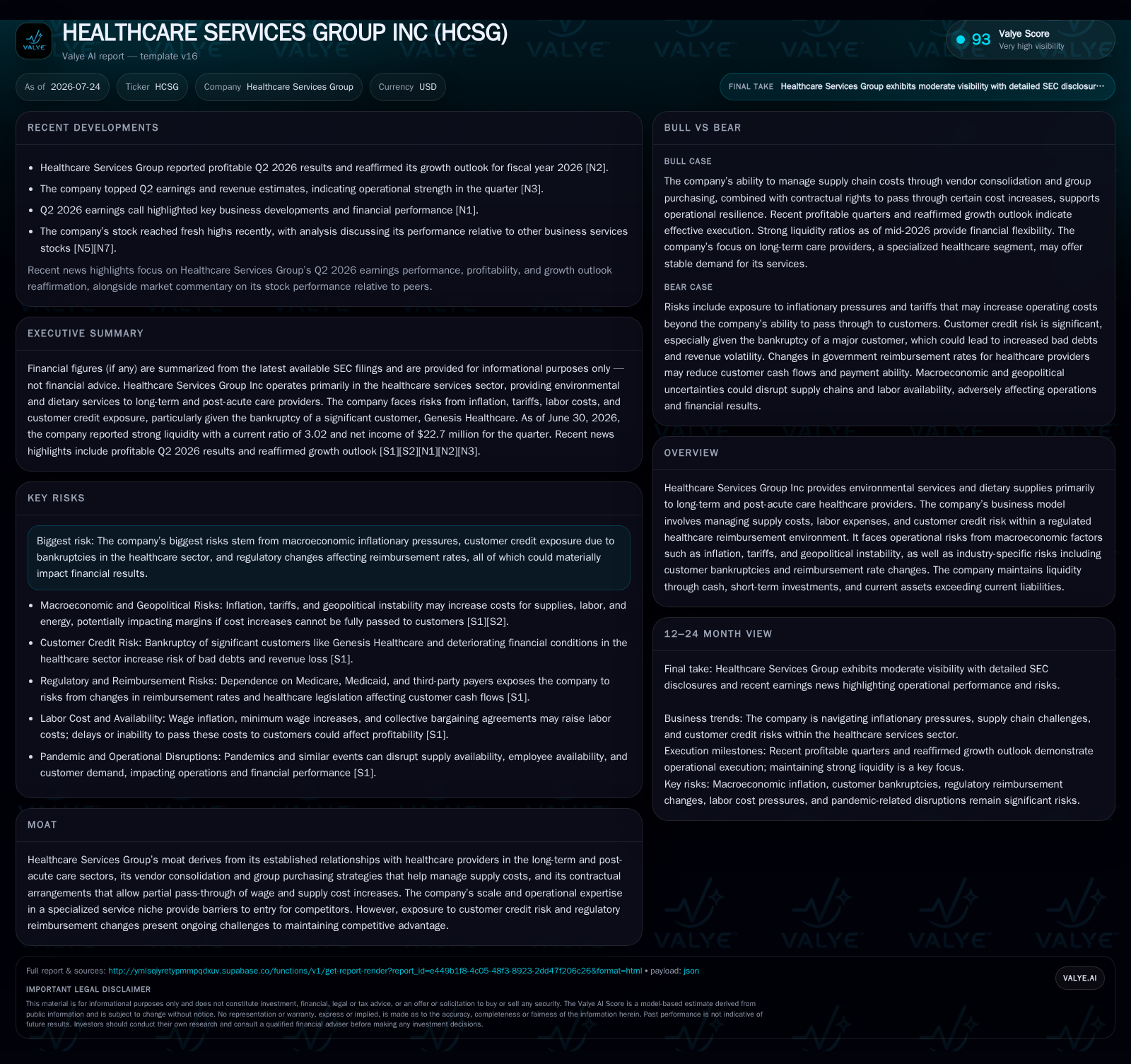
Healthcare Services Group (HCSG) reported strong second-quarter 2026 results, highlighted by effective cost management and profitable growth despite ongoing macroeconomic challenges including wage inflation and supply cost volatility. The company’s business model focuses on providing environmental and dietary services to long-term and post-acute care providers, relying on contractual mechanisms to mitigate inflationary pressures. However, exposure to customer credit risk persists, exacerbated by continuing reimbursement uncertainties in the healthcare sector. HCSG’s scale, operational expertise, and supply chain consolidation help maintain competitive positioning, while liquidity remains robust with a current ratio above 3x as of mid-2026.
Recent Operating Update
Healthcare Services Group, Inc. (HCSG) reported robust second-quarter 2026 results, demonstrating effective management of inflationary pressures and credit risks amid ongoing wage and supply cost challenges [S2][N2]. The company’s operating margin improved despite macroeconomic headwinds, supported by contractual pass-through provisions and strategic vendor consolidation. These results underscore HCSG’s ability to navigate a complex healthcare reimbursement environment while maintaining service quality and operational efficiency.
Business Model Analysis
HCSG specializes in delivering environmental services (EVS) and dietary services primarily to long-term care (LTC) and post-acute care providers, including nursing homes and rehabilitation centers [S1]. The company generates revenue through negotiated service contracts with these healthcare providers, which typically incorporate cost pass-through clauses allowing adjustments for wage inflation and supply cost fluctuations. This contractual structure is critical given the regulated reimbursement framework—largely Medicare and Medicaid—that governs customer budgets and payment terms.
Labor costs represent approximately 78% of EVS segment revenues but only about 59% of Dietary segment revenues, reflecting the labor-intensive nature of environmental services [S24]. Conversely, dietary supplies constitute nearly one-third of Dietary revenues but only about 7% of EVS revenues, exposing the Dietary segment to commodity price volatility and tariff impacts [S24][S15]. HCSG mitigates supply cost risks through vendor consolidation and participation in group purchasing organizations (GPOs), with over 50% of food and dining supplies sourced via Sysco, enabling negotiated pricing and supply chain efficiencies [S15][S24].
Operationally, HCSG functions as an intermediary between healthcare facility customers—who depend on fixed or formula-based government reimbursements—and suppliers of labor, food, and cleaning materials. The company centralizes procurement and manages on-site service delivery under bundled contracts tailored to local market conditions. This integrated model supports operational efficiency but also concentrates customer credit risk, as payment capacity is tied to the financial health of LTC providers and reimbursement policies [S1][S29]
Industry Structure & Competitive Positioning
The healthcare support services industry encompasses a spectrum of providers, from diversified firms like Aramark, Sodexo, and Compass Group offering broad food and facilities management, to specialized environmental and dietary service contractors, GPOs, and healthcare staffing agencies. HCSG’s competitive niche lies in its focused expertise serving LTC and post-acute care segments, where regulatory complexity and reimbursement constraints demand specialized compliance and contracting capabilities.
HCSG’s scale and supplier consolidation confer pricing leverage and operational efficiencies, enhancing its competitive moat. Its expertise in structuring contracts with wage and supply cost escalators is particularly valuable in a sector with limited margin flexibility and high regulatory scrutiny [S18][S24]. However, competitive risks include potential insourcing by larger healthcare providers, regional low-cost service entrants, and pricing pressures during contract renewals.
Growth Drivers
Demographic trends, notably the aging U.S. population, drive increased demand for LTC and post-acute care services, expanding the addressable market for environmental sanitation and dietary support [S1]. Outsourcing of non-core support functions by healthcare providers continues to grow as a cost-control strategy, benefiting specialized service providers like HCSG.
Regulatory emphasis on infection control and enhanced dietary/nutritional standards post-pandemic further elevates the value proposition for vendors demonstrating compliance excellence. Consolidation among healthcare providers creates opportunities for multi-site contract wins leveraging standardized service protocols and operational scale.
Supply chain innovations, including GPO participation, enhance margin resilience by reducing input cost volatility. Contractual pass-through mechanisms for wage and commodity cost increases stabilize cash flows and enable incremental pricing aligned with service expansion.
Risks & Watchpoints
Persistent macroeconomic inflation, particularly wage inflation driven by tight labor markets and minimum wage legislation, remains a key margin pressure [S25][S27]. Dietary segment margins are vulnerable to commodity price spikes and tariff-related cost increases, which may not always be immediately recoverable through contractual pass-throughs [S1][S24].
Customer credit risk is elevated due to the concentration of revenues from LTC providers reliant on Medicare and Medicaid reimbursements. Any reductions or delays in government funding can impair customer payment capacity, increasing bad debt expense and potentially leading to contract terminations [S29]
Regulatory uncertainties around reimbursement rates and healthcare funding policies pose risks to customer budgets, contract renewal rates, and pricing ceilings. Competitive pressures from regional providers and insourcing trends may also challenge contract retention.
Operational risks include maintaining service quality and compliance amid labor shortages and wage pressures. Dependency on key suppliers, notably Sysco, introduces supply chain concentration risk that could affect margins if disrupted.
What To Watch Next
Key indicators to monitor include Q3 bookings velocity and contract renewal rates at major client accounts, which will provide early signals of demand strength and customer financial stability. Tracking labor cost trends relative to negotiated pass-through effectiveness will be critical to assessing margin sustainability.
Regulatory developments affecting Medicare and Medicaid reimbursement policies should be closely watched for their impact on customer budgets and payment timing. Progress on geographic expansion and incremental service offerings can be evaluated through backlog growth and contract award disclosures.
Supply chain dynamics, especially any disruptions involving Sysco or shifts in commodity pricing, warrant attention given their potential near-term margin impact.
Financial Profile Discussion
As of June 30, 2026, HCSG held $123 million in cash and equivalents, with current assets totaling approximately $569 million against current liabilities of $188 million, resulting in a strong current ratio of 3.02 [F1][S2]. This liquidity position supports operational continuity and flexibility in a capital-light business model reliant primarily on human capital rather than fixed assets.
The company maintains an undrawn $300 million revolving credit facility extended through April 2031, providing ample financial flexibility for working capital needs and strategic initiatives [S20]. The absence of borrowings under this facility reflects prudent leverage management and a conservative capital structure.
Overall, HCSG’s financial profile combines solid liquidity reserves with manageable leverage, underpinning resilience amid inflationary and regulatory challenges while supporting growth investments.
This analysis is based exclusively on publicly filed disclosures and validated financial data through July 2026. It aims to provide a detailed understanding of Healthcare Services Group’s strategic positioning within the healthcare support services niche and the key operational and financial dynamics shaping its near-to-medium term outlook.
Disclaimer: This is research-only, informational analysis and not investment advice. It may include AI-generated interpretation and general industry context. Always verify important details using primary sources.

Comments