
Hawaiian Electric Industries’ Rebound Amid Litigation Settlements and Infrastructure Challenges
HEI’s financial recovery in 2025 is shaped by significant settlement payments, federal resilience funding, and capital investments tied to wildfire risk mitigation.
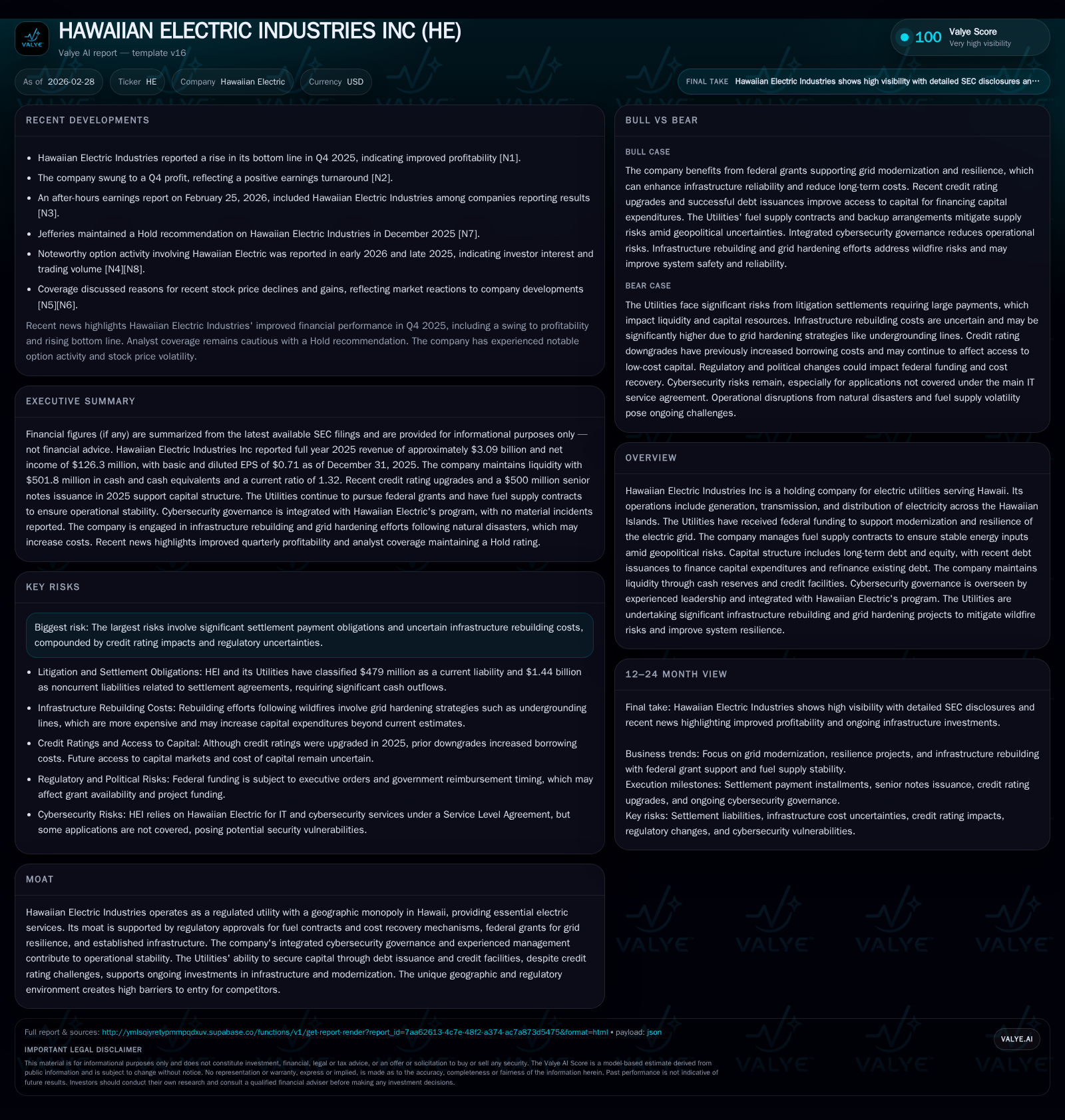
Hawaiian Electric Industries Inc (HEI) operates as the principal regulated electric utility provider in Hawaii. After a loss in 2024 heavily influenced by large settlement obligations related to 2023 wildfires, HEI posted a substantial return to profitability in 2025. This turnaround was supported by increased revenues, operating income growth, and federal grants aimed at grid modernization. However, the company faces ongoing risks including uncertain infrastructure rebuilding costs, regulatory scrutiny, and elevated credit spreads impacting capital access. HEI maintains strong liquidity and continues substantial capital expenditures focused on resilience and fuel supply stability. The utility’s geographic monopoly and cost recovery mechanisms underpin its moat but also concentrate exposure to unique local risks.
Company Overview and Moat
Hawaiian Electric Industries Inc (HEI) is the holding company for electric utilities that solely serve the Hawaiian Islands, covering electricity generation, transmission, and distribution. Its operations are regulated and benefit from a geographic monopoly under Hawaii’s Public Utilities Commission. This positioning forms a durable moat supported by regulatory-approved fuel contracts, cost recovery frameworks such as the Energy Cost Recovery Clause (ECRC), federal grants for grid modernization, and established infrastructure assets. In addition, HEI has developed integrated cybersecurity governance overseen by seasoned leadership with quarterly reporting to the board, enhancing operational risk management ([S1],[S11],[S12]).
Historical Financial Performance
Marked by volatility stemming from external shocks including wildfires settlement obligations, HEI’s financials swung sharply over recent years. Revenue fell steeply in 2024 due mainly to accounting for settlement payments but surged back sharply in 2025. Over the four-year span ending FY2025, revenue was generally stable around $3 billion except for a dip in FY2024:
Historical performance (annual)
| FY | Rev ($bn) | Net ($mm) | CFO ($mm) | OpInc ($mm) | Rev YoY | Net YoY |
|---|---|---|---|---|---|---|
| 2025 | 3.1 | 126 | 391 | 235 | +286.3% | +108.9% |
| 2024 | 0.8 | -1424 | 487 | 54 | -78.3% | -808.1% |
| 2023 | 3.7 | 201 | 551 | 353 | -1.6% | -17.2% |
| 2022 | 3.7 | 243 | 454 | 381 |
Source: SEC companyfacts cache [F1].
Capital returns and efficiency (annual)
| FY | Div ($mm) | FCF ($mm) | ROE% |
|---|---|---|---|
| 2025 | 0 | 50 | 7.9 |
| 2024 | 0 | 143 | -96.3 |
| 2023 | 113 | 103 | 8.6 |
| 2022 | 153 | 110 | 11.0 |
Source: SEC companyfacts cache [F1].
Source: [F1]
The vast net loss in FY2024 stemmed largely from material non-recurring settlement payments linked to the catastrophic Maui wildfires; these are recorded as liabilities totaling approximately $1.9 billion split between current ($479 million) and long-term obligations ([S9],[F1]). Despite this burden, operating income recovered robustly by FY2025 (+338% YoY), reflecting operational normalization and regulatory cost recovery support.
Future Growth Prospects
Looking ahead, HEI's growth will depend heavily on successful execution of infrastructure rebuilding coupled with modernization projects funded partly through federal resilience grants totaling $95 million under the Climate Adaptation Transmission and Distribution Resilience Program ([S13]). These efforts aim to create a resilient smart grid able to withstand climate risks while integrating increasing renewable energy resources.
Fuel procurement stability remains paramount given Hawaii's dependency on refined fuels historically sourced partially from Russian crude—which supply was disrupted due to sanctions—leading HEI to secure backup contracts with Vitol extending through mid-2026 ([S1],[S9]). The extension of these contracts promises operational continuity amidst global energy market uncertainties.
The planned use of more expensive undergrounding to mitigate wildfire damage will increase capital intensity but enhance system resilience—a trade-off signaling that future infrastructure costs could exceed previous baseline levels markedly ([S6]). Meanwhile, potential regulatory changes or delays pose downside risks given HEI’s cost passthrough framework hinges on PUC approvals.
Forecasts and Milestones
HEI's explicit guidance cites intentions to maintain strong liquidity positions sufficient for near-term obligations including scheduled settlement payments due starting early 2026 and continuing for four years total ([S9]). The company also outlines ongoing evaluation of financing options such as securitization or additional unsecured debt issuances to support capital investments ([S4],[S6],[S18]). Market-watchers should monitor upcoming quarterly filings for updates on settlement payment progress, federal grant disbursements timing, capital spending pace especially on grid hardening initiatives, and any changes in PUC rulings relevant to fuel contract recoveries.
Returns and Capital Allocation
HEI’s modest ROE stands at approximately 7.9% based on last reported annual net income relative to equity as of end-2025—reflective of utility sector norms tempered by recent extraordinary expenses ([F1]). Operating cash flow declined almost 20% YoY from FY2024 despite recovering profits owing to sustained high capital expenditure requirements exceeding $340 million annually focused on infrastructure reinvestments.
The utility suspended dividend distributions starting FY2024 coinciding with its heavy litigation-related cash needs but previously had paid dividends exceeding $100 million annually prior; no buybacks have been reported recently ([F1],[S17],[S22]). That approach demonstrates prioritized liquidity conservation during this restructuring phase.
Capital structure wise, HEI taps multiple credit facilities totaling over $600 million undrawn capacity alongside nearly half a billion dollars of cash balances yielding over $1.1 billion of available liquidity as of December 31, 2025 ([S4],[S5],[F1]). Notably, the company successfully issued $500 million of senior unsecured notes at an attractive but elevated coupon rate of ~6% reflecting sub-investment grade ratings that were subsequently revised upward amidst improving stability but still below investment grade consensus ([S6],[S16]).
Before these note issuances HEI redeemed all cumulative preferred stock by late FY2025 simplifying its balance sheet structure—a move favoring fixed-cost reductions going forward ([S17],[S20]).
Risks Summary
Key risks include:
- Large settlement payment obligations cast lingering credit pressure even though staged installment plans provide some clarity ([S7],[S9], valye_report_excerpt).
- Uncertainties around final costs for infrastructure rebuilding exacerbated by wildfire-driven design changes requiring costly underground lines instead of overhead wires.
- Credit rating challenges persist though partially alleviated since mid-2025 upgrades; higher borrowing costs remain a concern limiting flexibility.
- Regulatory uncertainty surrounding timely approval of rate adjustments connected to fuel contracts or recovery clauses could delay cost pass-throughs.
- Operational cybersecurity risks are actively managed but represent inherent threats given critical infrastructure status—governance is integrated across entities-supported by experienced veteran CISOs ensuring vigilance based on detailed quarterly oversight reports presented at board level ([S1],[S11],[S12]).
Conclusion
HEI finds itself on a cautious recovery trajectory after confronting extraordinary wildfire-related liabilities that rocked its financials in FY2024. Strong demand fundamentals amidst its monopolistic utility position combined with regulatory-supported cost recoveries have enabled the company to regain operating profitability quickly in FY2025 despite no dividend return thus far. Meanwhile federal grants plus ongoing resiliency upgrades represent vital pillars supporting sustainable growth although offsetting risks exist notably relating to rebuilding costs and debt servicing capabilities under current credit ratings. Market participants examining HEI should focus attention on near-term cash flow developments related to settlement installments and infrastructure spending progress alongside regulatory outlook shifts that materially influence earnings visibility beyond current milestones.
This analysis is based solely on publicly available information up until February 28, 2026. It is intended for informational purposes without constituting investment advice.
Disclaimer: This is research-only, informational analysis and not investment advice. It may include AI-generated interpretation and general industry context. Always verify important details using primary sources.

Comments