
Helix Energy Advances Integration and Optimizes Offshore Services Amid Q1 2026 Dynamics
Helix Energy Solutions reported improved operational cash flow and progressed a strategic merger, reinforcing its specialized offshore energy services position.
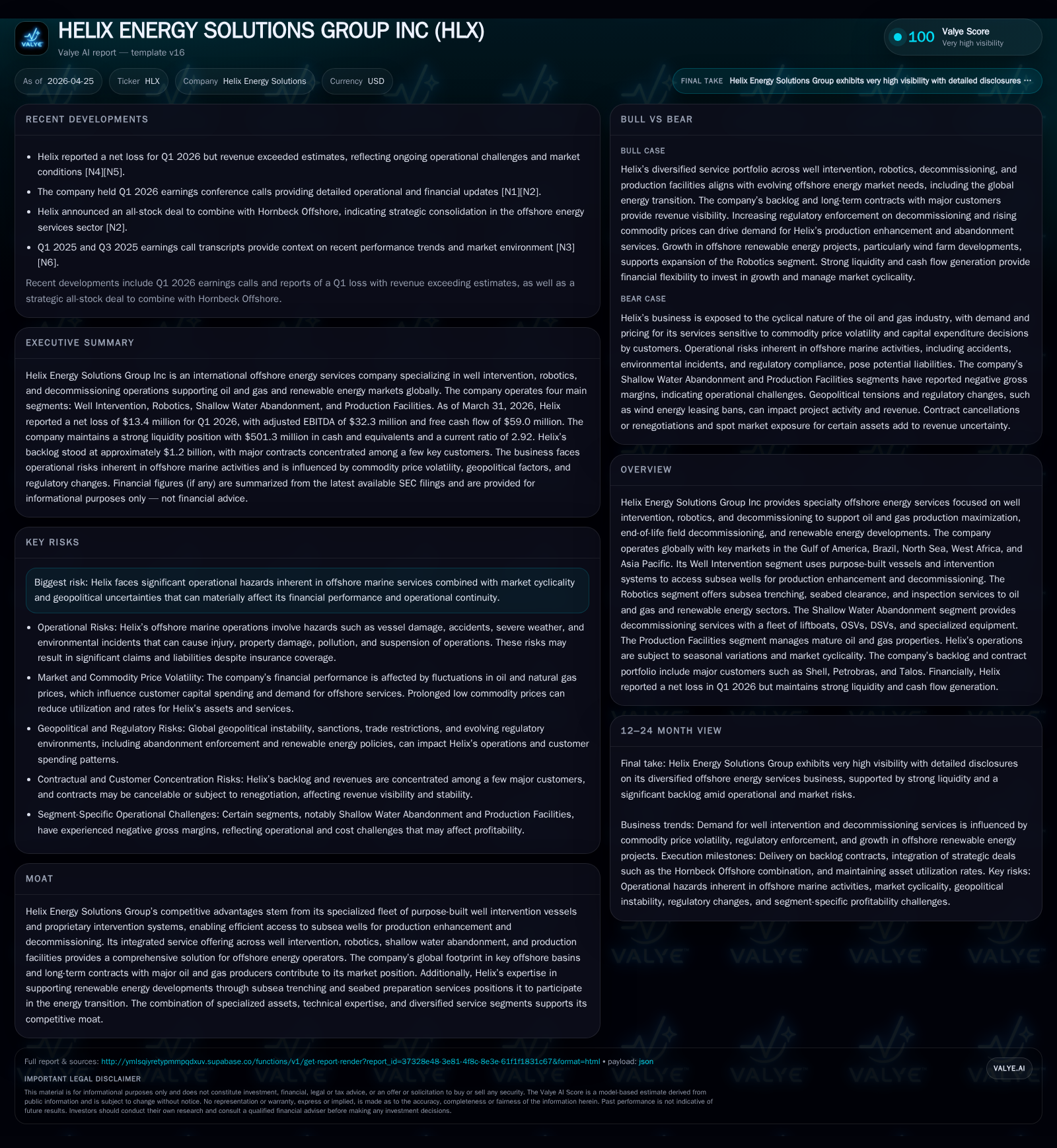
In Q1 2026, Helix Energy Solutions Group Inc demonstrated a substantial increase in operating cash flow despite headwinds in its Production Facilities segment. The company progressed a material all-stock merger with Hornbeck Offshore to expand fleet capabilities and geographical reach. Helix's business model hinges on specialized vessels and subsea robotics that serve oil and gas well intervention, decommissioning, and emerging renewable markets globally. While market cyclicality and regulatory risks persist, Helix maintains strong liquidity backed by robust cash balances and manageable debt levels. Investor focus will be on execution of integration, contract renewals amid rig overhang pressures, and capital allocation moving forward.
Recent Operating Update: Q1 2026 Results Anchor Near-Term Narrative
Helix Energy Solutions Group's latest quarterly filing for Q1 ended March 31, 2026 [S2] reveals several key developments shaping the company’s immediate operating landscape. Notably, operating cash flow soared to approximately $61.8 million compared to $16.4 million in the year-ago quarter [S14], signaling recovering operational momentum despite some pressure points.
However, the Production Facilities segment notably swung from a gross profit of $7.5 million in Q1 2025 to a gross loss of $7.5 million this period. This deterioration is largely attributed to elevated workover expenses at the Thunder Hawk field coupled with decreased revenues during the quarter [S9]. Selling, general & administrative expenses rose modestly driven by higher employee compensation and professional services reflecting an uptick in business activities.
Concurrent with results disclosure, Helix announced an all-stock merger agreement with Hornbeck Offshore [S3], aiming to combine fleets and expertise in a transaction contingent on customary closing conditions including antitrust approvals. Governance arrangements were set—four directors designated by Helix vs. three by Hornbeck—with William Transier slated to chair the combined board [S3]. This transaction signals strategic consolidation intending to strengthen Helix’s positioning in offshore energy services.
Business Model: Specialized Offshore Services with Integrated Segments
Helix Energy Solutions operates primarily across four complementary segments: Well Intervention, Robotics, Shallow Water Abandonment (field decommissioning), and Production Facilities [S2]. These segments synergize to deliver lifecycle offshore energy solutions—maximizing production from aging wells while managing their end-of-life adequately.
Well Intervention employs seven purpose-built vessels equipped with twelve intervention systems designed specifically for subsea access without resorting solely to traditional drilling rigs [S2]. This asset specificity grants Helix strategic pricing advantages by providing more flexible and cost-efficient options for clients needing to optimize mature fields or execute plug-and-abandon (P&A) operations.
Robotics features an extensive fleet of remote-operated vehicles (ROVs), trenchers for seabed preparation including renewable energy infrastructure support, and robotic boulder grabs facilitating seabed clearance [S2]. This technical portfolio places Helix at the nexus of subsea oil & gas service demands as well as nascent offshore renewables—a growth vector given global energy transition trends.
Shallow Water Abandonment utilizes a fleet including nine liftboats, six offshore supply vessels (OSVs), diving support vessels (DSVs), derrick barges, crew boats alongside plug-and-abandon tooling systems [S2]. This integrated offering enables comprehensive decommissioning services aligned with increasingly stringent regulatory requirements for field retirement.
Production Facilities manages interests in several mature oil & gas properties such as Thunder Hawk but faces profitability headwinds due to elevated operational costs [S9].
The overall revenue model blends long-term contracts with major oil producers—Shell accounting for roughly 18% of revenues in recent years—and spot or short-term engagements often shaped by rig activity overhangs impacting well intervention demand [S20].
Industry Structure & Competitive Position: Niche Expertise in Offshore Lifecycle Services
Helix occupies a differentiated niche exploiting proprietary well intervention vessels that enable subsea access at pricing levels typically below rig-based methods—a critical advantage amid cyclical drilling activity declines [S2]. The specialized nature of Helix's fleet also acts as a barrier-to-entry protecting market share against generic offshore service suppliers.
Robotics capabilities further extend competitive moats given substantial capital intensity required for ROV fleets capable of deepwater trenching or clearance operations. Participation across regions—including Gulf of Mexico, North Sea, Brazil’s pre-salt basins, West Africa, and Asia-Pacific—provides both geographical diversification and exposure to varying market dynamics.
Consolidation through the Hornbeck merger promises scale benefits potentially enhancing chartering flexibility across combined vessel inventories while broadening client relationships within offshore exploration & production firms [N8], aiming to counterbalance competitive pricing pressures from rig overhangs suppressing intervention rates.
Growth Drivers & Constraints: Balancing Cyclicality With Renewable Transition Prospects
Demand in well intervention remains tethered to broader offshore drilling activity cycles but has structural underpinnings tied to accelerating maturity of global offshore fields requiring ongoing production enhancement or P&A tasks [S2]. Rig availability surplus depresses utilization metrics temporarily but Helix's dedicated assets can capture incremental share if priced competitively.
Renewable energy projects signal promising growth avenues; subsea trenching for cable laying or seabed preparation will likely gain importance as offshore wind and tidal installations scale up globally—a sector where Helix’s Robotics segment aligns strategically [S1].
Constraints include capital intensity obligations related to vessel maintenance certifications prescriptions stipulated by regulators which elevate fixed cost bases. Environmental compliance costs remain unpredictable given evolving international standards governing decommissioning processes [S25]. Operational hazards inherent in marine environments expose Helix to risks including potential equipment damage or incident liabilities necessitating substantial insurance coverage yet still vulnerable to catastrophic event impacts [S24].
Geopolitical considerations linked to oil price volatility also wield influence over client spending patterns impacting contract volume visibility particularly outside core stable basins.
What To Watch Next: Key Execution Milestones & Market Indicators
Merger Closing: Fulfillment of Hart-Scott-Rodino antitrust waiver requirements coupled with parent shareholder approvals will determine timeline for Hornbeck deal closure and subsequent integration phases [S3]. Monitoring synergy realization targets post-combination will be critical.
Contract Renewals & New Awards: Given reliance on long-term customer engagements (Shell ~18%; Petrobras ~10%), updates on large contract renewals or expansions will signal demand health especially against backdrop of rig overhang pressure influencing price negotiations [S20].
Financial Metrics: Continued positive trajectory in operating cash flows with controlled SG&A expenses will underscore operational leverage gains; offsets needed against episodic segment losses such as Production Facilities reported recently [S9].
Capital Deployment: Decisions regarding share repurchase programs versus selective capex investments into fleet upgrades or robotics expansion may manifest evolving confidence levels in demand outlooks [S21].
Regulatory Environment: Compliance cost evolution around environmental mandates impacting decommissioning scope will factor into planning for Shallow Water Abandonment segment growth profile [S25].
Financial Profile: Liquidity Strength Amid Moderate Leverage Provides Cushion For Strategy Execution
Historical performance (annual)
|
| FY | Net ($mm) | CFO ($mm) | OpInc ($mm) | Net YoY |
|---|---|---|---|---|
| 2025 | 31 | 137 | 65 | -44.6% |
| 2024 | 56 | 186 | 127 | +613.4% |
| 2023 | -11 | 152 | 64 | +87.7% |
| 2022 | -88 | 51 | -45 |
Source: SEC companyfacts cache [F1].
Capital returns and efficiency (annual)
|
| FY | Buybacks ($mm) | ROE% |
|---|---|---|
| 2025 | 2.0 | |
| 2024 | 30 | 3.7 |
| 2023 | 12 | -0.7 |
| 2022 | -5.8 |
Source: SEC companyfacts cache [F1].
At March 31, 2026, Helix holds substantial liquidity resources evidenced by $501 million in cash & equivalents [F1]. Current assets exceed current liabilities with a current ratio near 2.92x, reflecting solid short-term financial flexibility [F1].
Total debt amounts to approximately $310 million, dominated by secured MARAD debt associated with the Q4000 vessel plus senior notes maturing in 2029 bearing fixed coupon interest around 9.75% [F1]. Net debt calculation—debt minus cash—yields negative $191 million underscoring a net cash position favorable for servicing obligations [F1].
Operating income trended downward comparing FY2025 ($65 million) versus FY2024 ($127 million), capped by gains from prior year’s elevated activity levels; net income similarly declined reflecting normalization effects after cyclical highs [F1]. Cash flow from operations fell from $186 million down to about $137 million year-on-year but remains robust enough to fund capital expenditures averaging mid-high teens millions annually while preserving free cash flow surplus near $79 million after capex deduction [F1].
Capital allocation maintains a judicious balance with recent share repurchases authorized up to $200 million to return excess capital yet subject to preserving investment capability into fleet refurbishment or strategic M&A transactions such as current merger effort [F1], [S21].
Disclaimer
This analysis is intended solely for informational purposes reflecting data publicly available as of April 24–25, 2026 without any investment recommendation or financial advice. Readers should conduct their own due diligence before any decision-making related to securities mentioned herein.
Disclaimer: This is research-only, informational analysis and not investment advice. It may include AI-generated interpretation and general industry context. Always verify important details using primary sources.

Comments