
HOPE Bancorp Builds on SBA Loan Leadership to Manage Commercial Real Estate Risks
HOPE Bancorp leverages its SBA Preferred Lender status and recent merger to fuel growth while addressing concentrated commercial real estate exposure and evolving regulatory challenges.
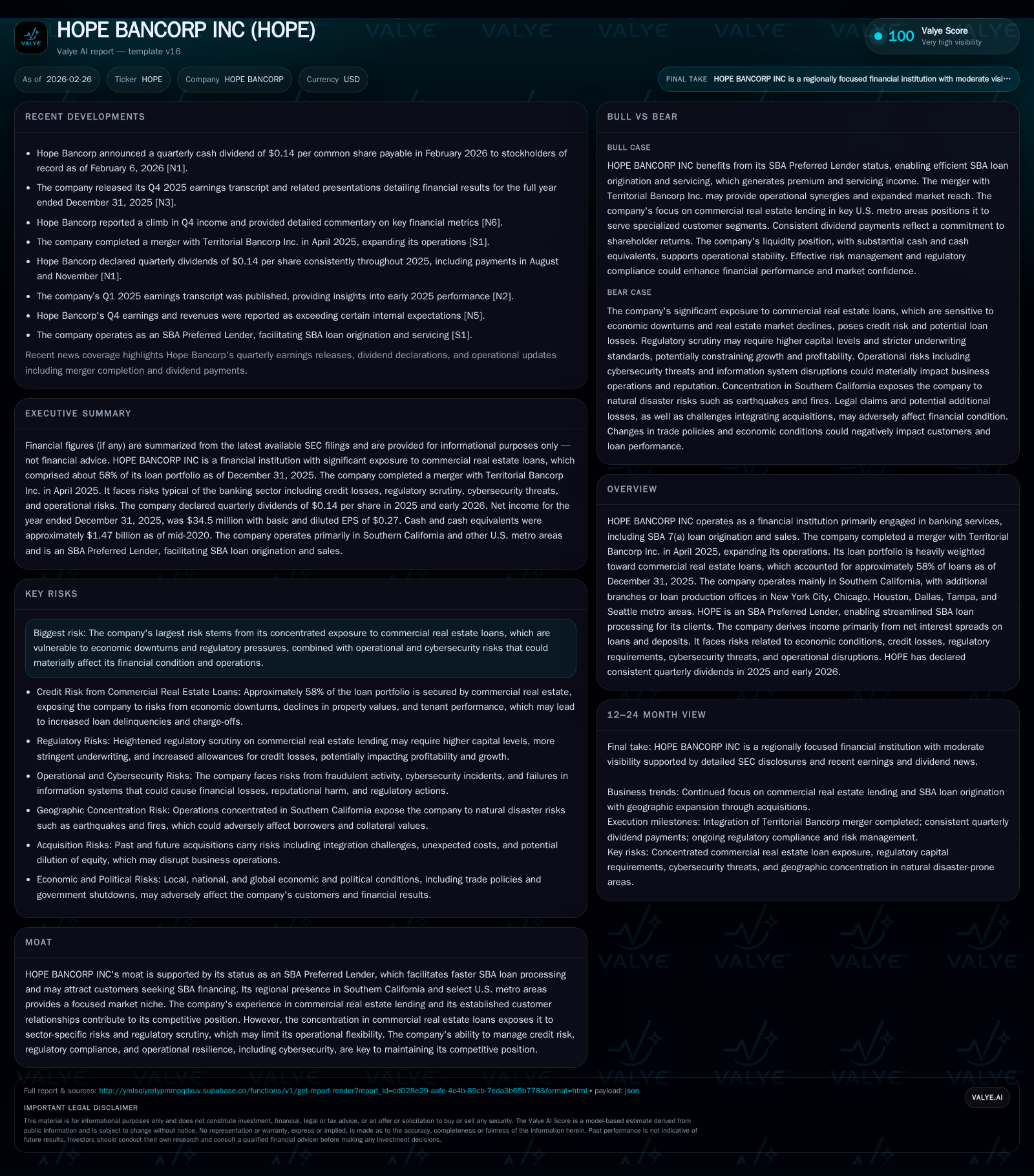
HOPE Bancorp's 2025 financial performance was marked by a significant 41.6% increase in net income, largely driven by robust SBA 7(a) loan originations and the strategic merger with Territorial Bancorp completed in April 2025. However, the company’s portfolio concentration—58% in commercial real estate loans—poses notable risks amidst tightening regulatory scrutiny and economic volatility. Geographic expansion into major U.S. metropolitan areas diversifies market exposure but adds complexity. Capital allocation remains conservative, with dividends maintained but no buybacks since 2023, reflecting a risk-aware stance amid operational challenges including cybersecurity and compliance. Key future watchpoints include credit loss provisions, regulatory capital demands, and integration progress of acquired operations.
Historic Growth Catalyzed by SBA Lending and Strategic Merger
HOPE Bancorp’s recent growth momentum is anchored firmly on its status as an SBA Preferred Lender and the successful completion of the Territorial Bancorp merger in April 2025 [S1][S5]. The SBA Preferred Lender designation affords HOPE accelerated approval processes for SBA 7(a) loans—a critical differentiator facilitating enhanced volumes in a competitive market niche focused on small business financing [S11]. For FY2025, HOPE reported net income of $34.47 million, a striking 41.6% increase over the prior year’s $24.34 million [F1]. This surge reflects both organic loan growth particularly in SBA products and synergistic benefits from integrating Territorial Bancorp’s assets and customer base.
The merger not only expanded HOPE’s loan originations but also broadened its deposit franchise and regional presence without immediate signs of operational disruptions [S5]. However, acquisition risks such as asset quality evaluation challenges and assimilation complexities remain operative risks moving forward [S5].
Commercial Real Estate Concentration: Risk Challenges and Regulatory Scrutiny
A defining feature of HOPE’s loan portfolio is its heavy weighting toward commercial real estate (CRE) loans which accounted for approximately 58% of total loans as of December 31, 2025 [S1]. While CRE lending can enhance yields via exposure to income-producing properties, it incurs elevated risk due to economic sensitivity—the payment capacity hinges tightly on tenant occupancy and property cash flows [S26]. Loan charge-offs in this segment have historically been higher on a per-loan basis than consumer or residential categories.
Regulatory oversight has intensified considerably given systemic concerns about CRE markets nationally [S26]. Federal and state banking regulators now demand stringent underwriting standards, rigorous internal controls, regular portfolio stress testing for adverse economic scenarios, higher allowances for credit losses, and increased capital reserves proportional to CRE exposures [S1][S26]. For HOPE, these factors translate into capital allocation constraints that can limit leverage usage and compress risk-adjusted returns.
Allowance for credit losses must adequately buffer against unexpected asset deterioration; failure in this regard risks earnings shocks and potential supervisory penalties [S23]. Given the illiquidity often associated with foreclosed commercial assets relative to residential collateral, recovery durations tend to be longer with attendant valuation uncertainties [S26]. Moreover, fluctuating real estate market conditions could materially affect collateral values unduly stressing the portfolio.
Expansion Beyond Southern California: Geographic Reach and Market Penetration
While Southern California remains HOPE’s core operating region via full-service branches, strategic expansion efforts have extended its footprint into six other U.S. metropolitan areas: New York City, Chicago, Houston, Dallas, Tampa, and Seattle [S1][S7]. Notably these out-of-state presences are primarily branch-lite 'loan production offices' rather than fully scaled branches—a cautious approach enabling origination activity without heavy fixed costs or deposits gathering responsibility.
This geographical diversification aims to reduce dependency on any single local economy while tapping into broader commercial lending opportunities [S7]. However, it introduces operational complexities such as unfamiliar market dynamics, increased compliance burdens owing to local regulations variation, elevated marketing expenses required for brand establishment outside legacy territories, and management challenges coordinating multi-market personnel effectively [S7]. Furthermore, margin pressure may emerge due to competition intensity or regional credit conditions differing markedly across these metros.
Earnings Momentum and Financial Highlights for FY2025
HOPE reported substantial financial progress in FY2025 as reflected by several key metrics drawn from filings:
- Net Income reached $34.47 million (+41.6% YoY), reflecting strong loan-related revenue gains [F1][N8]
- Operating Cash Flow surged by approximately 41% to $164.55 million underscoring robust liquidity generation from core operations [F1]
- Capital expenditures increased by a third (+33.4%), rising to nearly $13.09 million as investments into infrastructure presumably aligned with scaling initiatives [F1]
- Equity base grew modestly to $2.283 billion supporting measured balance sheet expansion [F1]
- Approximate Return on Equity (ROE) was around 1.5%, signaling capital retention consistent with prudent risk management rather than aggressive leverage deployment [F1]
Notably Q4 results beat analyst estimates consistently suggesting effective execution post-merger integration phase and favorable seasonal results [N3][N4]. While a precise net interest margin was not disclosed explicitly in available evidence making inference imprecise, income derived primarily from net interest spreads aligns logically with loan portfolio expansion dynamics.
Historical performance (annual)
| FY | Net ($mm) | CFO ($mm) | Capex ($mm) | Net YoY |
|---|---|---|---|---|
| 2025 | 34 | 165 | 13 | +41.6% |
| 2024 | 24 | 117 | 10 | -8.1% |
| 2023 | 26 | 474 | 13 | -48.8% |
| 2022 | 52 | 486 | 9 |
Source: SEC companyfacts cache [F1].
Capital returns and efficiency (annual)
| FY | Buybacks ($mm) | FCF ($mm) | ROE% |
|---|---|---|---|
| 2025 | 151 | 1.5 | |
| 2024 | 0 | 107 | 1.1 |
| 2023 | 0 | 461 | 1.2 |
| 2022 | 15 | 476 | 2.6 |
Source: SEC companyfacts cache [F1].
Outlook: Opportunities for Loan Growth Balanced Against Macro Constraints
Looking forward beyond FY2025, management commentary underscores measured optimism tempered with macroprudential caution [N1][N2][S2][S4]. The company intends to leverage its established SBA Preferred Lender status to sustain incremental SBA pipeline expansion but recognizes that growth will be moderated by:
- Regulatory-imposed ceilings on commercial real estate loan growth designed to mitigate systemic risks
- Macroeconomic uncertainties including inflationary pressures and trade policy volatility impacting borrower creditworthiness
- Localized market dependencies particularly within Southern California that remain sensitive to economic cycles
- Potential increases in credit loss provisioning reflecting cautious recognition of late-cycle lending risk
Loan origination targets will therefore require balancing volume ambitions against emerging provisions for credit deterioration; federal policy shifts regarding SBA guarantees or banking regulations remain material variables influencing trajectory [N1][N2][S4]. The landscape calls for active risk monitoring supported by portfolio stress tests reflecting adverse economic scenarios mandated by regulators.
Capital Allocation Strategy: Balancing Retained Earnings, Dividends, and Buybacks
From a capital stewardship perspective, HOPE demonstrates conservatism appropriate for its risk profile [F1][S17][N7]. Recent years show no share repurchases since FY2023 following prior buyback activity notably $14.67 million in FY2022 down from $50 million in FY2021 indicating strategic pause potentially driven by regulatory scrutiny or balance sheet priorities.
Dividends continue but are subject to regulatory constraints including Federal Reserve notifications during periods where earnings are insufficient legally or prudently to fund payments fully [S17]. The bank subsidiary's ability to upstream dividends is regulated under California Financial Code provisions limiting distributions based on retained earnings or multi-year net income thresholds accompanied by departmental approvals impacting timing or quantum thereof.[S17]
Return on equity at roughly 1.5% in FY2025 indicates that internal capital accumulation outweighs distributable returns currently — consistent with expectations given concentrated CRE exposure demanding thicker capital buffers mandated by examiners.[F1] Analysts should monitor any shifts toward resuming buybacks if regulatory conditions ease or if earnings strength sustains.
Operational Resilience: Managing Cybersecurity and Regulatory Compliance Risks
HOPE’s operations face increasing threats from fraudulent activities including complex cyberattacks typical in contemporary financial services sectors [S19][S28]. Unauthorized access risks extend not only to transactional systems but customer personal data jeopardizing reputational integrity if breached.[S19] The bank reports experiencing rising electronic fraudulent attempts consistent with sector-wide trends necessitating continual enhancement of technological safeguards.[S19] Operational dependence on third-party vendors further amplifies exposure requiring stringent oversight agreements.[S28]
Concurrently evolving regulatory frameworks governing anti-money laundering programs—including Bank Secrecy Act compliance—and requirements related to emerging AI technology use pose ongoing legal/regulatory compliance costs.[S21][S13] Failure here could prompt enforcement actions materially constraining strategic options such as mergers or dividend payouts.[S21]
Operational disruption risks extend beyond cyber threats encompassing system failures or client service interruptions that could inflict material damages internally and externally.[S28] Maintaining robust internal controls over financial reporting remains essential given SEC listing rules tied directly to disclosures reliability.[S25]
Key Metrics and Watchpoints for Investors
Looking through a buy-side lens at leading indicators shaping the company outlook:
- Loan Delinquencies & Nonperforming Assets: Material increases could compress margins through expense upticks related to provisions — critical especially within CRE focus segments prone to valuation volatility given tenant performance dependency.[S27]
- Provision for Credit Losses Adequacy: Adequate allowance levels ensure resilience; shortfalls may trigger one-time earnings charges or elevated future expenses.[S23]
- Merger Synergy Realization: Progress in integrating Territorial Bancorp impacts efficient cost structures and cross-selling opportunities affecting profitability trajectories.[N1][S5]
- Regulatory Capital Adjustments: Future capital ratio requirements particularly pursuant to CRE exposure scrutiny will influence ability to pursue growth through leverage.[S26]
- Operational Risk Evolution: Cybersecurity incidents frequency/severity trends alongside AML program effectiveness remain reputationally sensitive domains watched closely by regulators.[S19][S21]
- Dividend Policy & Capital Return Activity: Regulatory approvals coupled with earnings strength dictate shareholder return prospects - absence of buybacks invites attention should profitability improve materially.[F1][S17]
Understanding these dimensions is vital as HOPE balances growth ambitions enabled through SBA leadership against concentrated commercial real estate exposure compounded by multifaceted regulatory landscapes.
This analysis compiles public company disclosures as of February 26th, 2026 without offering investment advice or price targets.
Disclaimer: This is research-only, informational analysis and not investment advice. It may include AI-generated interpretation and general industry context. Always verify important details using primary sources.

Comments