
Hudson Pacific Properties' Mixed Financial Trends and Leverage Pressures in 2025
The REIT faces revenue softness and cash flow contraction amid a highly leveraged balance sheet.
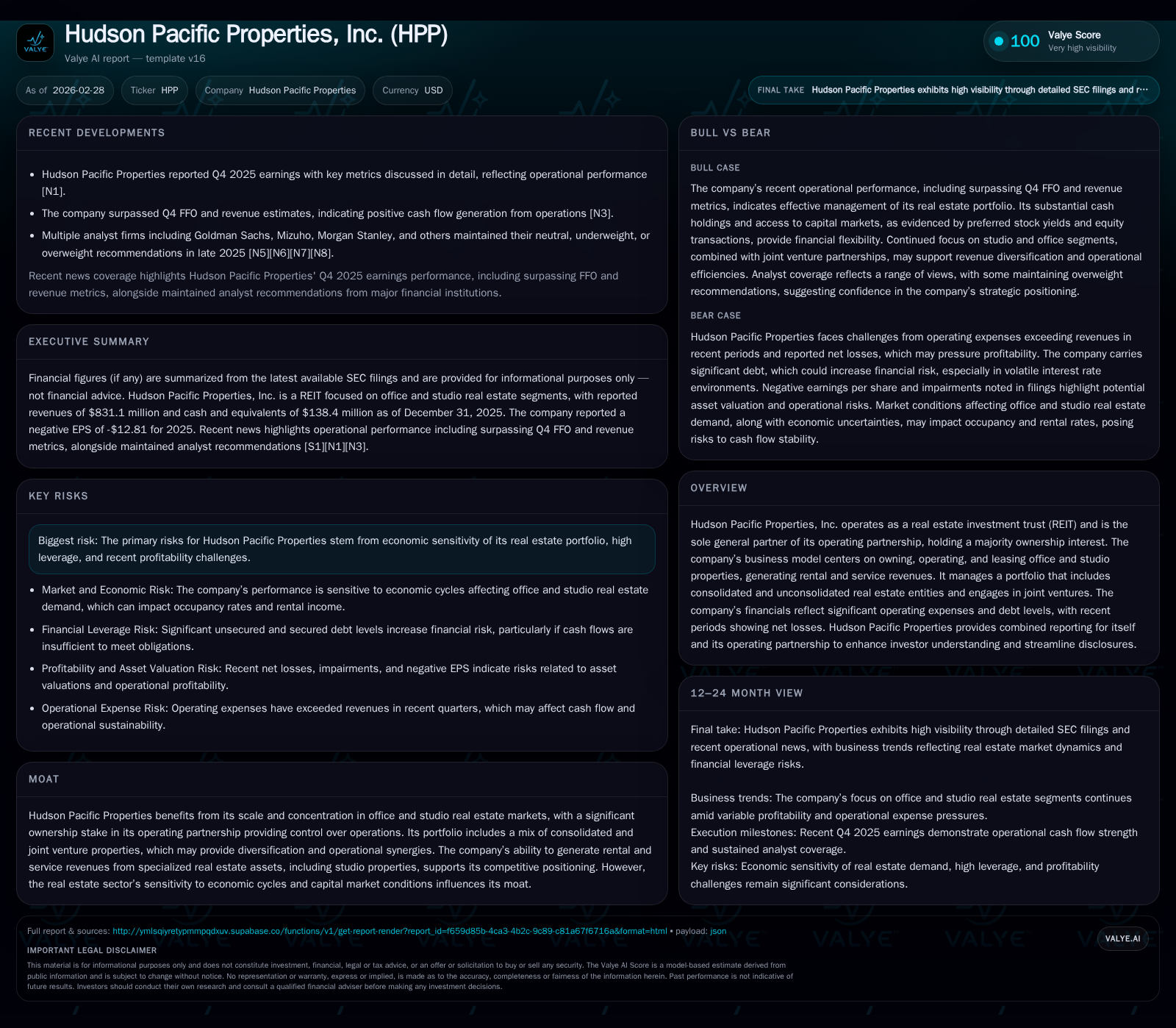
Hudson Pacific Properties, Inc. showed a slight decline in revenue for 2025 alongside reduced operating cash flows compared with prior years. While net income remains positive, the company’s leverage and recent profitability challenges underscore risks typical of office-focused real estate assets in current economic conditions. Dividend payments have drastically contracted, reflecting prudence given liquidity pressures. Future growth hinges on stabilizing lease revenues and managing substantial debt maturities due through the next few years.
Company Overview and Business Model
Hudson Pacific Properties, Inc. (HPP) operates primarily as a real estate investment trust specializing in office and studio properties with a concentration on West Coast urban markets known for technology and entertainment industries. The company holds majority interest as sole general partner in its operating partnership, which consolidates both wholly owned and joint venture assets providing diversified exposure within its niche of specialized commercial real estate. Revenues are generated mainly through property leases supplemented by ancillary services tied to studio operations [S1], [N2].
Structurally, HPP leverages combined reporting of itself and its operating partnership to streamline investor reporting while maintaining control over day-to-day asset management via the partnership framework. This setup supports operational flexibility but also embeds complexity into capital structure disclosures due to differing equity interests between the company entity and partnership units.
Historical Financial Performance
Hudson Pacific’s revenue trajectory over the past four years shows a gradual softening after peaking at just above $1 billion in 2022. The decline has continued through 2023 and into 2025 — with revenues recorded at $831 million at fiscal year-end 2025 — translating into an approximate -1.3% year-over-year contraction from $842 million in 2024 [F1]. This trend points toward ongoing headwinds in leasing activity or rate softness within their core asset classes.
Operating income disclosures are limited beyond 2017 data ($43.8 million), but net income figures highlight compressions from highs approaching $32 million in 2017 down to about $13.6 million by end-2019, with recent annual results indicating marginal profits amidst challenging operating environments [F1]. Notably, operating cash flow has experienced more acute declines — dropping over one-quarter from around $165 million in 2024 to about $121 million by end-2025 — reflecting tighter internal funding dynamics against rising costs or tenant concessions prevalent across office real estate sectors currently [F1].
Capital returns have been restrained; dividends paid plunged dramatically from $15.4 million in 2024 to just $0.35 million last reported period. Meanwhile, share buybacks halted entirely since mid-2023 levels ($1.37 million repurchased that year), signaling prioritization of liquidity preservation ahead of balancing growth investments or debt servicing demands [F1], [S18], [S28].
Annual Financial Summary
Historical performance (annual)
| FY | Rev ($mm) | CFO ($mm) | Rev YoY |
|---|---|---|---|
| 2025 | 831 | 121 | -1.3% |
| 2024 | 842 | 165 | -11.6% |
| 2023 | 952 | 232 | -7.2% |
| 2022 | 1026 | 370 |
Source: SEC companyfacts cache [F1].
Capital returns and efficiency (annual)
| FY | Div ($mm) | Buybacks ($mm) |
|---|---|---|
| 2025 | 0 | 0 |
| 2024 | 15 | 0 |
| 2023 | 55 | 1 |
| 2022 | 145 | 37 |
Source: SEC companyfacts cache [F1].
* Net income YoY and CFO YoY based on available trailing data points preceding or closest to latest full year.
Capital Structure and Leverage Profile
Hudson Pacific's total assets declined moderately over the course of fiscal year ending December 31, 2025, settling around $7.8 billion from $8.13 billion the year prior, indicative of asset sales or depreciation outpacing acquisitions during this period [S7]. Correspondingly, aggregate unsecured and secured debt decreased substantially to approximately $3.56 billion from prior levels near $4.18 billion as part of active deleveraging or refinancing initiatives aimed at mitigating exposure amid rising rates and market uncertainty [S7], [S8].
Despite this reduction in nominal debt balances, overall leverage remains high relative to peers given asset base shrinkage paired with constrained earnings capacity—a common challenge among large office REITs navigating post-pandemic workspace utilization shifts.
The company also maintains preferred equity instruments including Series C cumulative preferred stock with yields recently pushing past an attractive threshold exceeding multiple conventional fixed income offerings—reflecting risk premiums attached to HPP securities given sector volatility ([N5]). Additionally, the December 2025 reverse stock split effectively consolidated outstanding shares by combining every seven shares into one while adjusting par value proportionally without materially altering ownership percentages—a strategic move often designed to stabilize trading liquidity and market perception during periods of capital restructuring [S28].
Business Moat Considerations
HPP’s moat derives primarily from its scale within specialized office markets tightly coupled with West Coast media production studios—a niche requiring specific infrastructure such as sound stages that limits competition compared with generic office spaces alone . The joint venture arrangements diversify operational risk while enabling tap into distinct market segments tied to entertainment demand cycles.
However, macroeconomic sensitivity inherent to commercial real estate is amplified by high leverage levels; shifts such as increased remote work adoption or economic slowdowns dampen occupancy rates or rent renewals impacting cash flows directly.[S6]
Risks Highlighted by Recent Filings
Risks emanate chiefly from cyclical pressures on office tenancy demand compounded by sizeable near-term debt maturities requiring refinancing under potentially less favorable terms than historically enjoyed ([S6]). Profitability challenges noted via recent quarterly losses or compressed margins reinforce these concerns alongside potential rating implications for credit facilities.
Liquidity remains challenged despite some improvement measures: dividends pared significantly reflecting caution while share repurchases have ceased ([S18]). Continued monitoring of tenant retention trends especially within technology/media clients who constitute meaningful lease profiles remains critical.
Outlook and What to Watch Next
Official guidance remains sparse with no explicit forecasts disclosed publicly as of early 2026 reports ([N3]). However key milestones include lease renewal outcomes across flagship properties closing fiscal Q1/Q2 periods impacting revenue visibility deeply next cycle.
Interest expense management via hedging instruments disclosed across several filings offers partial buffer against rising rates but will remain a focal point alongside capital markets appetite for new issuance.[S9] Successful capital recycling via selective asset sales paired with disciplined acquisitions could pivot growth trajectories longer term.
Dividend policy stance may evolve if stable cash generation resumes which investors will watch closely given recent drop-offs.
Returns and Capital Allocation Summary
HPP's return on equity calculated roughly at a subdued level near or below one half percent most recently underscores constrained profitability amid current financial environment ([F1]). Operating cash flow contraction further restrains free cash available for discretionary returns.
The company has shifted focus away from buybacks entirely while slashing dividend payouts drastically—a typical approach employed by REITs facing refinancing imperatives prioritizing creditworthiness preservation ([F1], [S18]). Capital allocation hence pivots foremost toward deleveraging efforts rather than growth investments until more stable fundamentals emerge.
Disclaimer: This report is prepared for informational purposes only without any recommendation regarding investment decisions related to Hudson Pacific Properties, Inc. Readers should conduct further independent analysis before making any financial choices.
Disclaimer: This is research-only, informational analysis and not investment advice. It may include AI-generated interpretation and general industry context. Always verify important details using primary sources.

Comments