
Henry Schein’s Earnings Growth and Strategic Shifts in Healthcare Distribution
Modest revenue growth and restructuring define Henry Schein's evolving financial and operational profile in 2025.
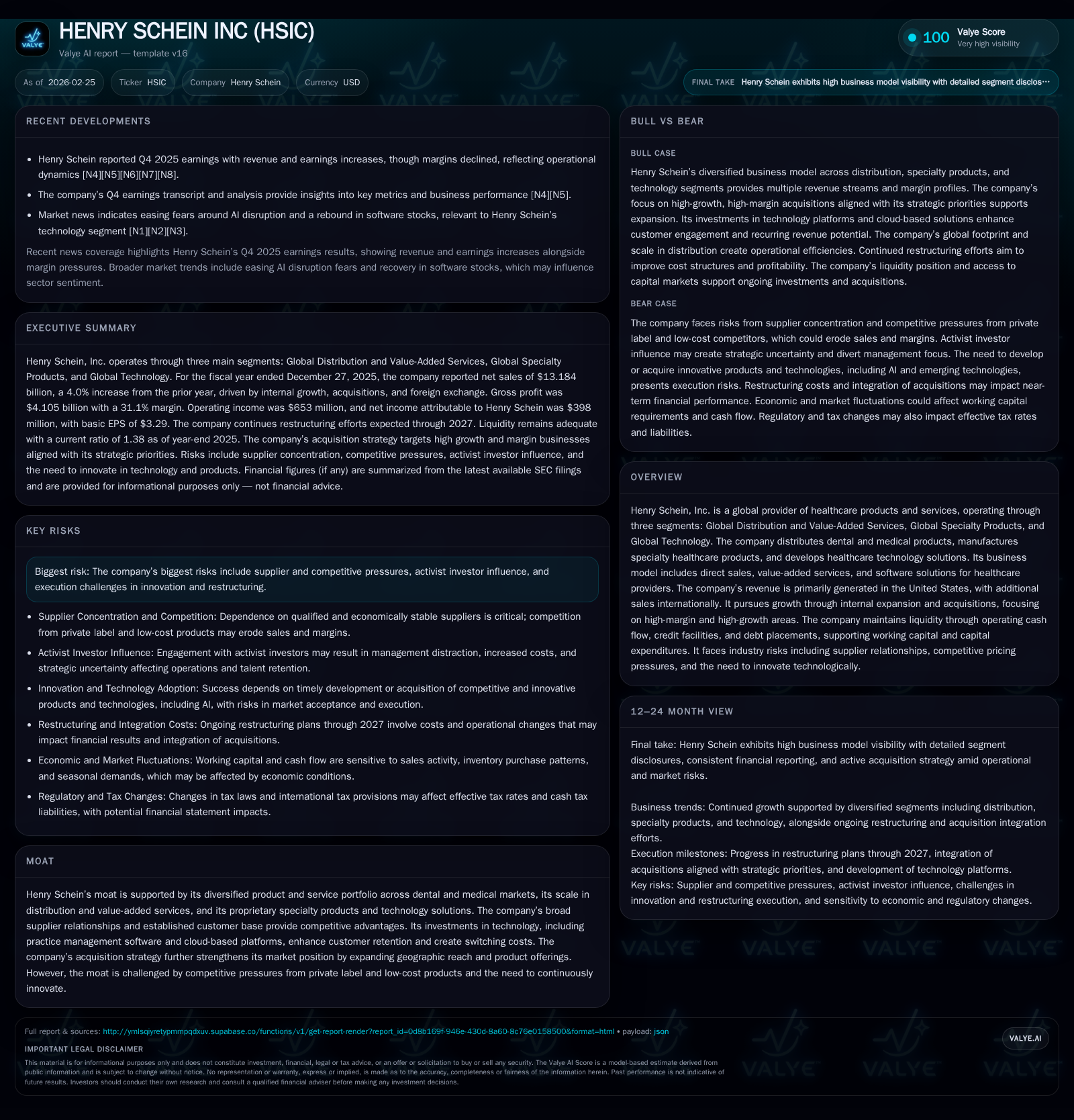
Henry Schein, Inc. posted a 4.0% increase in revenue to $13.2 billion for fiscal 2025, supported by its diverse segments spanning distribution, specialty products, and technology solutions. Operating income rose moderately by 5.2% despite margin pressures from promotional activity and product mix shifts, while ongoing restructuring under its 2024 Plan weighed on expense lines. Capital allocation favored aggressive share repurchases amid declining operating cash flow and stable capital expenditures. The company’s liquidity remains robust with extended debt maturities and steady credit facility access supporting strategic growth initiatives. Looking ahead, margin recovery efforts and integration of acquisitions under the BOLD+1 strategy are critical milestones for investors to monitor.
Historical Financial Trajectory: Revenue, Margins, and Operating Income Trends
In fiscal year (FY) 2025, Henry Schein’s revenue reached approximately $13.18 billion, marking a 4.0% advance over $12.67 billion recorded in FY2024 [F1]. This top-line improvement was supported primarily by volume gains in the Global Distribution and Value-Added Services segment alongside specialty product acquisitions contributing incremental sales. Operating income grew more moderately to $653 million (+5.2%) from $621 million in the prior year, reflecting ongoing operating leverage tempered by increased restructuring expenses under its strategic renewal [S1][F1]. Net income advanced only 2.1% to $398 million [F1], as tax benefits partially mitigated higher operating expenses.
Operating cash flow (CFO) reversed course versus the prior-year boost attributed partially to residual collections related to a prior cyber incident; CFO dropped 16% from $848 million in FY2024 to $712 million in FY2025 driven by working capital build-up including accounts receivable and inventory increases [F1][S11]. Capital expenditure was relatively stable at $139 million (down slightly by ~6%), demonstrating a controlled approach focused on sustaining core infrastructure [F1].
Historical performance (annual)
| FY | Net ($mm) | CFO ($mm) | OpInc ($mm) | Capex ($mm) | Net YoY |
|---|---|---|---|---|---|
| 2025 | 398 | 712 | 653 | 139 | +2.1% |
| 2024 | 390 | 848 | 621 | 148 | -6.3% |
| 2023 | 416 | 500 | 615 | 147 | -22.7% |
| 2022 | 538 | 602 | 747 | 96 |
Note: Omitted columns lack sufficient annual XBRL coverage in the provided tags (need ≥2 annual points): Rev, Div. Source: SEC companyfacts cache [F1].
Capital returns and efficiency (annual)
| FY | Buybacks ($mm) | FCF ($mm) | ROE% |
|---|---|---|---|
| 2025 | 850 | 573 | 12.3 |
| 2024 | 385 | 700 | 11.5 |
| 2023 | 250 | 353 | 11.4 |
| 2022 | 485 | 506 | 15.6 |
Source: SEC companyfacts cache [F1].
Note: Fiscal year data table omits metrics like dividends paid due to unavailability.
Segmented Growth Drivers: Distribution, Specialty Products, and Technology Contributions
Henry Schein operates through three reportable segments: Global Distribution and Value-Added Services (GDVS), Global Specialty Products (GSP), and Global Technology (GT). GDVS generated net sales of approximately $11.14 billion in FY2025 (+3.6%), driven by increased volume across both dental merchandise and equipment categories as well as expanded value-added services like financial services and continuing education offerings [S9][S15]. This segment carries relatively lower gross margins (circa mid-20%s) due primarily to the scale-driven high-volume sales with large group customers who negotiate lower pricing.
Conversely, GSP experienced nearly an identical percentage increase (+4.8%) bringing net sales near $1.54 billion with organic volume growth complemented by recent acquisitions focusing on higher-margin specialty healthcare products such as dental implants and orthopedics [S9][S15]. Margins here are historically higher (~55%) given proprietary manufacturing capabilities and specialized product offerings.
GT segment sales totaled approximately $675 million (+7%) benefiting from uptake in practice management software licenses and cloud-based e-services that command premium pricing driving gross margins near two-thirds [S9][S15]. The blend of software licensing revenues alongside recurring service fees promotes revenue visibility while creating stickiness through switching costs.
Differences in gross margin performance across these segments reflect variation in product mix—commodity-like consumables versus specialized proprietary devices—and customer concentration effects where large volume buyers impose tighter pricing within distribution while smaller office-based practitioners allow for higher margin realization.
Margin Compression Factors: Promotional Activity, Product Mix, and Competitive Pressures
Despite topline expansion across segments, total gross margin percentage slipped modestly from approximately 31.7% in FY2024 to around 31.1% in FY2025 mainly owing to targeted promotional programs implemented within GDVS aimed at volume growth acceleration at the expense of unit margins [S4]. This reflects typical tradeoffs between market share extension strategies against immediate profitability pressures especially in distribution-centric operations where competitive intensity is most acute.
Within GSP, mix shifts toward less price-insensitive new product categories exerted downward pressure on overall margin rates despite increased volumes [S4]. GT segment gross margins improved slightly due to favorable product mix with adoption trending towards high-value software offerings.
Competitive headwinds particularly from private label alternatives combined with industry-wide consolidation among manufacturers have intensified pricing pressures potentially limiting upside margin improvement absent innovation or differentiation [S6][S16]. Such dynamics underscore the importance of Henry Schein’s value-added service portfolio which provides some insulation against commoditization.
Strategic Reorganization: The 2024 Plan and Its Operational Impact Through 2027
Henry Schein initiated a comprehensive restructuring program labeled the "2024 Plan" starting mid-2024 aimed at integrating multiple recent acquisitions while streamlining cost structures via right-sizing initiatives encompassing workforce reductions, accelerated amortization of leased assets, and business unit disposals [S1]. Charges associated with this plan totaled about $105 million for fiscal year ended December 27, 2025 compared with $73 million recognized during FY2024.
These restructuring efforts are expected to continue through end-2027 with further cost savings anticipated but remain subject to uncertainties around exact timing and quantum [S1]. Disposal gains/losses tied to certain exited businesses notably within value-added services indicate tactical portfolio refinement increasing operational focus on core competencies.
Ongoing integration complexity may limit short term margin expansion even as medium-to-long term efficiencies bolster competitiveness enabling enhanced returns once fully executed.
Capital Deployment: Buybacks Surge Amid Moderated Cash Flow and Capex Patterns
A pronounced feature of fiscal year discussion involves Henry Schein’s capital allocation strategy which notably accentuated share repurchases ramping buyback payments up to approximately $850 million—more than doubling prior year levels—in spite of a simultaneous decline in operating cash flows [F1][S5]. This sharp upscaling signals management’s intent to optimize capital structure leveraging strong liquidity positions while returning surplus cash to shareholders.
Capital expenditures remained largely consistent at around $139 million reflecting measured spend focused on maintaining distribution infrastructure rather than aggressive expansion commitments [F1]. Return on equity approximates a healthy midpoint near ~12%, derived from net income relative to shareholders' equity standing at roughly $3.25 billion as of FY2025 end [F1].
Absence of disclosed dividends mandates caution interpreting total shareholder returns though buybacks appear primary mechanism for capital return currently.
Liquidity Profile and Debt Management: Credit Structures Supporting Expansion
Liquidity remains robust due largely to access afforded by revolving credit facilities extending through mid-decade coupled with refinanced term loan arrangements originally scheduled for maturity in mid-2026 now extended through June 2030 following amendments completed June 2025 [S7][S10]. Interest rates indexed off Term SOFR currently yield effective blended costs just above five percent benefiting from fixed-rate hedges covering ~90% notional balance reducing volatility risk.
Current ratio stands solidly at approximately 1.38 reflecting conservative working capital management despite build-up relating partly to seasonal inventory forward buy-in practices common across healthcare distribution sectors [F1][S10]. Total corporate debt aggregated just above $3 billion exhibiting manageable leverage metrics consistent with investment-grade expectations.
Continued financing flexibility supports acquisition-fueled growth ambitions underpinning execution of the BOLD+1 strategic roadmap toward enhancing vertical integration into technology-enabled health service platforms [S5].
Navigating Supply Chain Vulnerabilities in Healthcare Distribution
As expressed explicitly by management disclosures [S6][S1], Henry Schein faces meaningful supply chain risks stemming from reliance on numerous third-party suppliers without long-term contractual commitments for its broad assortment of distributed healthcare products including those manufactured internally under specialty brands.
Approximately one quarter of aggregate purchases stem from the top ten suppliers while single largest supplier contributes around four percent indicating some concentration risk yet diversified vendor base overall mitigates catastrophic interruption likelihood [S1]. Nonetheless regulatory compliance challenges impacting suppliers’ production capacity or geopolitical/economic disruptions could precipitate inventory shortages adversely impacting fill rates ahead of competition especially during periods of heightened demand or unexpected events.
Rapid identification and onboarding of alternative sources remains critical capability alongside inventory management practices buffering short-term shocks though no guarantees exist around timely replacement availability given specificity of certain healthcare consumables.
Outlook Considerations: What to Watch in Upcoming Earnings and Strategic Updates
While official guidance remains absent given current transitional dynamics under ongoing restructuring [N1][S1], key investors should monitor forthcoming quarterly earnings for progress indicators related to margin trajectory improvements driven by product mix optimization within specialty segments alongside reduction in restructuring charges over time.
Additionally, developments related to the strategic partnership agreement with private equity firm KKR—including potential equity stake increases enabled via standstill amendments—may influence governance priorities or provide additional growth capital for bolt-on acquisitions amplifying Henry Schein’s footprint particularly internationally [N14][S1].
Persistent competitive pressures underscore the necessity for continued investments into technology platforms such as practice management software which constitute important differentiators capable of delivering switching costs that safeguard revenue streams [N3][S15].
In summary, upcoming reporting periods likely will reflect maturation stage effects from operational realignments started under the BOLD+1 plan covering through end-2027 offering critical insight into sustainability of earnings growth momentum juxtaposed against evolving healthcare industry dynamics.
This analysis relies exclusively on publicly disclosed data from Henry Schein’s SEC filings (10-Ks, earnings releases), Nasdaq transcripts, and validated XBRL financial facts as of February 25, 2026; it does not constitute investment advice or recommendations but offers an informed perspective grounded in documented corporate disclosures.
Disclaimer: This is research-only, informational analysis and not investment advice. It may include AI-generated interpretation and general industry context. Always verify important details using primary sources.

Comments