
Infinity Natural Resources' Transition: IPO Impact and Appalachian Basin Operations
Infinity Natural Resources, Inc.'s public market entry and corporate restructuring underpin its financial growth and operational footprint in Appalachia's upstream oil and gas sector.
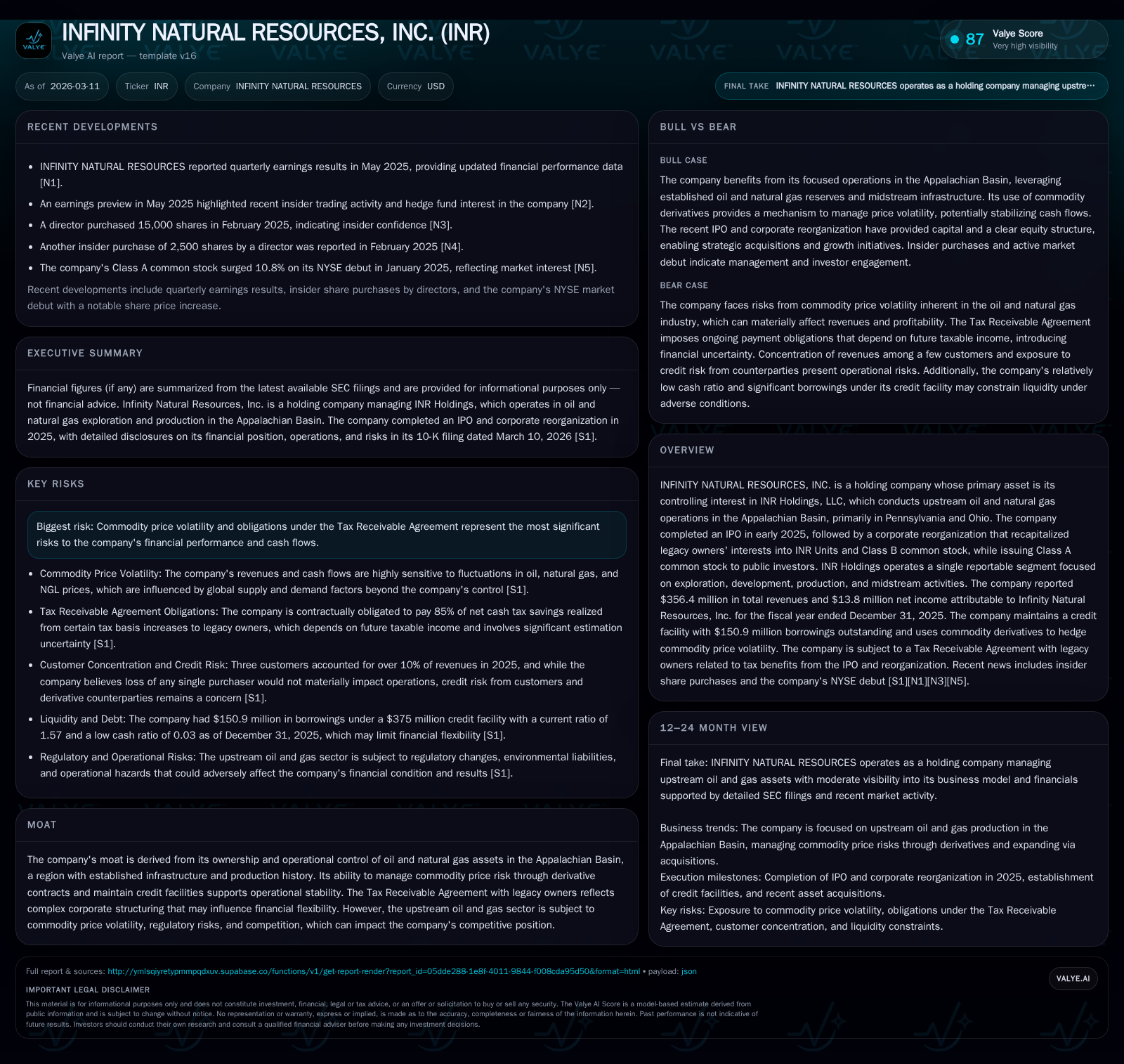
Infinity Natural Resources, Inc. completed its IPO in early 2025 followed by a corporate reorganization that reshaped ownership interests and consolidated its upstream operations in the Appalachian Basin. The company reported $356 million in revenue with net income of $13.8 million for fiscal year 2025, reflecting initial public market impacts on growth and capital structure. Operational control of regionally integrated oil and natural gas assets combined with derivative risk management supports the company's competitive moat, while its tax receivable agreement adds complex liabilities affecting financial flexibility. Looking forward, commodity price volatility, debt covenant compliance, and strategic execution of share repurchases remain critical considerations for the firm’s trajectory in a cyclical industry.
From Private Legacy to Public Markets: Growth and Revenue Trends
Infinity Natural Resources transitioned from a privately held upstream operator to a publicly traded entity early in 2025 through an initial public offering (IPO), triggering a comprehensive corporate restructuring that converted legacy ownership interests into INR Units paired with Class B common stock, while allocating Class A common stock to public investors. For the fiscal year ended December 31, 2025, Infinity reported total revenues of $356.4 million with operating income of approximately $11.9 million and net income attributable to the company of roughly $13.8 million [F1][S1].
This revenue surge reflects both organic operational expansion within its Appalachian Basin footprint as well as favorable commodity price environments during the period relative to prior years. Historical revenue figures demonstrate growth from approximately $161.7 million in 2023 to $259.0 million in 2024 before hitting $356.4 million in 2025, signifying compounded top-line momentum catalyzed by IPO-related capital inflows supporting accelerated drilling programs [F1]. Concurrently, net income improved substantially from previous losses or minimal profits leading up to IPO.
The company’s shareholder equity base expanded commensurately post-recapitalization, facilitating an approximate return on equity (ROE) near 4.5% for 2025 — indicative of moderate profitability given capital-intensive upstream operations [F1]. This ROE calculation considers net income relative to equity recorded after the corporate reorganization which consolidated legacy owners’ interests and public equity investments.
Historical performance (annual)
| FY |
|---|
| 2025 |
Source: SEC companyfacts cache [F1].
Table shows annual results highlighting substantial revenue growth through the IPO year [F1]. Some metrics omitted where historical data unavailable.
Appalachian Basin Operations and Asset Control: The Company’s Operational Moat
Infinity Natural Resources commands operational control over upstream oil and gas assets concentrated exclusively within the Appalachian Basin geographically situated primarily in Pennsylvania and Ohio [S18]. This regional focus provides strategic advantages rooted in well-established infrastructure corridors facilitating cost-efficient drilling activity and midstream integration which supports logistics optimization.
The company's ownership includes not only producing acreage weighted towards proved reserves but also midstream assets such as gathering pipelines and compression facilities enabling end-to-end operational oversight across exploration to sales points [S1]. Such vertical integration contributes to what can be termed a competitive moat by reducing reliance on third-party service providers whilst affording more predictable cost structures amid fluctuating commodity markets.
Critically, this asset base secures a borrowing base supporting a sizable credit facility offering reserves-based lending capacity ($375 million as of December 31, 2025) that underwrites liquidity [S4]. Reserve engineering reports validating estimated economically recoverable volumes are foundational to these commitments ensuring capital availability aligned with operational plans.
Sector jargon like “midstream optimization” encapsulates efforts to maximize throughput efficiency mitigating basis differentials between regional supply hubs and pricing benchmarks—a key margin driver within Appalachian-centered upstream operations.
Financial Structure and Capital Allocation in the Wake of IPO Reorganization
The IPO precipitated a layered equity taxonomy comprising Class A common stock available to public investors endowed with economic rights including voting abilities and dividend participation; Class B common stock paired with INR Units owned largely by legacy owners primarily holding economic interests without public-market trading exposure [S9].
Legacy owners retain substantial influence via holding about 74.4% interest in INR Holdings LLC contrasted with approximately 25.6% held indirectly by Infinity itself post-restructuring [S17]. This dynamic necessitates balancing legacy owner contractual rights and public shareholder interests.
A conspicuous feature is the Tax Receivable Agreement (TRA), obligating Infinity Natural Resources to remit approximately 85% of tangible federal, state, and local tax savings generated from basis step-ups attributed to exchanging legacy units for public shares or cash equivalents [S1][S12]. This agreement produces contingent liabilities appearing on balance sheets under ASC Topic 450 due to uncertainties about timing/magnitude of taxable income realization driving payables estimation.
Although generating upfront tax benefits increasing net operating cash flows initially, the TRA represents an ongoing future cash outflow potential which can constrain financial flexibility especially when coupled with debt servicing demands or commodity downturns [S28]. It is crucial for analysts understanding this structure to factor this complexity into forecasting cash flow availability given its potential impact on leverage ratios or dividend capacity.
Managing Commodity Price Risk: Derivatives and Counterparty Exposures
Commodity price fluctuations constitute primary earnings volatility drivers given Infinity’s exposure to crude oil, natural gas, and natural gas liquids (NGL) production sales [S1][S6]. To partially mitigate raw price risk variability affecting operating cash flows, Infinity maintains an active hedging program employing derivative instruments such as fixed price swaps, collars, and basis swaps.
These derivatives provide contractual assurances locking minimum price floors or establishing defined price bands securing stable revenues under unpredictable market conditions—a critical tool termed “hedge book” management within energy finance circles [S6]. Derivative fair values roll through earnings immediately as these instruments are not designated under hedge accounting rules resulting in periodic realized/unrealized gains or losses reported alongside core revenues.
Counterparty exposure risks are controlled by limiting concentration through multiple counterparties restricted exclusively to investment-grade rated entities participating also in the credit facility syndicate—an approach frequently applied in reserves-based lending frameworks minimizing counterparty default risks ultimately supporting more predictable liquidity [S13].
The mark-to-market process ensures that derivative instruments’ values reflect current market conditions incorporating risks such as creditworthiness adjustments enhancing transparency though potentially increasing income statement volatility outside physical production results.
Tax Receivable Agreement: Complexity, Implications, and Risk Factors
The TRA is inherently complex due to contingent liability nature tied directly to future taxable income realization from amplified tax bases generated after restructuring transactions linked to legacy owner unit exchanges [S1]. Accounting treatment per ASC Topic 450 mandates periodic reassessment involving significant judgment on projected taxable profits reflecting inherent uncertainties over variables such as commodity price cycles or regulatory tax changes impacting estimates materially.
From a valuation standpoint, this liability reduces potential distributable cash flow thereby depresses valuation multiples compared to companies without such arrangements although upfront tax shield benefits initially improve reported effective tax rates.
Stakeholders must monitor developments influencing taxable income outlooks closely since unexpected shortfalls may increase TRA waterfall payments sooner or necessitate higher accrual provisions leading to earnings pressure.
Liquidity Position, Credit Facility Updates, and Debt Profile
At year-end December 31, 2025 Infinity maintained borrowings of approximately $150.9 million drawn against a credit facility secured by first-priority liens on essentially all consolidated assets backed by reserves valued at an increased borrowing base ceiling of $375 million pre-February amendment increments [S4][F1].
Interest rates averaged around 7.2% for calendar year 2025 versus prior periods at higher rates (~8.3%) reflecting improving credit conditions or negotiated amendments easing borrowing costs [S6]. The debt comprises SOFR-indexed variable-rate loans plus applicable spreads without currently deployed interest rate hedging strategies exposing some sensitivity to rising benchmark rates; however incremental cost impact remains modest given borrower discipline around leverage targets.
Borrowing base redeterminations occur semi-annually guided strictly by reserve engineering submissions sustaining flexible liquidity management concomitant with capex programs emphasizing reserve replacement economics highlighted by adherence to covenant ratios including leverage capped near three times debt-to-EBITDA ensuring prudent financial stewardship [S10][S29].
Amortization of debt issuance costs approximated $2.3 million for the period incorporated within interest expense figures emphasizing ongoing funding cost burdens factored into free cash flow analysis.
Performance Metrics: Returns on Equity, Cash Flow Generation, and Capital Expenditure
With net income close to $13.8 million delivering approximately a 4.5% ROE post-IPO reflective of initial stabilization stages amid capital intensive spending patterns inherent in upstream exploration/development activities [F1], Infinity balances reinvestment priorities carefully against return yield expectations.
Reported free cash flow — defined here as cash flow from operations minus capital expenditures — proxies near $258.6 million indicating robust operational cash conversion power enabling internal funding sources for expansion projects absent reliance on equity dilution or incremental debt issuances currently [F1].
Capital expenditures captured primarily investments into property acquisition drill rigs completion projects reflecting sustained growth ambitions anchored on Appalachian Basin prospectivity supported by expanding midstream infrastructure footprint maintaining operational control needed for execution efficiency.
On capital returns policy front, no dividends were declared during FY25 consistent with conservation ethos present in many E&P operators ramping production risking variable commodity markets concurrent with board authorization of share repurchase program noted but unexecuted thus far leaving open substantial discretion regarding timing magnitude amid balance sheet considerations [S9][S23].
Looking Ahead: Corporate Strategy, Market Constraints, and Key Milestones to Watch
Absent explicit forward-looking guidance from management beyond standard disclosures around strategy areas such as organic acreage development leveraging midstream integration advantages or measured capital deployment [N/A][S2], emphasis falls naturally on key scenario factors including commodity pricing environment trajectories heavily influencing revenue/cash flow generation potentials especially during volatile cycles typical within Appalachia shale plays.
Debt covenant monitoring following recent refinancing amendments raises focus on leverage ratio trends supporting adherence critical for minimizing default risk while preserving financial agility handling anticipated acquisition opportunities or downturn stress events as illustrated by the recent expansions outlined post-period end transactions albeit not yet reflected in financial statements dated December 31st .
The effective continuation or modification of share repurchase programs will broadcast management confidence levels while TAX policy evolution at federal/state entities must be tracked closely given material impacts posed via ongoing TRA obligations affecting distributable earnings credibility making it an essential watch point for analysts assessing sustainable free cash distributions vs reinvestment trade-offs.
Hedging program efficacy amidst shifting forward curves along with continuous docking operational improvements unlocking incremental recoveries position Infinity strategically but also tether it tightly within capital markets’ risk appetites calibrated for energy sector cyclicality. Altogether these elements form a composite picture depicting both upside optionality balanced against structural challenges common across pure-play independent operators managing portfolio transformations post-IPO.
This report synthesizes publicly filed SEC data through fiscal year-end 2025 without speculative forecasts or investment recommendations; readers should consider emerging disclosures beyond this timeframe for updated context.
Disclaimer: This is research-only, informational analysis and not investment advice. It may include AI-generated interpretation and general industry context. Always verify important details using primary sources.

Comments