
Heritage Commerce Corp: Navigating Regional Banking Growth Through Strategic Merger and Credit Discipline
Heritage Commerce Corp reported robust Q4 2025 earnings ahead of estimates and announced a strategic merger with CVB Financial Corp to enhance regional scale and growth potential.
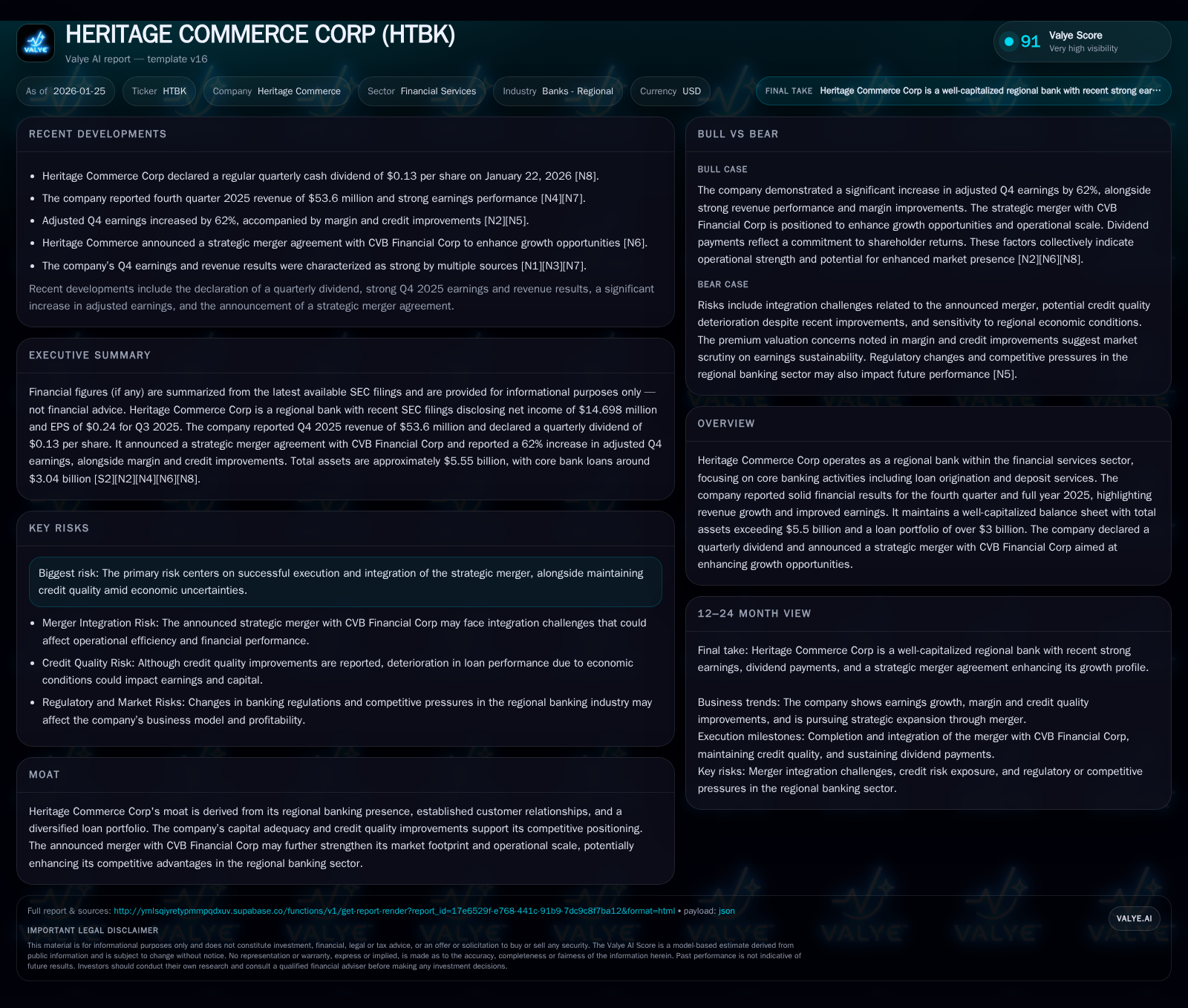
Heritage Commerce Corp, a regional bank with over $5.5 billion in assets and a $3 billion loan portfolio, demonstrated strong financial performance in Q4 2025, including a 62% increase in adjusted earnings and revenue surpassing expectations. The firm declared a quarterly dividend and unveiled plans to merge with CVB Financial Corp to expand its market footprint and operational scale. While credit quality and capital adequacy remain strengths, successful integration of the merger and maintaining credit discipline amid economic uncertainties will be critical going forward.
What Changed Recently
In late January 2026, Heritage Commerce Corp reported Q4 and full-year 2025 financial results that surpassed analyst expectations. Adjusted earnings increased by 62% year-over-year, with revenue coming in at $53.6 million, beating FactSet estimates of $50.8 million [N1, N3]. The company highlighted margin improvements and credit quality gains as key drivers behind the strong earnings performance [N4]. Concurrently, Heritage Commerce declared a regular quarterly cash dividend of $0.13 per share, underscoring its stable capital position and cash flow generation [N7, N10].
Crucially, the company announced a strategic merger agreement with CVB Financial Corp, a move intended to enhance growth opportunities by expanding the combined entity’s regional banking footprint and operational scale [N1, N9]. This deal is positioned as a strategic step toward building a more competitive platform in the fragmented regional banking sector.
Amid the announcement, an investor alert was issued by a law firm investigating the adequacy of the merger’s price and process, pointing to possible shareholder concerns regarding valuation and deal execution [N11]. This adds a layer of scrutiny to the transaction's successful completion.
Business Model as a System
Heritage Commerce operates as a regional bank focused on traditional banking products centered on loan origination and deposit services. Its balance sheet features total assets exceeding $5.5 billion, with a loan portfolio of roughly $3 billion primarily composed of core bank loans [S2, S3]. The company generates revenue mainly through net interest income, derived from the spread between interest earned on loans and interest paid on deposits and borrowings.
Noninterest income, including fees and service charges, contributes a smaller but meaningful portion of total revenue, helping diversify income streams beyond interest margin [S4].
Operating expenses are dominated by salaries and employee benefits, amounting to approximately $14.8 million in the most recent reported quarter, illustrating the labor-intensive nature of community banking [S6]. The bank’s cost structure also includes technology investments, insurance, and occupancy costs, typical for institutions balancing branch networks with digital capabilities.
Liquidity management is prudent, with a loan-to-deposit ratio near 75%, reflecting a conservative stance that prioritizes stable deposit funding over wholesale borrowings [S18]. The bank maintains access to collateralized borrowing lines with the Federal Home Loan Bank and Federal Reserve Banks, providing additional liquidity buffers.
Capital adequacy is maintained above regulatory minimums, supporting credit quality and enabling organic growth opportunities. The company’s risk management framework includes stress testing for liquidity and credit risk under various economic scenarios, which is standard in regional banking [S18].
Industry Map & Competitive Battlefield
Regional banking in the U.S. is characterized by fragmented competitors ranging from large national banks to smaller community banks. Heritage Commerce competes primarily on relationship banking, local market knowledge, and product breadth within its operational geography.
The competitive landscape includes peers such as CVB Financial Corp, the merger partner, which similarly targets regional markets with an emphasis on commercial lending and deposit gathering. Other competitors include regional players focusing on specialized lending niches like commercial real estate or equipment financing, as well as the increasing threat of fintech entrants and digital banks.
Consolidation remains a prominent trend in this industry, driven by the need for scale efficiencies, technology investments, and regulatory compliance costs. The announced merger with CVB Financial is consistent with this trend, aiming to combine complementary portfolios and reduce overlapping costs [N9].
Technology adoption is a critical battleground; regional banks face pressure to upgrade digital platforms for customer acquisition, loan processing, and risk management without disproportionately increasing costs. Heritage Commerce’s reported software subscriptions and operational expenses suggest ongoing investments in this area [S9, S16].
Overall, the competitive battlefield is defined by balancing personalized customer service with operational scale, leveraging capital to originate quality loans, and managing credit risk carefully in a macroeconomic environment that remains uncertain.
Where The Economics Become Real
At its core, Heritage Commerce’s unit economics pivot on net interest margin (NIM), loan portfolio performance, and operating leverage.
The company’s loan portfolio of approximately $3 billion generates most revenue, with interest income reflecting prevailing rates and credit spreads [S3]. Maintaining a conservative loan-to-deposit ratio near 75% helps control funding costs and liquidity risk [S18]. Interest expense on deposits and borrowings totaled around $36.7 million recently, indicating the cost side of the spread equation [S11].
Noninterest income, though smaller, provides incremental revenue that can enhance overall profitability without proportional increase in variable costs [S4].
Operating expenses, notably labor costs near $14.8 million per quarter, reflect the bank’s fixed-cost base, which can benefit from scale economies through merger-related synergies [S6]. Capital expenditures and technology subscriptions, while not disclosed in detail, are necessary to remain competitive and compliant [S9, S16].
Credit quality improvements, as noted in recent results, reduce provisions for loan losses and directly bolster net income. These improvements allow for more aggressive loan growth or margin expansion without compromising risk [N4, S18].
Dividends at $0.13 per share illustrate stable distributable earnings, an important metric for investor returns and signal of underlying cash flow health [N7].
Potential bottlenecks include integration costs and complexities from the merger, which could temporarily dampen operating leverage, and credit risk exposure if economic conditions deteriorate.
Diligence Questions / Disconfirming Signals
- What specific operational and cost synergies are expected from the CVB Financial merger, and what is the anticipated timeline for their realization?
- How will the integration manage overlapping branch footprints, systems, and personnel without disrupting service or increasing costs?
- What are the detailed credit quality metrics across loan segments, including nonperforming loans, charge-offs, and reserves, post recent improvements?
- How dependent is the company on interest rate spreads versus fee income to sustain earnings in a potentially shifting rate environment?
- What is the concentration risk within the loan portfolio, particularly in commercial real estate or construction loans?
- How robust is the company’s technology platform to support digital banking growth, and what are the planned capital expenditures in this area?
- What regulatory hurdles or timing uncertainties exist regarding merger approval?
- To what extent does the investor alert around the merger suggest shareholder dissatisfaction or potential legal challenges?
- Are there any material off-balance-sheet risks or contingent liabilities that could affect capitalization or liquidity?
- How does Heritage Commerce’s performance and valuation compare to regional peers pre- and post-merger announcement?
This analysis synthesizes publicly available financial disclosures and recent news to provide a grounded understanding of Heritage Commerce Corp’s current operating environment, strategic trajectory, and financial dynamics. It is intended for informational purposes and does not constitute investment advice.
Disclaimer: This is research-only, informational analysis and not investment advice. It may include AI-generated interpretation and general industry context. Always verify important details using primary sources.

Comments