
Havertys Furniture Confronts Tariff Pressures and Market Dynamics with Stable Operations and Select Expansion
Havertys leverages its curated product assortment and integrated customer experience while navigating cost headwinds from tariffs and a soft housing market.
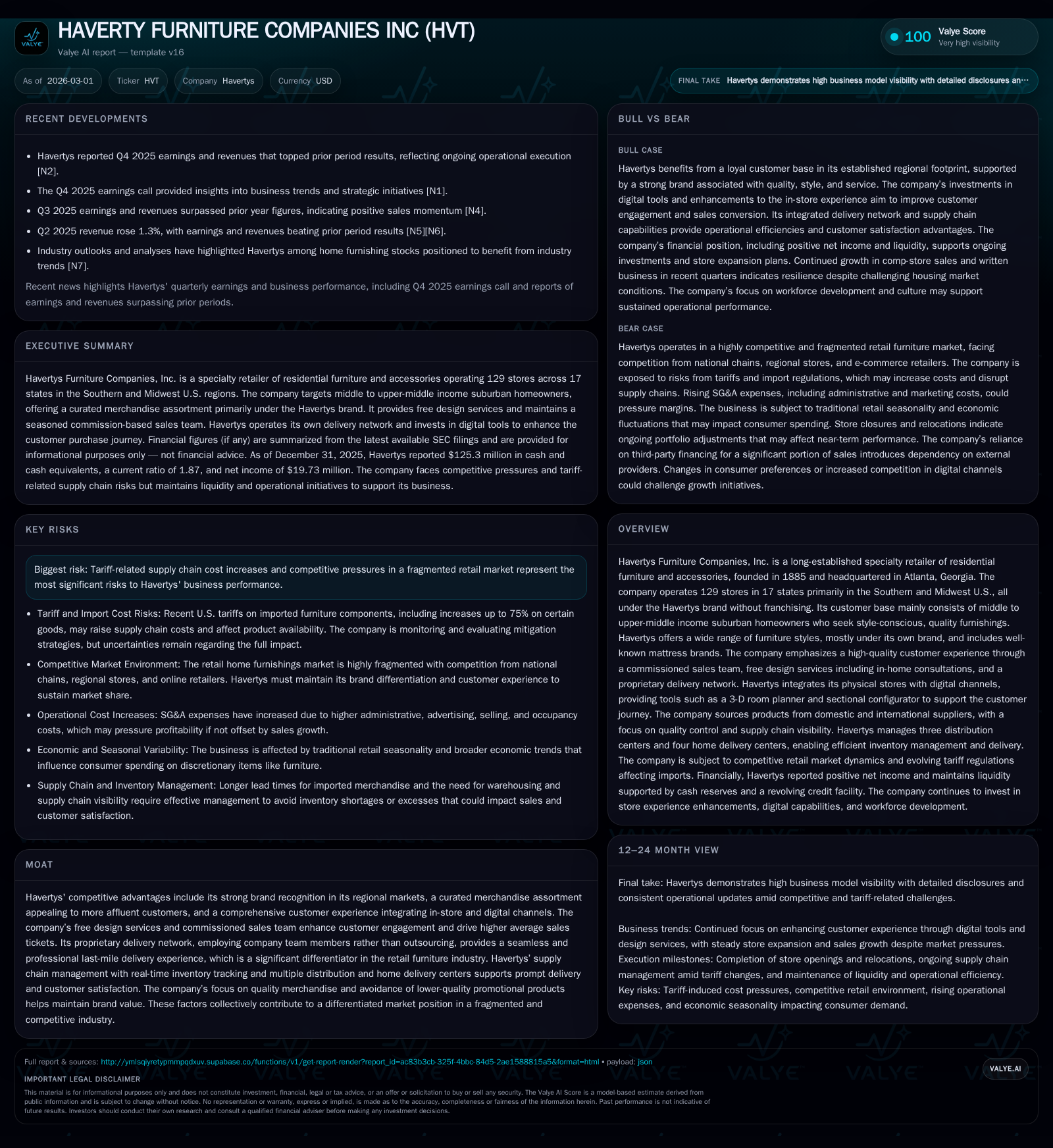
Havertys Furniture Companies, Inc., a specialty retailer with a long history and strong regional brand, reported modest declines in revenue and net income in 2025 as tariff-induced supply chain costs and competitive pressures weighed on results. The company maintains a differentiated market position through a comprehensive omnichannel experience, commissioned sales team, proprietary delivery network, and tailored product offerings targeting middle to upper-middle income suburban homeowners. Despite macroeconomic challenges, Havertys is selectively expanding its store footprint within its core southern and midwestern markets. Capital allocation demonstrates disciplined cash flow management, dividends, and modest share repurchases.
Company Overview and Market Position
Founded in 1885 in Atlanta, Georgia, Havertys Furniture Companies Inc. has evolved into a leading specialty retailer of residential furniture with a strong heritage spanning over 140 years [S1]. Operating exclusively under its corporate brand — without franchising — the company runs 129 stores primarily concentrated across the Southern and Midwest United States markets [S1][S9]. This geographic focus aligns well with the demographic profile of its core customers: middle to upper-middle income suburban homeowners who prioritize stylish, quality furnishings rather than promotional driven discounts.
Havertys’ product mix features a wide range of styles from traditional to contemporary, mostly branded under its own label but supplemented by nationally recognized mattress brands like Tempur-Pedic and Serta [S7][S15]. The emphasis on curated merchandise appealing to discerning consumers supports premium pricing strategies that favor margin preservation over aggressive discounting often deployed by competitors.
Historical Financial Performance
Examining Havertys’ recent financial track record reveals moderate top-line contractions paired with relatively stable profitability metrics:
Historical performance (annual)
| FY | Net ($mm) | CFO ($mm) | Capex ($mm) | Net YoY |
|---|---|---|---|---|
| 2025 | 20 | 53 | 20 | -1.1% |
| 2024 | 20 | 59 | 32 | -64.6% |
| 2023 | 56 | 97 | 53 | +137.3% |
| 2022 | 24 | 51 | 28 |
Source: SEC companyfacts cache [F1].
Capital returns and efficiency (annual)
| FY | Div ($mm) | Buybacks ($mm) | FCF ($mm) |
|---|---|---|---|
| 2025 | 21 | 5 | 33 |
| 2024 | 20 | 5 | 27 |
| 2023 | 35 | 7 | 44 |
| 2022 | 34 | 30 | 23 |
Source: SEC companyfacts cache [F1].
(Figures rounded; source [F1])
Revenue showed slight declines recently due partly to macroeconomic pressures affecting discretionary spending. Net income experienced volatility with a notable peak in FY2023 followed by normalization.
Operating cash flow remains solid despite a recent decline linked to inventory build-up, while capital expenditures have been scaled back substantially after prior expansion phases.
Operational Drivers Behind Growth
Havertys’ growth is supported by several key operational strengths:
- A commissioned sales force with deep product expertise enhances customer engagement during purchase decisions [S1].
- Complimentary design services including in-home consultations contributed to approximately one-third of written sales in 2025, with these customers typically generating double the average ticket size compared to non-design-assisted buyers [S17].
- The company employs its own delivery personnel for last-mile fulfillment, ensuring high service quality and faster delivery times averaging three to five days for stocked products—a notable advantage over competitors relying on third-party carriers [S9].
- Supply chain management utilizes multiple distribution centers equipped with real-time inventory tracking technology facilitating efficient stock control amid tariff-driven supply disruptions [S9].
Industry Environment and Risk Factors
The furniture retail sector remains fragmented with competition from local independent stores, national chains, mass merchandisers offering limited furniture assortments, and online-only retailers [S15]. Havertys distinguishes itself by avoiding promotional price wars that could dilute brand value.
Significant tariff increases on imported wood-based furniture components enacted in mid-2025 have raised costs substantially—up to as much as a 75% tariff on certain Chinese imports effective January 2026—prompting adjustments in sourcing strategies and cost management efforts [S2][S8][S20]. Management continues close monitoring of these risks including potential legal outcomes affecting tariff policies.
Store Network Developments
As of end-2025, Havertys operated 129 stores across over 90 cities in seventeen states primarily within the Southern and Midwest regions of the U.S., maintaining a strategy focused on leasing former big-box retail sites sized between approximately 25,000–35,000 square feet [S17][S24].
Recent store activity includes:
- Openings: Houston (Q1 & Q4-25), St. Louis (Q1-26), Nashville (Q2-26), with planned openings later in Houston and Pittsburgh through late 2026.
- Closures/Relocations: Atlanta and Waco stores closed mid-2025; relocation of Daytona Beach store completed.
Store designs emphasize inviting curb appeal matched with consistent merchandising standards aligned across physical showrooms and digital platforms featuring tools like sectional configurators enabling custom furniture visualization online or in-store [S16][N1].
Digital Channel Integration
While physical stores drive the bulk of revenue (~97%), Havertys views its website as an extension of the brick-and-mortar experience offering design tools including a free design center with three-dimensional room planning capabilities enhancing customer decision-making [S16]. Online furniture sales are geographically limited within the company’s delivery network ensuring reliable fulfillment.
Mobile optimization investments reflect that most digital traffic comes from smartphones requiring intuitive navigation alongside rich content including customer reviews that boost conversion rates amidst growing e-commerce competition.
Profitability and Margin Trends
Gross profit margins have remained robust around low-60% levels supported by disciplined product selection favoring quality goods at favorable price points enhanced by free design services which increase average transaction values [S11][S14][S25].
Selling, general & administrative expenses rose modestly as a percentage of sales due chiefly to increased occupancy costs related to new store openings alongside higher administrative expenses driven by compensation adjustments including incentives and stock awards reflecting workforce retention efforts amid tight labor markets [S11][S25].
Variable selling expenses fluctuate with sales commissions while fixed/discretionary expenses such as advertising have been managed carefully balancing customer acquisition needs against cost controls.
Liquidity Position and Capital Structure
At December 31, 2025, Havertys held approximately $125 million in cash and equivalents supporting strong liquidity with a current ratio near 1.87 indicating ample short-term asset coverage relative to liabilities [F1].
The company maintains an $80 million revolving credit facility maturing October 2027 providing additional liquidity optionality beyond internally generated cash flows which remain solid despite working capital headwinds largely from inventory build-up tied partially to tariff mitigation efforts [F1][S4][S12].
Capital Allocation: Dividends and Share Repurchases
Havertys continued steady dividend payments totaling about $20.8 million during fiscal year ending December 31, 2025 reflecting ongoing commitment to shareholder returns despite margin pressures from tariffs [F1][S12].
Share repurchases were more modest at approximately $4.8 million representing cautious capital deployment amid uncertain external conditions while preserving financial flexibility.
Outlook Considerations
While explicit forward guidance is limited publicly, growth prospects appear anchored on:
- Continued selective store expansions within core regional markets leveraging demographic insights.
- Enhancements of digital tools supporting omnichannel customer journeys improving conversion rates.
- Strategic sourcing adjustments mitigating tariff impacts preserving gross margin integrity.
- Completion of ongoing improvements to the in-store shopping experience expected over next two years enhancing customer engagement further.
- Macroeconomic risks remain notably from housing market softness potentially impacting discretionary spending though Havertys’ focus on higher-income homeowners may mitigate downside relative to broader retail peers.
Key metrics for continued monitoring include comparable-store sales trends inclusive of online orders within delivery areas; margin fluctuations influenced by input cost changes; SG&A expense discipline particularly advertising effectiveness; inventory turnover balancing availability versus carrying costs; and uptake of free design consultations driving ticket size expansion [N1][N2][N4].
This analysis is based solely on public disclosures without investment advice.
Disclaimer: This is research-only, informational analysis and not investment advice. It may include AI-generated interpretation and general industry context. Always verify important details using primary sources.

Comments