
Hyperion DeFi Expands On-Chain Yield Strategies While Managing Volatility and Liquidity Risks
The latest quarter highlights Hyperion DeFi’s strategic pivot toward liquid staking, option vaults, and equity capital raises to underpin growth amid digital asset price volatility.
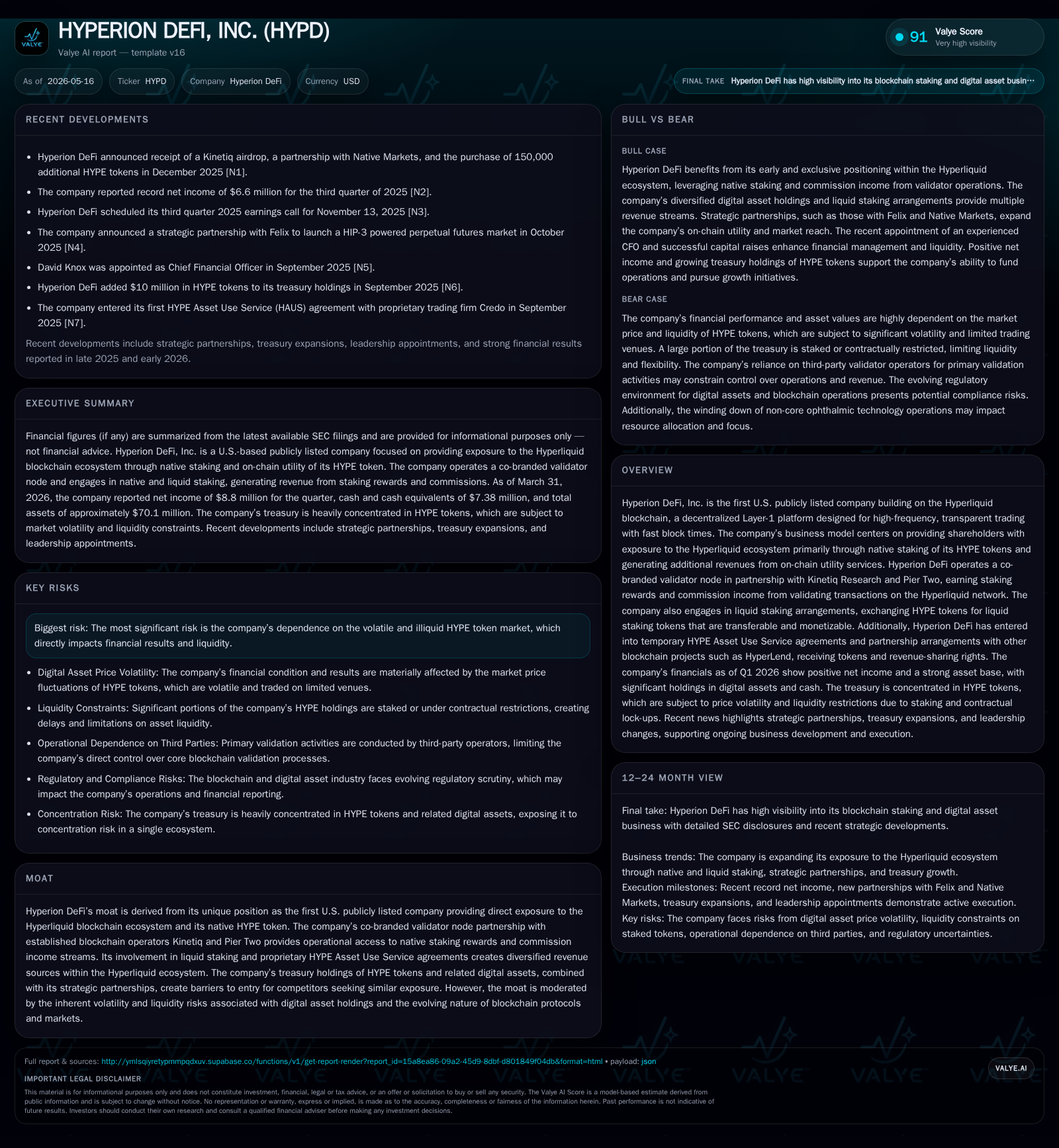
Hyperion DeFi, the first U.S. publicly listed company directly exposing investors to the Hyperliquid blockchain ecosystem via its native HYPE token, reported a net income turnaround in Q1 2026 driven by gains on digital assets and derivatives despite ongoing operating cash burn. Its core business model blends native staking rewards from its validator partnership with Kinetiq Research and Pier Two plus liquid staking and proprietary asset use services, creating diversified on-chain revenue streams. The company recently closed a significant at-the-market equity raise supporting liquidity for continued deployment into yield strategies. However, its financial results remain tightly coupled to the volatile and relatively illiquid HYPE token market, compounded by contractual transfer restrictions on staked tokens. Monitoring HYPE token market dynamics, staking reward sustainability, and option vault performance will be critical near-term demand indicators.
Recent Operating Update
In its latest Q1 2026 Form 10-Q filed May 15, 2026 [S2], Hyperion DeFi reported a notable financial inflection with net income of approximately $8.8 million versus a net loss of $3.5 million in the comparable Q1 2025 period [S3]. This swing was predominantly attributable to unrealized gains on its holdings of HYPE digital assets ($10.97 million) alongside realized gains from derivative instruments such as OTC options written against the HYPE token [S14], part of an expanded yield strategy launched in late 2025.
Operationally, Hyperion continues building on its unique position as the first U.S.-listed entity providing direct exposure to Hyperliquid’s decentralized Layer-1 blockchain designed for ultra-fast (70 ms block time), transparent perpetual futures and spot order book trading [S2]. The company runs a co-branded validator node named "Kinetiq x Hyperion," via partnerships with Kinetiq Research (institutional blockchain scientists) and Pier Two (staking infrastructure provider). This arrangement entitles Hyperion to 50% of staking commissions while Kinetiq and Pier Two share the remainder equally [S1].
Since July 2025, capital raised has been deployed into multiple revenue-generating activities centered around the native HYPE token: native staking on the validator node; liquid staking producing transferable liquid staking tokens (LSTs); proprietary HYPE Asset Use Service agreements (HAUS) granting temporary usage rights; plus launching an Institutional Volatility Income Vault (IVIV) offering OTC put options collateralized by stablecoins convertible back into on-chain assets [S2][S20]. These efforts aim to compound shareholder exposure to the HYPE ecosystem beyond simple token holding.
Notably, about $25.4 million worth of HYPE assets are held as treasury digital assets on March 31, 2026 [S16], mostly locked due to native staking requiring a mandatory seven-day unstaking queue before sale or transfer is possible. Within this pool, around $22.3 million worth is encumbered under HAUS or validator agreements with additional 90-day transfer restrictions [S16][S19]. This binding tenure constraint adds liquidity risk despite diversified operational usage.
The company also closed a recent at-the-market (ATM) equity offering in May 2026 raising approximately $8.7 million net proceeds with an additional $0.4 million from option exercise by Chardan Capital Markets within days afterwards [S16][S24], signaling management’s proactive steps to secure funding for ongoing operations amidst crypto market volatility.
Business Model
Hyperion DeFi generates value predominantly through:
Native Staking: By running an institutional-grade validator node on Hyperliquid’s Layer-1 blockchain in collaboration with seasoned partners, it earns approximately half of the node's staking commissions and rewards paid in HYPE tokens.
Liquid Staking: It converts staked HYPE into LSTs that unlock marketplace liquidity since these tokens can be transferred or sold more freely than locked native stakes.
HYPE Asset Use Service Agreements (HAUS): These proprietary contracts allow third parties temporary usage rights over staked HYPE tokens generating contractually fixed revenue streams.
OTC Options Strategy via IVIV: The company writes covered calls and sells put options using a smart-contract enabled Institutional Volatility Income Vault collateralized partly by stablecoin USDH collateral pools underpinning these derivatives.
Revenue flows thus depend both on underlying demand for decentralized finance staking mechanisms and institutional appetite for structured options strategies tied to cryptocurrency price movements.
Margins are influenced by protocol transaction fees, commission splits under joint validator arrangements, costs associated with derivative instrument fair valuation changes, option premiums earned minus potential credit losses allowance for receivables collateralized by digital assets [S20][S21].
Industry Structure & Competitive Position
Hyperion DeFi occupies a niche intersecting decentralized blockchain validation operations with active treasury management via layered yield products based on native token utility. It operates within the relatively nascent but rapidly evolving sector of Layer-1 blockchains optimized for high-frequency synthetic perpetual futures trading.
Its moat derives from being U.S.-listed — offering regulated public market access — combined with established validator partnerships with Kinetiq Research and Pier Two which provide technical infrastructure credibility crucial given operational complexity tied to transaction validation consensus.
Competing entities often include standalone blockchain validators focusing purely on commission income or centralized crypto funds deploying treasury assets solely for speculative return without validating nodes or proprietary service agreements imposing additional revenue niches.
Liquidity constraints caused by native-stake lockups contrast favorably against fully liquid non-staking token holders but also pose challenges relative to fully decentralized protocol participants whose token holdings may move more freely without contractual encumbrances.
Growth Drivers
Several vectors underpin potential growth:
Uptake of Liquid Staking Tokens: Increasing demand for tradable LSTs enhances secondary market volume allowing Hyperion better monetization flexibility versus traditional locked stake approaches.
Expansion of IVIV Derivatives Activity: Amplified issuance of OTC covered calls/puts can increase premium income while hedging exposure within volatile crypto markets.
Strengthening Validator Network Referral Commissions: Growth of delegations referred into the joint validator node could scale commission revenues beyond current splits.
Broader Adoption of Hyperliquid Blockchain: As traders leverage ultra-low latency Layer-1 infrastructure for perpetual swaps & spot order books supported directly on chain (~70ms blocks), increased transaction throughput will boost node fee generation.
Risks & Growth Constraints
Key risks include:
Volatile & Illiquid Token Market: Concentrated treasury holdings in volatile HYPE tokens expose revenue recognition and asset carrying values to sharp swings impacting reported financial results [S5].
Token Transfer Restrictions: Native staked tokens require seven-day unstaking queues plus multi-week contractual constraints under HAUS agreements limiting asset liquidity needed for opportunistic repositioning [S16].
Regulatory Uncertainty: The dynamic regulatory environment surrounding blockchain validations, cryptocurrency offerings, and derivatives creates execution risk.
Dependence on Capital Markets Access: Although recent ATM offerings provided fresh funds (~$9.1m net), availability under acceptable terms is uncertain once market conditions shift constraining operational budgets [S16].
What To Watch Next
Attention should focus on:
HYPE Token Price & Trading Volume Dynamics: Because earnings generation is tethered closely to token mark-to-market valuations.
Redemption & Transfer Activity Around LSTs & HAUS Agreements: Impacts liquidity flexibility crucial during rapid portfolio repositioning needs.
IVIV Option Vault Performance Metrics: Premium accruals vs realized losses will indicate viability as a sustainable revenue stream.
Booking Pipeline For Validator Referral Delegations: Growth here expands base commission revenue capacity linearly with volume.
Capital Raise Execution Timing & Terms: Future equity or debt transactions will underpin cash runway extension given ongoing operating cash flow deficits despite profitable quarter reported Q1 [S5][F1].
Financial Profile Summary
Latest financial snapshot
| Metric | Value | Period |
|---|---|---|
| Cash & equivalents | $7mm | |
| 2026-03-31 | ||
| Current assets | $9mm | |
| 2026-03-31 | ||
| Current liabilities | $4mm | |
| 2026-03-31 | ||
| Current ratio | 1.97x | |
| 2026-03-31 |
Source: SEC companyfacts cache [F1].
As of March 31, 2026 (Q1), Hyperion DeFi held approximately $7.38 million in cash and equivalents against current liabilities of roughly $4.47 million resulting in a solid current ratio near 1.97 indicating sufficient short-term liquidity coverage [F1]. Total debt remains modest relative to cash levels though last updated June 30, 2021 at about $7.5 million; no later confirmed debt figures exist explicitly in filings post-quarter [F1]. Net debt is effectively near zero when factoring available cash reserves.
The company converted investment allocations primarily into producing digital assets totaling nearly $25.4 million mainly held as staked HYPE constrained by mandatory drip-release unlock schedules plus contractual lockup clauses extending up to three months [S16][S19].
Operating cash flows continue negative around $4.2 million quarterly despite accounting profitability driven heavily by unrealized digital asset gains reflecting intrinsic market volatility rather than core cash generation improvements yet [S14][F1].
Recent May 2026 public equity issuance raised approximately $9.1 million net supporting working capital stability through at least one year per management guidance though contingent on steady market access availability [S5][S16].
Disclaimer: This report is an independent analysis based solely on publicly available SEC filings up to May 16, 2026 relating to Hyperion DeFi, Inc., intended solely for informational purposes without any investment advice or recommendation.
Disclaimer: This is research-only, informational analysis and not investment advice. It may include AI-generated interpretation and general industry context. Always verify important details using primary sources.

Comments