
Interactive Brokers’ Financial Momentum and Regulatory Hurdles in 2026
IBKR’s robust profit growth powered by technology faces significant regulatory and operational challenges.
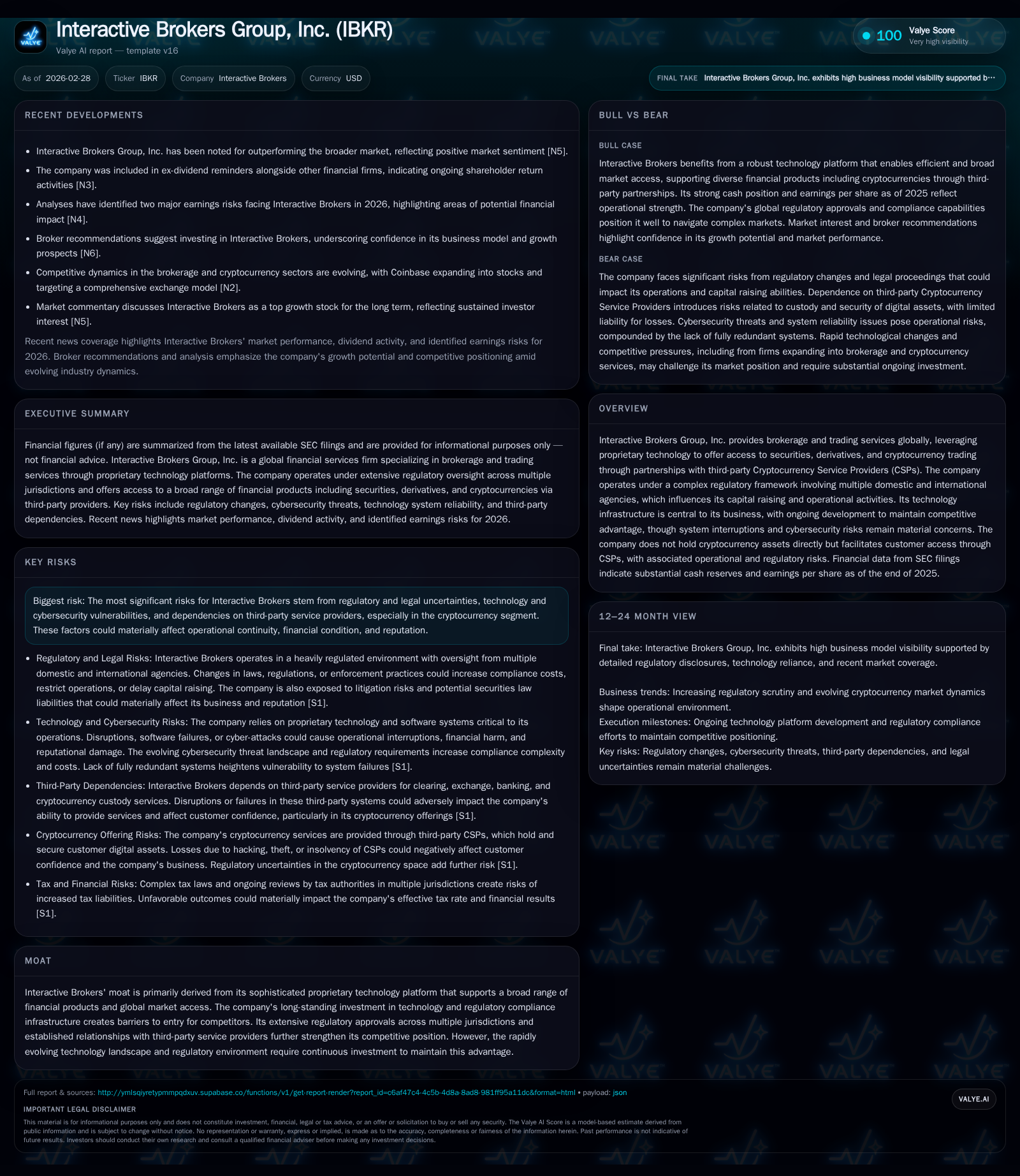
Interactive Brokers Group, Inc. has demonstrated sustained financial growth driven by its sophisticated trading platform and expanding brokerage volumes, notably reflected in a doubled operating cash flow recently. However, the company grapples with complex multi-jurisdictional regulations impacting capital maneuvers and causing rising compliance costs. Its proprietary technology remains a key competitive moat but is increasingly tested by cybersecurity threats and system vulnerabilities. Looking ahead, growth opportunities hinge on navigating regulatory approvals and third-party dependencies, especially in cryptocurrency services.
Financial Growth Trajectory and Operational Drivers Over Recent Years
Interactive Brokers has exhibited a notable trajectory of growth over the recent historical period, underpinned chiefly by its technology-enabled brokerage scale and increasing client activity across global markets. Revenue advanced from $1.475 billion in fiscal year (FY) 2016 to $2.58 billion in FY2019, representing a compound annual growth rate hovering near 20% during those years. The latest available data extending through FY2025 indicates operating cash flow accelerated sharply to $15.81 billion — an increase exceeding 81% year-over-year — emphasizing strong earnings quality and efficient working capital management ([F1]).
This financial momentum reflects Interactive Brokers’ leveraging of its proprietary electronic trading technology with broad access to equities, derivatives, forex, and increasingly digital assets via third-party providers. The firm's broker-dealer subsidiaries enable participation in major exchanges while its ForecastEx platform offers regulated event contracts through a CFTC-registered Designated Contract Market (DCM) ([S5], [S12]). This diversity in product offerings drives trading volumes and transaction revenues.
Historical performance (annual)
| FY | CFO ($bn) |
|---|---|
| 2025 | 15.8 |
| 2024 | 8.7 |
| 2023 | 4.5 |
| 2022 | 4.0 |
Source: SEC companyfacts cache [F1].
Note: Latest revenue figures post-2019 are unavailable; operating cash flow and equity data reflect recent years for full financial context ([F1]).
Regulatory Landscape and Compliance Complexities Impacting IBKR
Interactive Brokers operates within an exceptionally complex regulatory environment spanning multiple jurisdictions including the U.S., Canada, U.K., Ireland, Switzerland, Hong Kong, Singapore, India, Japan, Australia among others ([S1], [S4], [S5], [S8]). Its broker-dealer subsidiaries are members of FINRA and subject to strict rules such as FINRA Rule 1017 requiring approvals for any change in control involving ownership stakes exceeding 25%. Similar change-of-control provisions exist across other key regulators like FCA (U.K.), CIRO (Canada), SFC (Hong Kong), MAS (Singapore).
These regulations constrain IBKR’s ability to fluidly raise equity capital or conduct share sales without prior regulator approval — a process that can delay or inhibit financing initiatives essential to strategic expansions or acquisitions ([S4]). Compliance costs have escalated accordingly over recent years due to intensified supervisory scrutiny on risk management practices, governance standards, anti-money laundering controls, transaction reporting and data privacy mandates.
Additionally, emerging crypto regulations raise uncertainties given IBKR's provision of cryptocurrency access through partnerships with regulated Cryptocurrency Service Providers (CSPs). The legal framework for digital assets remains fluid globally with varying interpretations from securities commissions to tax authorities affecting permitted activities ([S4], [S5], [S12]).
Technology Infrastructure as Core Competitive Advantage and Associated Risks
Central to Interactive Brokers' business model is its proprietary technology platform which facilitates high-speed order execution across tens of global markets offering equities, options, futures, FOREX and cryptocurrencies via CSPs ([S10], [S19]). This technology moat constrains entry for competitors lacking equivalent infrastructure or regulatory reach.
However, this reliance presents material operational risks. The company acknowledges intermittent past system interruptions impacting customer experience as well as exposure to cybersecurity threats including malware attacks, ransomware campaigns, data breaches or denial-of-service attempts ([S9], [S10], [S11]). These could cause erroneous trades or halt services temporarily leading to reputational damage or customer attrition.
Management continuously invests heavily in software development to maintain technological superiority amid evolving industry standards and AI-driven innovations potentially disrupting established trading methodologies ([S19]). Nevertheless, inherent vulnerabilities persist due to incomplete redundancy plans globally and dependence on third-party service providers whose security postures may not be fully under IBKR’s control ([S18]).
Scrutinizing Future Growth Opportunities Amid External Constraints
Looking forward, Interactive Brokers’ growth outlook contains dual forces. New product initiatives such as forecasting contracts via ForecastEx present unique market segment penetration potential while expansions into cryptocurrency through CSP partnerships tap into fast-growing digital asset trading demand ([N13], [N1], [S1]).
Yet growth could be capped by protracted regulatory reviews or changes limiting availability of some products internationally ([S4], [S12]). Volatility or bearish trends in crypto markets may depress client activity impacting transactional revenue contribution from these segments ([N5], [N6]). Furthermore technological dependencies on CSPs—whose failure or discontinuation of services could disrupt access—pose additional operational hazards ([S21], [S22]).
A critical dimension to monitor will be upcoming licensing announcements or modifications across key jurisdictions like the U.S., Singapore and Hong Kong where digital asset regulation is rapidly evolving and whose decisions could materially influence IBKR’s strategic deployment timeline ([N13], [N1]).
Capital Allocation Trends: Cash Flow, Dividends, and Shareholder Returns
The company’s latest reported figures show a striking $15.8 billion in operating cash flows for FY2025 coupled with $5.36 billion in equity capital indicating substantial liquidity reserves relative to shareholder funds. Despite this liquidity abundance the return on equity remains modest near 0.8%, signaling conservative leverage or reinvestment strategies ([F1]).
Historical dividend payments ended several years ago; the last recorded dividend was around $29 million paid in FY2018 with no recent evidence of resumed distributions ([F1], [S29]). There is no explicit indication of sizable share buyback programs being deployed recently likely attributable in part to regulatory clearance complexities relating to control changes (FINRA Rule 1017 etc.) restricting aggressive capital return maneuvers ([S4], [S29]).
The company appears focused on preserving capital flexibility potentially for regulatory compliance costs or future investments into technology rather than prioritizing direct shareholder payouts at present.
Key Milestones to Monitor: Earnings Risks and Market Sentiment
Market sentiment around IBKR remains cautiously optimistic yet alert towards certain flagged earnings risks outlined by analysts. Recent reports highlight concerns regarding potential margin pressures stemming from increased compliance expenses as well as uncertainties tied to the profitability contributions from new product lines such as Forecast Contracts and crypto services ([N1], [N3], [N7]).
The timing of forthcoming quarterly earnings releases will be pivotal inflection points shaping investor perceptions especially if actual results diverge from expectations shaped around cautious optimism given enhanced scrutiny on cost structures versus revenue growth balance ( [N3], [N9]). Additionally any newsflow related to regulatory developments—particularly concerning CSP partnerships or international licensing—could provoke marked stock volatility ( [N1], [N13]).
Cybersecurity Threats and Third-Party Dependencies Shaping Risk Profile
Interactive Brokers’ cybersecurity program is embedded within its enterprise risk management framework overseen directly by senior executive leadership including the CEO, EVP Technology and Chief Information Security Officer (CISO). Periodic internal audits complemented by annual external SOC 2 attestations aim to ensure adequate defenses against sophisticated cyber intrusions prevalent within financial services ( [S23], [S24]).
Nonetheless evolving attacker tactics—including AI-enabled malware—and inherent exposure posed by reliance on externally operated Cryptocurrency Service Providers amplify vulnerability horizons ( [S11], [S17]). Any breach involving customer data or inadvertent disruptions attributable either internally or downstream amongst third parties could cause significant reputational harm along with litigation risks ( [S11]). The contractual structures around CSP relationships generally limit IBKR’s liability absent proven negligence but do not eliminate indirect fallout effects if losses occur ( [S17], [S21]).
Overall, enterprise resilience requires continuous vigilance coordinated response protocols through specialized governance committees such as the Cyber Materiality Committee active in incident assessment ( [S23]) coupled with investments in advanced technology controls.
This analysis synthesizes available SEC filings through February 2026 alongside contemporary market commentaries without projecting future financial outcomes beyond documented evidences. It aims solely at elucidating Interactive Brokers' strategic positioning balancing vigorous financial expansion powered by proprietary technology against growing complexities engendered by broad regulatory regimes and systemic risk exposures characteristic of modern global brokerage operations.
Readers should consider these insights contextual rather than investment guidance.
Disclaimer: This is research-only, informational analysis and not investment advice. It may include AI-generated interpretation and general industry context. Always verify important details using primary sources.

Comments