
International Business Machines Accelerates Hybrid Cloud and AI Growth Amid Shifting Legacy Dynamics
IBM's Q2 2026 results reveal robust hybrid cloud and AI revenue expansion contrasted by softness in legacy infrastructure and financing segments, reflecting strategic transition pressures.
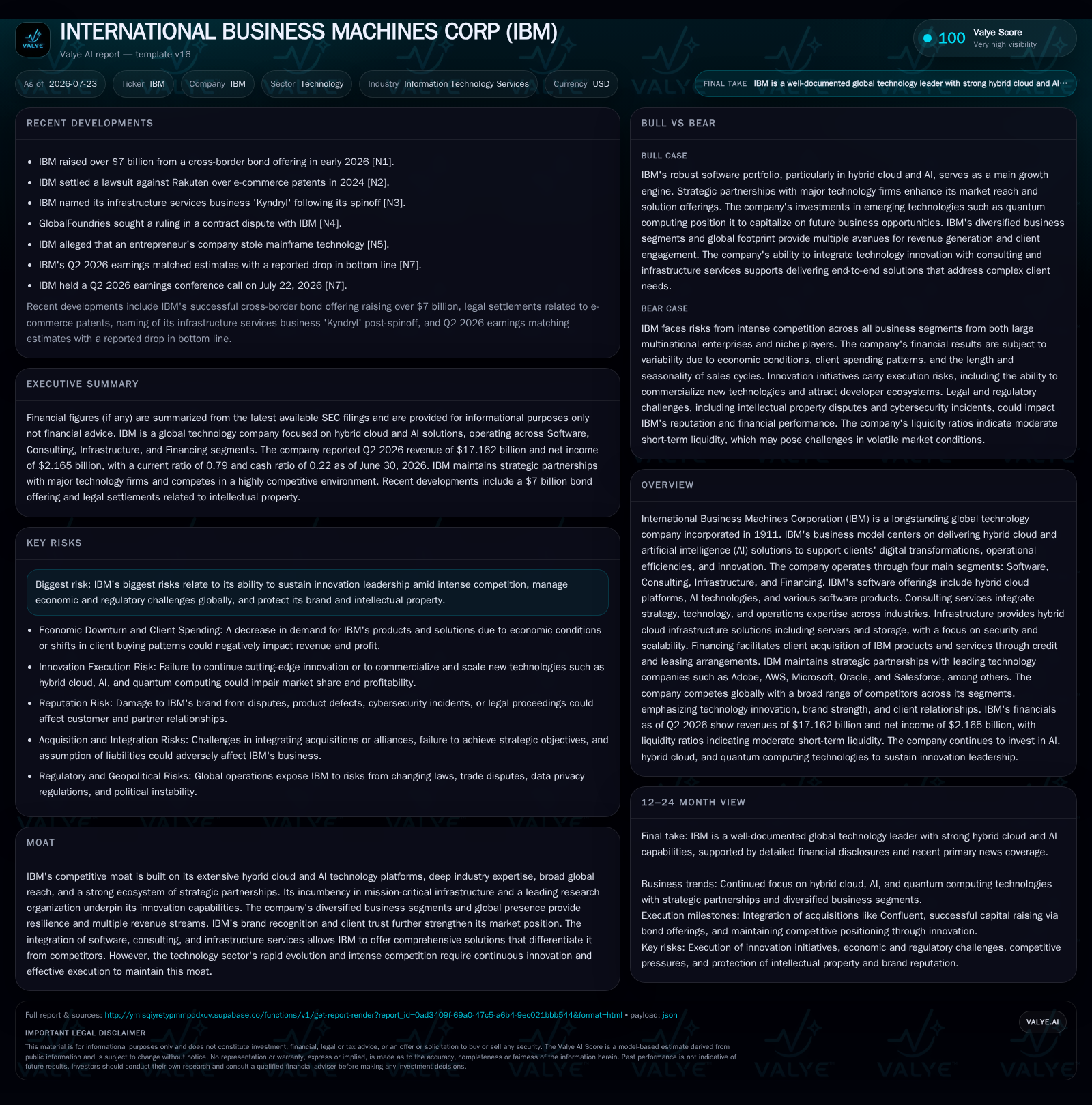
In its latest quarterly filing, IBM demonstrated significant revenue growth driven primarily by hybrid cloud and artificial intelligence offerings, signaling strengthened demand for digital transformation solutions. While software and consulting segments showed momentum through integrated client engagements and improving utilization, legacy transaction processing infrastructure revenues declined modestly, weighing on overall margin expansion. Strategic partnerships and sustained R&D investments underpin IBM’s competitive moat, yet execution challenges in shifting legacy businesses remain a near-term headwind. Monitoring recurring revenue mix, consulting utilization rates, and bookings will be critical to validating the durability of IBM’s ongoing strategic pivot.
Q2 Revenue Dynamics Reflect Hybrid Cloud Momentum Amid Legacy Segment Pressure
IBM's Q2 2026 results highlight a clear revenue shift driven by accelerated adoption of hybrid cloud and AI-enabled software solutions. Hybrid cloud software revenue increased to $1.998 billion, up from $1.796 billion year-over-year, underscoring growing client demand for integrated digital transformation platforms that combine cloud infrastructure with AI-driven automation and data analytics capabilities [S2]. Total software segment revenue expanded to $7.761 billion, supported by gains in automation and data platforms alongside hybrid cloud growth, reflecting IBM's strategic emphasis on recurring software-as-a-service (SaaS) and platform-based offerings that enhance client agility and operational efficiency [S2].
Conversely, legacy transaction processing infrastructure revenues declined modestly to $2.030 billion from $2.208 billion in the prior-year period. This contraction reflects broader industry trends where clients increasingly migrate workloads from traditional on-premises, mission-critical hardware toward flexible, cloud-native architectures that offer scalability and cost advantages [S2]. While IBM maintains deep incumbency and trusted relationships in these legacy environments, this segment’s lower-margin profile and volume softness act as a structural drag on overall operating margins amid the ongoing portfolio transition.
Software and Consulting Integration Fuels Strategic Differentiation
IBM’s business model intricately integrates hybrid cloud software licenses with high-value consulting services that help clients architect end-to-end digital transformations. The consulting segment leverages improved utilization rates of specialized staff who engage deeply on multi-year contracts, bundling technology integration with process consulting across industries such as financial services, healthcare, and manufacturing [S1], [S2]. This integration enhances client retention through increased switching costs and encourages longer contract durations, supporting a higher proportion of recurring revenue.
Sustained investment in research and development (R&D) remains pivotal, fueling AI augmentation embedded across IBM’s offerings while advancing foundational platform capabilities required for scale and security in complex enterprise environments [S1]. The improved consulting utilization observed in Q2 suggests operational leverage potential that may progressively enhance segment margins as software penetration deepens within client portfolios.
This bundled approach differentiates IBM from pure-play hyperscalers or consulting-only firms by addressing complex business workflows requiring both technology modernization and management change, positioning IBM as a comprehensive hybrid cloud and AI transformation partner.
Industry Context: Competitive Landscape and Peer Positioning
IBM operates within a highly competitive ecosystem that includes large global IT services firms such as Accenture and Cognizant, which excel primarily in consulting scale, alongside dominant hyperscaler cloud providers like Amazon AWS and Microsoft Azure focused on infrastructure-as-a-service (IaaS) offerings. Enterprise software vendors such as Oracle and SAP represent peers concentrating on vertical-specific software solutions.
IBM’s competitive advantage lies in blending broad hybrid cloud platforms with AI capabilities and consulting expertise, enabling clients to execute comprehensive digital transformations securely while leveraging IBM’s incumbency in mission-critical environments [S1]. Strategic partnerships with major hyperscalers extend IBM’s technological reach but also introduce competitive dynamics, as many partners overlap as competitors in select domains.
Geographically, IBM’s global footprint supports diversified industry exposure beyond regions where market saturation or regulatory complexity constrain peers’ penetration, providing resilience amid geopolitical uncertainties.
Growth Catalysts: Ecosystem Partnerships and Innovation Pipeline
Strategic alliances are central to IBM’s growth trajectory, enabling broader technology integration and accelerating customer adoption of hybrid cloud and AI solutions. Partnerships with AWS, Microsoft, Adobe, Salesforce, Samsung Electronics, Oracle, and SAP span complementary domains from infrastructure provision to application-level analytics, enhancing IBM’s client value proposition and solution breadth [S1], [S2].
IBM reported approximately $68 billion in remaining performance obligations (RPO), with about 69% expected to be recognized as revenue within two years, signaling robust contract visibility that supports top-line confidence [S2]. However, execution risks remain around booking conversion rates, especially given evolving market conditions and competitive pressures.
Sustained R&D investment underpins IBM’s innovation pipeline, essential for navigating rapid technological evolution including explorations in quantum computing and AI advancements that may drive future growth inflections.
Risks and Constraints: Legacy Segment Headwinds and Market Execution Challenges
Despite advances in hybrid cloud and AI segments, legacy transaction processing infrastructure continues to exhibit volume softness, exacerbated by client budget constraints amid uncertain macroeconomic conditions globally [S1]. This dependency introduces margin pressure due to product mix dilution and the lower profitability profile of legacy hardware sales.
IBM faces intense competition not only from large incumbents but also from emerging niche players agile in cloud-native approaches, which lower barriers for disruption. Cybersecurity threats add operational risk and complexity around compliance as IBM integrates multi-vendor solutions deeply embedded within customers’ critical workflows.
Intellectual property protection challenges and geopolitical tensions impacting international operations constitute further hurdles requiring vigilant management attention [S1]. These risks underscore the importance of maintaining innovation leadership and operational execution discipline.
Monitoring Signals: Client Adoption Metrics, Utilization Rates, and Bookings
Key performance indicators to monitor include the recurring revenue percentage, reflecting SaaS license renewals and subscription stability, which contribute to top-line predictability; increases here would validate rising customer reliance on subscription models over transactional sales [S2]. Average contract length trends also provide insight into successful client entrenchment.
Consulting staff utilization rates serve as an inferential gauge of operational efficiency and margin improvement potential, with rising rates often presaging better fixed-cost absorption under project engagements [N1], [S2].
Deal pipeline strength and bookings provide forward-looking metrics on new client wins or expansions, underpinning sustained growth particularly amid economic sensitivity influencing IT spending decisions.
Financial Profile Discussion: Leverage, Cash Flow, and Capital Deployment
At quarter-end June 30, 2026, IBM reported cash and equivalents of approximately $7.2 billion against total debt near $63.1 billion, resulting in net debt of roughly $55.9 billion. This leverage level is moderate for a large global IT services firm managing capital-intensive infrastructure operations alongside significant R&D outlays [F1], [S2].
Operating cash flows remain robust, with net income for the first half of 2026 reaching approximately $3.38 billion [S2]. Non-cash adjustments include depreciation of $1.088 billion, amortization of capitalized software and acquired intangibles of $1.535 billion, and stock-based compensation of $1.004 billion, highlighting substantial investment activity supporting IBM’s innovation pipeline balanced against earnings quality preservation
This financial footing allows IBM continued discretion over capital allocation priorities, favoring strategic R&D investments essential for sustaining competitive differentiation while managing debt maturities amid fluctuating interest rate environments.
This analysis draws exclusively from publicly filed SEC reports dated July 23–24, 2026, as well as contemporaneous market commentary, without speculative forward-looking assertions or unsupported competitive rankings.
Disclaimer: This is research-only, informational analysis and not investment advice. It may include AI-generated interpretation and general industry context. Always verify important details using primary sources.

Comments