
ImmunityBio 2026: Commercializing Anktiva, Navigating Regulatory Pathways, and the Stakes of Oncology Market Penetration
ImmunityBio’s 2026 story centers on its immunotherapy platform and the conditional EU approval of Anktiva for bladder cancer, against the backdrop of significant net losses and ongoing FDA regulatory engagement. With a reported liquidity position buffer, the company’s future hinges on regulatory milestones, commercial traction, and the durability of its clinical and technological edge in a fiercely competitive oncology landscape.
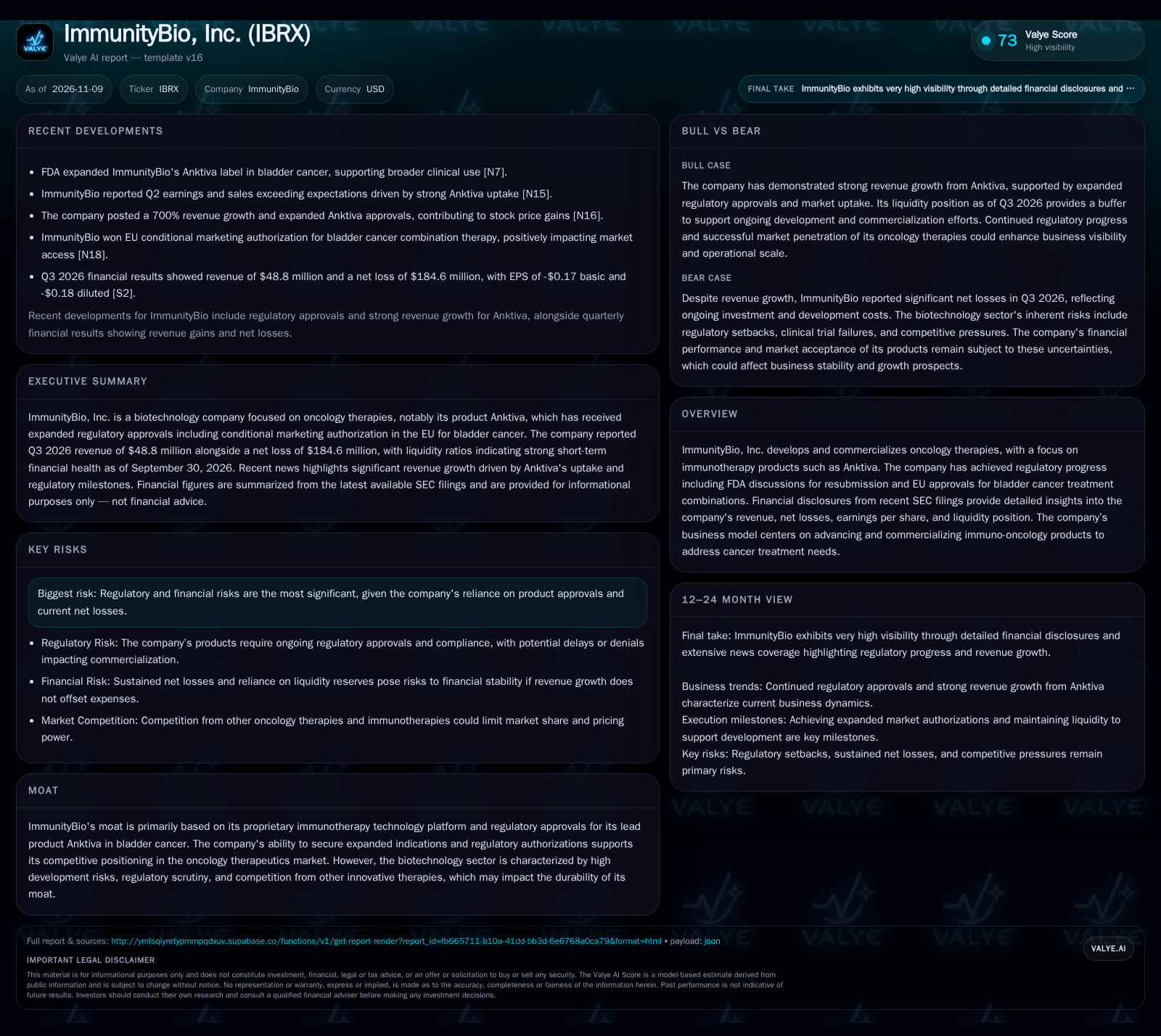
ImmunityBio’s Q3 2026 revenue reached $48.8 million, but the company posted a net loss of $184.6 million as it ramps up commercialization of Anktiva, an immunotherapy with conditional EU approval for bladder cancer. [S2]
ImmunityBio, Inc. stands at a pivotal juncture in late 2026, defined by the conditional EU approval of its lead immunotherapy Anktiva for bladder cancer, ongoing FDA resubmission efforts, and the challenge of translating scientific innovation into commercial success. The company’s Q3 2026 results underscore the capital-intensive nature of biotech commercialization: $48.8 million in revenue offset by a $184.6 million net loss, with a reported liquidity position. The next phase will test ImmunityBio’s ability to scale Anktiva, secure further regulatory wins, and defend its position in a competitive, fast-evolving oncology market. [S2]
Expanded EU Approval, Persistent Losses, and Regulatory Crossroads in 2026
ImmunityBio’s most consequential 2026 developments are the conditional marketing authorization of Anktiva in the EU for bladder cancer and the company’s ongoing FDA resubmission discussions. These regulatory milestones are pivotal: EU approval opens a substantial new market, while US regulatory progress remains a critical gating factor for commercial scale. Financially, ImmunityBio’s Q3 2026 revenue of $48.8 million is a meaningful step up, but the net loss of $184.6 million underscores the heavy costs of late-stage development and launch. The company reported cash and liquidity metrics for the period; these figures do not by themselves establish operating runway, investment capacity, financial flexibility, or financing capacity. [S2]
The Economics of Immuno-Oncology Commercialization: Scale, Margins, and Capital Demands
ImmunityBio’s core business model is predicated on developing and commercializing immunotherapy products, with Anktiva as the lead asset. In oncology, successful commercialization typically hinges on premium pricing for novel therapies and the potential for rapid revenue scaling if clinical differentiation and regulatory approval are achieved. However, fixed costs—R&D, regulatory, clinical, and manufacturing infrastructure—are substantial, and upfront launch investments can drive deep losses before a product reaches breakeven. Variable costs are driven by manufacturing, distribution, and ongoing post-marketing commitments. Given the reported revenue and persistent net losses, ImmunityBio appears to be in the early commercial phase where operating leverage is negative; scaling sales will be essential to convert fixed costs into margin expansion.
Capital requirements remain high, as biotech companies often need to fund long clinical timelines and regulatory processes before and after initial launch. The economics of Anktiva will ultimately depend on pricing, reimbursement, market share, and the ability to expand indications beyond bladder cancer.
The path to profitability in immuno-oncology commercialization is often nonlinear and heavily contingent on multiple interdependent factors. For ImmunityBio, the ability to optimize manufacturing scale and supply chain efficiency will be critical to managing variable costs, which can otherwise erode margins despite premium pricing. Additionally, payer negotiations and health technology assessments in different jurisdictions will influence reimbursement levels and patient access, thereby affecting revenue growth trajectories. The company’s investment in post-marketing studies and real-world evidence generation could serve as a lever to enhance payer confidence and justify premium reimbursement, but these initiatives also require sustained capital outlays. Consequently, the timing and scale of these investments relative to revenue ramp-up will materially impact the company’s cash flow dynamics and capital structure.
Another dimension influencing the economics is the potential for indication expansion beyond bladder cancer. If ImmunityBio successfully navigates regulatory approvals in additional tumor types, this could diversify revenue streams and improve asset utilization. However, each new indication typically entails incremental clinical development costs, regulatory submissions, and tailored commercial efforts, which may temporarily increase fixed costs and delay breakeven. The company’s ability to leverage existing manufacturing and distribution infrastructure across multiple indications could provide operating leverage benefits, but only if the incremental revenues sufficiently offset the associated incremental costs. Therefore, strategic prioritization of indications based on market size, competitive landscape, and reimbursement potential will be essential to optimize the overall portfolio economics.
Defending a Foothold in Oncology: Differentiation, Substitution, and Market Forces
ImmunityBio operates in an intensely competitive environment, facing both established pharmaceutical giants and emerging biotech innovators targeting oncology indications. The company’s primary asset, Anktiva, differentiates itself through its immunotherapy mechanism and recent conditional EU approval for bladder cancer. Regulatory progress offers some moat, as does proprietary technology, but these advantages are at constant risk of erosion due to rapid scientific advances, competitive launches, and alternative therapeutic modalities (e.g., CAR-T, checkpoint inhibitors).
Switching frictions in oncology can be meaningful—physicians and patients are often slow to change standard-of-care regimens, especially without compelling real-world evidence or guideline inclusion. However, the existence of multiple immuno-oncology approaches means pricing power and market share are not guaranteed. Market access, payer reimbursement, and clinical differentiation will be decisive. The company’s ability to expand Anktiva’s indications, maintain regulatory momentum, and demonstrate superior real-world outcomes will determine whether its initial foothold can translate into a durable position.
If Anktiva Gains US Approval and Accelerates Adoption: A Path to Scale
The most favorable scenario for ImmunityBio features successful FDA resubmission and subsequent US approval for Anktiva, unlocking the largest oncology market globally. Coupled with the recent EU approval, this would position the company to rapidly scale revenues, leverage fixed costs, and potentially reach operating profitability in the medium term. If Anktiva demonstrates real-world efficacy and safety comparable or superior to existing bladder cancer therapies, and if payer reimbursement is secured at premium pricing, ImmunityBio could capture significant share in its target indication.
Confirming evidence would include: FDA approval announcements, rapid uptake in both EU and US markets, positive real-world clinical outcome data, and sequential revenue growth outpacing expense increases. Falsification would come from regulatory delays, negative post-marketing data, or slow market adoption despite approvals.
Commercial Progress Amidst Incremental Regulatory Advances and Cost Pressures
The most probable trajectory is one of gradual commercial progress in the EU, ongoing regulatory engagement with the FDA, and continued investment in both Anktiva and pipeline assets. ImmunityBio may achieve moderate revenue growth from initial EU sales while US approval timelines remain uncertain. The company could pursue additional capital raises if cash burn remains high.
Confirmation would come from steady revenue increases quarter-over-quarter, updates on FDA discussions, and maintenance of a reported current ratio. Falsification would involve stagnating or declining revenues, regulatory setbacks, or worsening cash burn without external funding.
Regulatory Setbacks and Slow Market Uptake Could Threaten Sustainability
In an adverse scenario, ImmunityBio faces delays or denials in its FDA resubmission for Anktiva, limiting access to the US market and constraining revenue potential. If EU adoption is slower than expected—due to payer pushback, competitive launches, or underwhelming real-world outcomes—revenue growth may stall while fixed costs remain high. Sustained net losses could deplete the current reported cash balance, forcing the company to seek dilutive financings or restructure operations.
Milestones That Will Shape ImmunityBio’s Oncology Trajectory in 2027 and Beyond
Quarterly revenue trends for Anktiva, especially in newly approved EU markets, will be a direct signal of commercial traction. [S2]
Updates on FDA resubmission process and any formal communications regarding Anktiva’s US regulatory status will be essential to monitor. [S2]
Any new regulatory filings or approvals for expanded indications of Anktiva or other pipeline assets would help test the scalability of the platform. [S2]
Real-world clinical outcome data for Anktiva, if disclosed, would provide insight into differentiation and potential for inclusion in treatment guidelines.
Payer reimbursement decisions and pricing outcomes in both the EU and US will determine realized revenue per patient and market access.
Competitive product launches or new clinical data from rivals targeting bladder cancer could shift the opportunity landscape and impact ImmunityBio’s share.
Disclaimer: This is research-only, informational analysis and not investment advice. It may include AI-generated interpretation and general industry context. Always verify important details using primary sources.

Comments