
United States Brent Oil Fund (BNO): Futures Mechanics, Volatility Exposure, and the Realities of Oil ETF Tracking
BNO delivers regulated exposure to Brent crude oil prices by holding and rolling futures contracts, but its ability to track the benchmark is shaped by regulatory limits, cash management, and the volatility of global oil markets. Recent declines in NAV and net assets underscore how market and structural forces interact for this ETF.
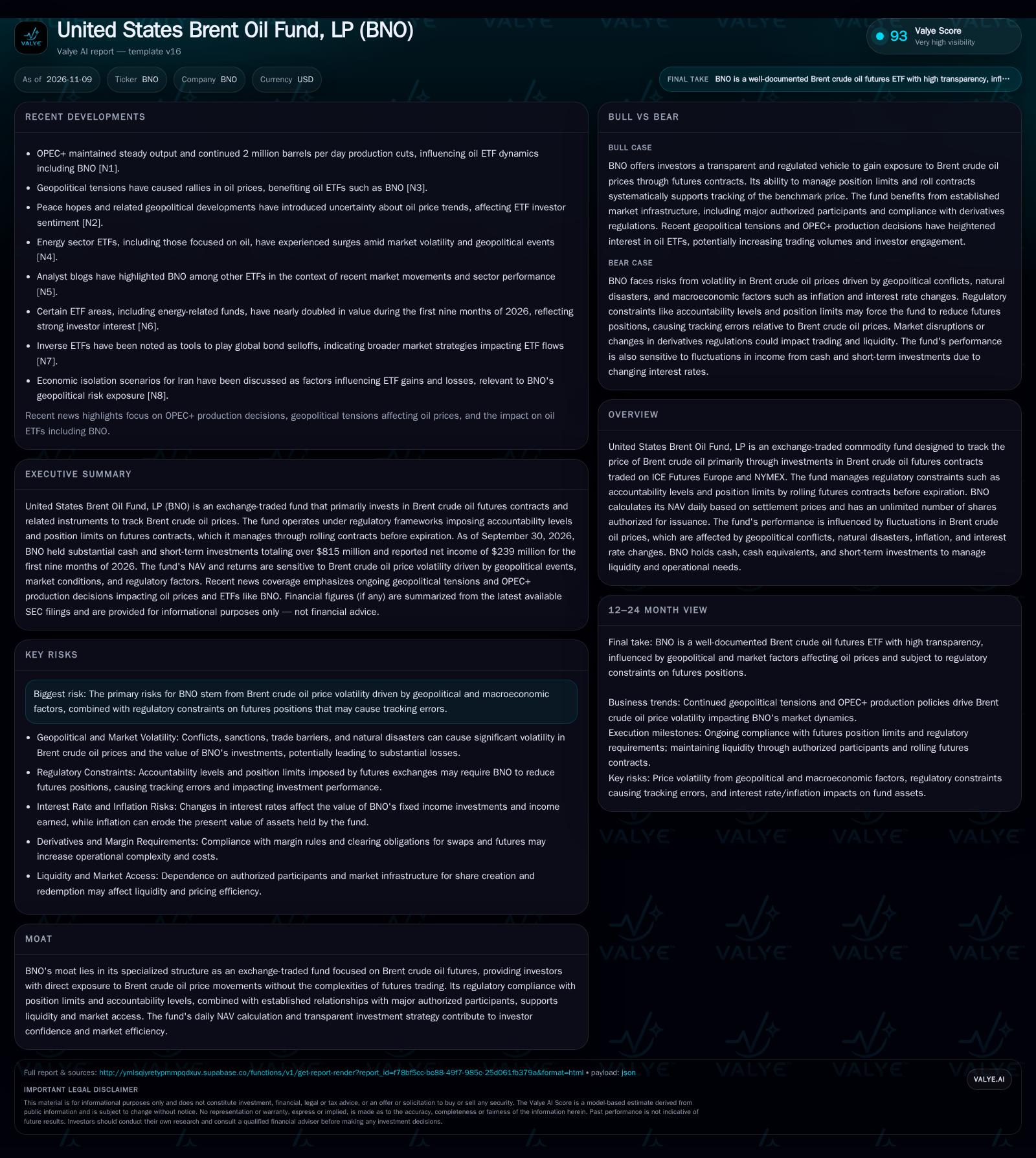
United States Brent Oil Fund (BNO) is an exchange-traded fund designed to mirror Brent crude oil price movements by investing in futures contracts. As of September 2026, BNO held significant cash and short-term investments, with a reported net income of $239 million for the first nine months of 2026. The fund's NAV fell 6.14% in 2025, reflecting weaker oil prices, and its ability to track Brent is influenced by rolling mechanics, regulatory position limits, and broader market volatility [S1] [S2].
United States Brent Oil Fund (BNO) offers a liquid, regulated vehicle for investors seeking exposure to the price of Brent crude oil without the operational complexity of trading futures directly. By holding and rolling Brent futures contracts, BNO aims to mirror spot price movements, but its performance is shaped by market volatility, regulatory position limits, and the mechanics of futures roll. Recent declines in NAV and net assets illustrate the fund’s sensitivity to oil price trends and the importance of operational discipline in maintaining its tracking objective. As investor interest in oil ETFs surges amid geopolitical uncertainty, BNO's structure and risk exposures warrant close examination.
Recent Declines and Operational Position: What the Latest Figures Reveal
BNO’s net asset value (NAV) per share decreased by approximately 6.14% in 2025, driven primarily by falling Brent crude oil prices and lower futures contract values [S1]. This decline was compounded by a reduction in average daily total net assets, which fell from about $146.5 million in 2024 to $97.2 million in 2025, reflecting both market-driven outflows and potential shifts in investor sentiment [S1]. As of September 30, 2026, the fund held $290.99 million in cash and equivalents and $524.42 million in short-term investments, with net income of $239.08 million for the first nine months of 2026 [S2]. These figures highlight BNO’s substantial liquidity base for managing margin requirements and redemptions, but also demonstrate the volatility inherent in tracking a commodity as geopolitically sensitive as Brent crude.
How BNO Makes (and Potentially Loses) Money: Futures Roll, Fee Structure, and Tracking
BNO earns or loses value based primarily on changes in Brent crude oil futures prices. The fund systematically rolls its holdings from the near-month futures contract to the next month to avoid position limits and accountability levels set by exchanges [S1]. This rolling process introduces the risk of roll yield: when the futures curve is in contango, BNO may sell lower-priced expiring contracts and buy higher-priced forward contracts, leading to a drag on returns. Conversely, in backwardation, rolling can benefit performance. BNO charges management fees and incurs operational expenses, both of which are subtracted from investor returns. In 2025, these expenses declined in part due to lower professional fees and fewer contracts held, reflecting the fund’s scale sensitivity [S1]. Interest and dividend income from cash and short-term Treasuries can offset some expenses, but this income fell to $3.89 million in 2025 as rates declined [S1]. BNO’s structure requires diligent cash management to meet margin requirements and potential redemptions, making asset allocation between futures and liquid reserves a balancing act.
ETF Structure, Liquidity, and the Challenge of Differentiation in Oil Exposure
BNO’s competitive position rests on offering transparent, regulated exposure to Brent crude oil—a benchmark distinct from the West Texas Intermediate (WTI) focus of many U.S.-listed oil ETFs. Its authorized participant network includes major market makers and broker-dealers, supporting efficient share creation and redemption [S1]. However, BNO competes with other commodity ETFs, synthetic oil products, and direct futures trading. While its specialized Brent focus may appeal to global or non-U.S. oil exposure seekers, the fund’s tracking fidelity is periodically challenged by regulatory position limits and market microstructure effects. No ETF can fully eliminate tracking error, especially when forced to alter exposure or roll contracts under adverse market conditions. Additionally, broader competition from energy sector equity ETFs and multi-commodity funds provides investors with alternative ways to express oil market views.
Geopolitical Shocks and Supply Cuts: When BNO Outperforms
An upside scenario for BNO would be characterized by a sharp, sustained increase in Brent crude oil prices, perhaps triggered by escalated geopolitical tensions, OPEC+ production cuts, or significant supply disruptions. Under these conditions, BNO’s rolling futures strategy could capture most of the upward movement in front-month prices, especially if the market is in backwardation, minimizing roll costs. Confirmation would come from a marked rise in the fund’s NAV per share, inflows from investors seeking oil exposure, and high trading volumes. Evidence of robust tracking (minimal tracking error) despite volatile conditions would further validate this scenario. Conversely, if BNO’s NAV lags Brent spot prices, or if position limits force significant tracking error, the thesis would be weakened.
BNO in a Volatile but Rangebound Oil Market: Tracking the Middle Ground
The most plausible scenario over the next 12–24 months is an environment where Brent crude oil prices remain volatile but largely rangebound, driven by alternating geopolitical risks and macroeconomic headwinds. In this context, BNO is likely to deliver returns that broadly reflect Brent futures price movements, subject to the persistent drag of roll yield (if the market remains in contango) and management fees. Modest inflows and outflows would correspond to shifts in investor risk appetite. Evidence confirming this scenario would include continued transparency in NAV tracking, stable or moderately fluctuating asset levels, and expense ratios remaining in line with historical norms. Falsification would require persistent, material tracking error or unexpected liquidity disruptions.
Tracking Error, Position Limits, and Prolonged Oil Price Weakness: What Could Go Wrong
A downside scenario emerges if Brent crude oil prices fall sharply or remain depressed due to global economic weakness, excess supply, or rapid energy transition developments. In this case, BNO’s NAV would decline, potentially leading to investor outflows and a shrinking asset base. Regulatory position limits could force BNO to reduce its futures exposure, increasing tracking error and diminishing the fund’s utility as a Brent proxy [S1]. Extended periods of contango would exacerbate roll costs, further eroding returns. Evidence supporting this scenario would include a growing gap between BNO’s NAV performance and the Brent benchmark, falling trading volumes, and repeated mention of tracking error in fund disclosures. If, instead, BNO maintains close tracking and reported liquidity position despite adverse oil markets, this scenario would be less likely.
Metrics and Market Developments That Will Determine BNO’s Effectiveness as an Oil Proxy
The magnitude and direction of BNO’s tracking error versus Brent front-month futures over rolling periods, if disclosed, would help test the fund’s efficacy as a proxy.
Changes in average daily net assets and trading volumes, signaling shifts in investor interest and market liquidity.
Frequency and materiality of regulatory position limit or accountability level breaches, and any resulting changes in portfolio composition.
The structure of the Brent futures curve (contango vs. backwardation) at each roll window, which drives roll yield impact.
Interest income from cash and short-term investments, as this can partially offset management fees and roll costs.
Expense ratio trends, especially if they rise due to operational complexity or declining scale.
External factors such as OPEC+ production decisions, major geopolitical events, or significant regulatory changes affecting oil futures markets.
Disclaimer: This is research-only, informational analysis and not investment advice. It may include AI-generated interpretation and general industry context. Always verify important details using primary sources.

Comments