
United States Oil Fund (USO): Tracking Crude, Navigating Futures Market Constraints and Volatility
USO offers liquid, exchange-traded exposure to crude oil price movements, but faces persistent challenges from regulatory position limits, market structure dynamics, and volatile investor flows. Understanding the fund’s mechanics and the interplay of futures pricing, regulatory risk, and macro shocks is crucial for evaluating its tracking fidelity and long-term investor appeal.
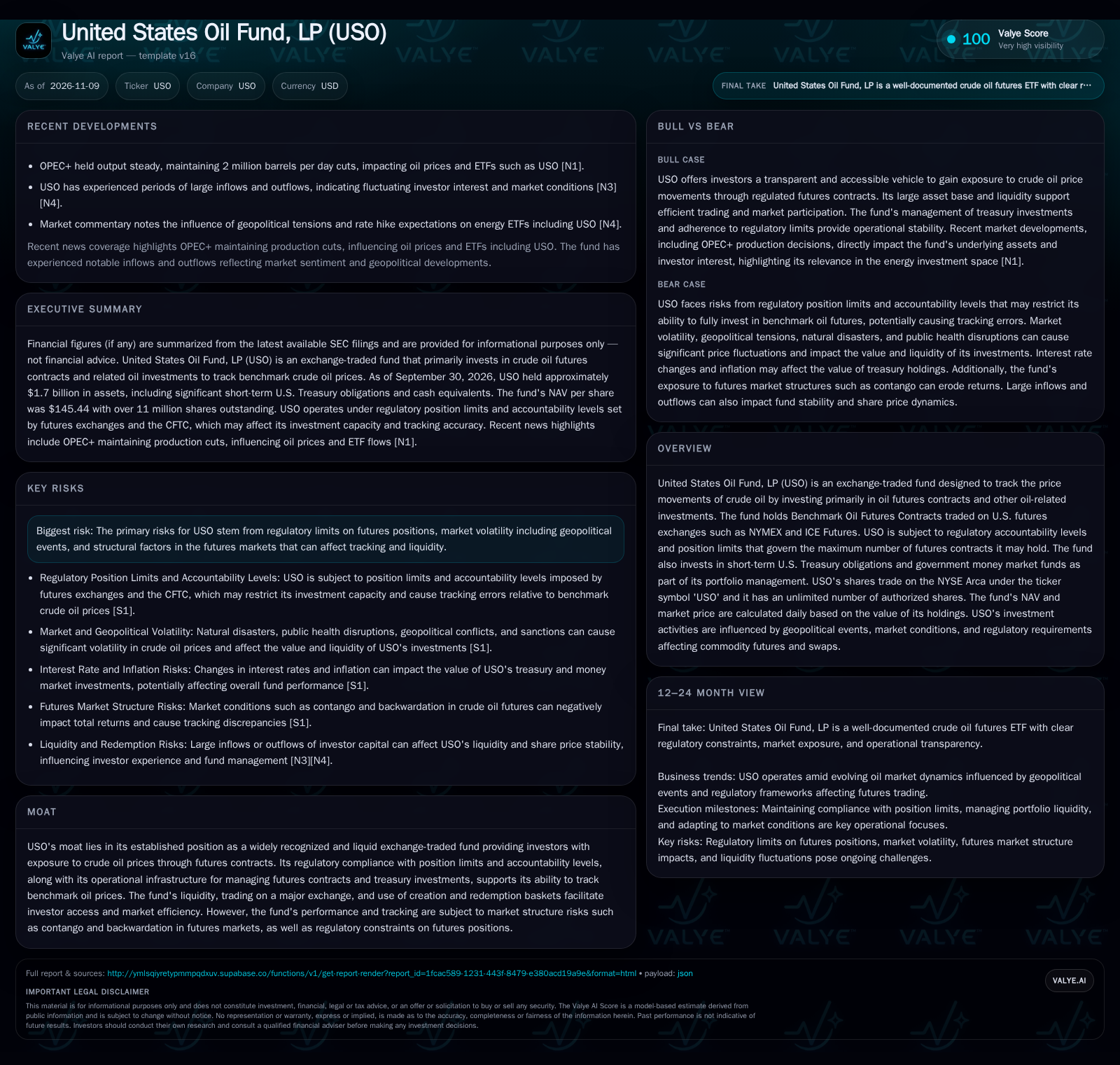
United States Oil Fund (USO) is a major crude oil futures ETF with $1.7 billion in assets and a NAV of $145.44 per share as of September 2026. It provides direct exposure to benchmark oil futures but must operate within regulatory position limits, which can cause tracking discrepancies. The fund’s performance is shaped by futures market structure (contango/backwardation), macro shocks, and swings in investor flows—factors that may disrupt its ability to mirror oil price movements closely. Ongoing OPEC+ output decisions and macro volatility further amplify these dynamics. [S2] [N3]
United States Oil Fund (USO) stands as one of the largest and most visible exchange-traded vehicles for investors seeking exposure to crude oil price movements. By holding large positions in NYMEX WTI crude oil futures and supplementing with short-term U.S. Treasuries, USO aims to track the daily price changes of oil benchmarks. However, its ability to mirror oil prices precisely is continually tested by regulatory position limits, market structure quirks such as contango and backwardation, and the volatile ebb and flow of investor demand. Ongoing geopolitical and macroeconomic events—like OPEC+ output decisions—further complicate the investment landscape for USO, making a nuanced understanding of its operating mechanics essential.
Latest Data: Asset Base, Regulatory Positioning, and Investor Flow Dynamics
As of September 30, 2026, USO managed approximately $1.7 billion in total assets, with a net asset value (NAV) per share of $145.44 and 11.3 million shares outstanding. The portfolio was primarily composed of 13,180 NYMEX WTI crude oil futures contracts, supplemented by substantial holdings in short-term U.S. Treasury obligations and cash equivalents. Despite exceeding NYMEX's accountability levels for WTI contracts, USO remained within formal position limits, and no regulatory action was taken. The fund generated $678.7 million in net income on $682.3 million in revenue over the first nine months of 2026—a period marked by notable swings in investor inflows and outflows, reflecting the broader volatility in oil markets and investor sentiment. These operational facts underscore USO’s scale, regulatory sensitivity, and exposure to rapid changes in market demand. [S2] [N3]
How USO Earns and the Mechanics of Tracking Oil Prices
USO’s core economic model is to provide daily exposure to crude oil price movements by holding and rolling short-dated futures contracts. Revenue and NAV changes are driven chiefly by price movements in the underlying oil futures, not by traditional business operations. The fund earns interest on its Treasury and cash positions, with recent yields in the 3.4%-3.8% range, but this is a minor contributor relative to the impact of oil price changes. Management fees (around $4.4 million in 2025) and transaction costs are deducted from returns.
The fund’s structure creates several economic frictions. Futures market structure—especially periods of contango, where longer-dated contracts are more expensive than near-term ones—can erode returns as USO must regularly roll expiring contracts into costlier future months. This roll yield drag can cause the fund to underperform spot oil prices over time, especially in prolonged contango environments. Conversely, in backwardation, roll yields can be positive.
USO’s capital needs are largely dictated by investor demand, as the fund uses a creation/redemption basket mechanism to accommodate inflows and outflows. Operating leverage is limited; scale does not meaningfully reduce tracking error or roll costs, and the fund’s liquidity is a function of both its own trading and the underlying futures market’s depth.
Evaluating USO’s Role Among Oil-Linked Investment Vehicles
USO competes with other commodity ETFs, exchange-traded notes (ETNs), and structured products offering oil price exposure. Its primary advantages are liquidity, simplicity, and regulatory transparency—traits valued by both retail and institutional investors seeking direct oil exposure without the complexity of futures accounts. However, USO’s tracking error, especially during periods of extreme contango or regulatory constraint, is a known challenge.
Substitutes include other oil ETFs with alternative rolling methodologies, commodity mutual funds, physically-backed products (rare for oil due to storage constraints), and energy equities, which provide leveraged but less direct exposure. USO’s operational moat lies in its scale, trading liquidity, and established infrastructure for rolling contracts and managing compliance, though these do not eliminate the fundamental economic challenges of the futures market.
The fund’s competitive position is periodically threatened by regulatory changes (such as tighter position limits or margin requirements), innovations in oil-tracking product design, and shifts in investor preference toward products that minimize roll yield drag or offer more nuanced exposure (e.g., multi-contract or options-based ETFs).
When Macro Shocks and Market Structure Align: The Case for Outperformance
If oil markets enter a period of backwardation—where near-term futures trade at a premium to longer-dated contracts—USO could benefit from positive roll yields, reducing tracking error versus spot oil and potentially delivering superior returns relative to its historical averages. This scenario is most likely during supply shocks, robust demand recoveries, or aggressive OPEC+ production cuts that drive up prompt crude prices. Increased investor inflows, if absorbed without breaching position limits or causing excessive premium/discount to NAV, could further enhance liquidity and secondary market efficiency.
Evidence of this upside would include: persistent backwardation in the WTI curve, narrowing tracking error between USO and spot oil benchmarks, and robust net inflows without significant NAV slippage. Confirmation could also come from regulatory stability, allowing USO to maintain its preferred futures positioning, and from positive investor sentiment during macro supply disruptions.
Managing the Ongoing Tug-of-War: Tracking Error, Investor Flows, and Regulatory Compliance
The most plausible outcome is that USO continues to offer liquid, regulated oil price exposure with modest but persistent tracking error relative to spot oil, primarily due to roll yield drag and occasional regulatory constraints. The fund will likely see periods of both inflows and outflows as macro events (such as OPEC+ policy shifts or geopolitical shocks) drive investor sentiment.
Fund performance will generally mirror the direction of oil prices, but with underperformance in contango environments and slightly better tracking in backwardation. Regulatory position limits will remain an operational ceiling, especially during periods of extreme investor demand. The fund’s ability to manage inflows/outflows efficiently through its creation/redemption process will be critical to minimizing NAV distortions.
Evidence supporting this scenario would include continued NAV/market price alignment, steady assets under management, and roll yields that reflect prevailing market structure. Any pronounced deviation from these patterns—such as persistent large tracking errors or regulatory interventions—would challenge the base case.
Contango Stretches, Regulatory Clampdowns, and the Risk of Disrupted Tracking
A confluence of persistent contango in oil futures, surging investor inflows, and tighter regulatory position limits could severely impair USO’s ability to track oil benchmarks. In this scenario, roll yield drag compounds as the fund rolls into successively higher-priced contracts, while position limits force USO to diversify into less correlated or less liquid contracts, increasing tracking error. Regulatory actions or abrupt changes in accountability levels could further limit the fund’s flexibility.
A rapid reversal of investor sentiment—triggered by an oil price collapse, geopolitical resolution, or a shift in macro policy—could drive large outflows, potentially forcing USO to unwind positions at unfavorable prices and exacerbating NAV volatility. Evidence of this scenario would include: sharp, sustained underperformance versus spot oil, widening NAV/market price discounts or premiums, and public regulatory interventions or warnings.
What Will Shape USO’s Ability to Deliver Oil Exposure in 2026–2027?
Persistent tracking error between USO’s NAV returns and the performance of spot WTI crude benchmarks—especially during periods of pronounced contango or backwardation—would help test the fund’s tracking fidelity.
Changes in regulatory position limits or accountability levels imposed by the CFTC or futures exchanges; any public enforcement actions or new rule proposals could materially alter USO’s operating flexibility.
Net inflow/outflow trends—especially any sustained surge or exodus—if disclosed, as they affect the fund’s ability to maintain efficient creation/redemption and secondary market liquidity.
The shape and volatility of the WTI futures curve; extended contango or backwardation will directly impact roll yield and fund performance.
Ongoing OPEC+ production announcements and major geopolitical developments affecting oil supply/demand, which can drive both oil prices and investor flows into USO.
Interest rate trends, as these affect returns on the fund’s Treasury holdings and can indirectly influence oil market dynamics.
Management fee and expense ratio changes, if disclosed, as they affect net returns to shareholders.
Disclaimer: This is research-only, informational analysis and not investment advice. It may include AI-generated interpretation and general industry context. Always verify important details using primary sources.

Comments