
Ponce Financial Group: Navigating New York’s Regulatory Maze in Multifamily Lending
Ponce Financial’s specialized focus on New York multifamily real estate lending offers both opportunity and exposure as regulatory headwinds, capital requirements, and operational risks shape its performance outlook. Recent mixed earnings highlight the stakes of execution in a high-barrier, policy-sensitive market.
Ponce Financial Group’s core business—multifamily real estate lending in New York—positions it at the intersection of local regulatory change and capital discipline. While recent quarters revealed earnings volatility, strong capital ratios and market momentum suggest resilience if the company can manage policy, compliance, and operational challenges. The next phase depends on navigating rent control risks, maintaining asset quality, and adapting to shifting monetary policy.
Ponce Financial Group stands out for its deep specialization in New York’s multifamily real estate lending—a segment defined by regulatory complexity, cyclical risks, and high barriers to entry. The company’s recent financials show reported liquidity position and capital compliance, but volatile earnings underscore the sensitivity of its model to external shocks and policy shifts. With rent control laws and capital requirements in flux, Ponce’s ability to manage risk, maintain asset quality, and adapt its lending strategy will likely have an outsized impact on its future trajectory.
Earnings Variability and Regulatory Exposure: The Current State
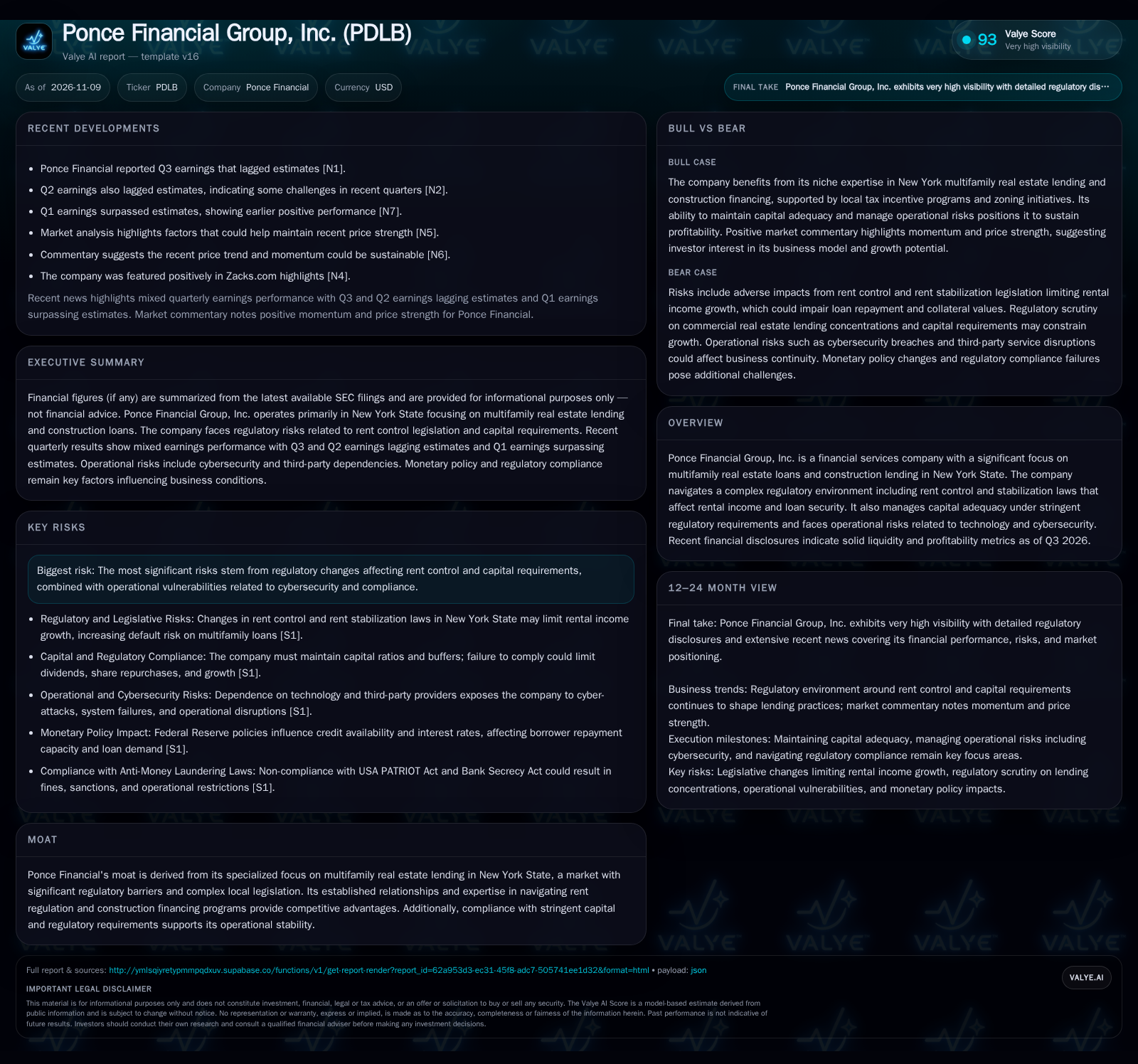
Ponce Financial’s Q3 2026 earnings came in below analyst estimates, continuing a trend from Q2, though Q1 results had previously exceeded expectations [N1] [N2] [N7]. This pattern highlights the impact of external factors—particularly rent control and stabilization laws in New York—on the company’s core lending business [S1]. The loan portfolio’s concentration in multifamily and construction loans makes asset quality and repayment closely tied to local legislative and policy developments. As of September 30, 2026, Ponce reported cash and cash equivalents of $132.2 million and net income of $18.2 million, maintaining compliance with all capital adequacy requirements [S2]. The company’s operational landscape is further shaped by ongoing risks from cybersecurity threats and technology dependencies [S1].
The interplay between regulatory developments and Ponce Financial’s earnings volatility underscores the importance of scenario planning and stress testing in the company’s risk management framework. Given the concentration in New York multifamily loans, even marginal changes in rent control enforcement or tax incentive eligibility can disproportionately impact borrower cash flows and, consequently, loan performance. This sensitivity necessitates robust underwriting that incorporates forward-looking regulatory risk assessments and dynamic credit monitoring. Additionally, operational resilience in cybersecurity and third-party management is critical, as disruptions can exacerbate financial stress during periods of regulatory uncertainty, potentially affecting both customer retention and regulatory compliance.
How Multifamily Lending Drives Revenue—and Risk
Ponce Financial’s primary revenue engine is interest income from multifamily real estate and construction loans in New York. Pricing typically reflects credit risk, property type, and regulatory constraints, with yields influenced by local rent controls, borrower quality, and the competitive lending environment. The mix of construction versus stabilized loans affects both risk and interest margins: construction loans may offer higher yields but carry greater default and completion risks, especially when dependent on tax incentives like the 485-x ANNY program [S1].
Fixed costs—such as regulatory compliance, technology infrastructure, and staffing—create operating leverage, while variable costs scale with loan origination and servicing. Funding needs are ongoing, as the company must manage deposit flows, wholesale funding, and regulatory capital buffers. The ability to maintain or grow the loan book without breaching capital ratios will determine scalability. If Ponce can maintain strong asset quality and low credit losses, profitability could benefit from positive operating leverage; however, credit deterioration or regulatory tightening could quickly erode margins.
The company’s revenue dynamics also hinge on the balance between loan origination volume and portfolio credit quality. If regulatory conditions tighten, Ponce may face pressure to restrict new lending or increase risk premiums, which could dampen origination growth and compress net interest margins. Conversely, easing regulations or expanded tax incentives could enable more aggressive loan growth but might also attract higher-risk borrowers, necessitating vigilant credit risk controls. From a capital management perspective, the firm must carefully calibrate loan growth against capital buffers to avoid regulatory breaches, which could limit operational flexibility. Furthermore, the fixed-cost nature of compliance and technology infrastructure means that scaling the loan book efficiently is essential to improving operating leverage and profitability.
Barriers, Advantages, and Pressure Points in New York’s Lending Arena
Ponce Financial’s specialization in New York multifamily lending provides a defensive moat rooted in regulatory expertise, deep local relationships, and the complexity of navigating state and city housing policy [S1]. Many potential competitors—regional banks, credit unions, and non-bank lenders—face steep learning curves and compliance hurdles entering this market. However, these same barriers can become double-edged if regulatory changes reduce lending opportunities or compress margins across the sector.
Alternative lenders and fintech platforms may compete on speed and digital convenience, but Ponce’s edge is likely in underwriting complex, policy-sensitive loans and leveraging local tax incentive programs. Substitution risk comes from broader capital market shifts—if institutional investors or non-traditional lenders become more aggressive, pricing power could weaken. The company’s dependence on New York’s real estate cycle and policy climate, however, limits its geographic diversification and exposes it to concentrated shocks.
Ponce Financial’s competitive positioning is further influenced by the evolving landscape of alternative financing sources and technological innovation. While the company benefits from its expertise in regulatory navigation and local market knowledge, fintech entrants and institutional investors may disrupt traditional lending models by leveraging data analytics, automation, and broader capital access to offer more competitive pricing or faster approvals. However, these competitors may lack the nuanced understanding of complex rent regulation and tax incentive frameworks that Ponce possesses, which could limit their ability to underwrite risk effectively in this niche. The company’s challenge will be to integrate technological advancements that enhance operational efficiency without diluting its core underwriting discipline or regulatory compliance capabilities.
When Policy and Execution Align: Pathways to Outperformance
If New York’s regulatory environment stabilizes or becomes slightly more favorable to landlords and developers—through either rent control reform or expanded tax incentives—Ponce could see improved loan demand, higher collateral values, and stronger borrower repayment profiles. Sustained compliance with capital requirements would support prudent loan growth, while effective management of operational and cybersecurity risks would limit costly disruptions.
Confirmation of this scenario would include: a return to consistent earnings beats, stabilization or improvement in net interest margins and asset quality metrics, and positive regulatory developments (such as renewal or expansion of tax incentive programs). Continued positive market momentum and investor interest, as highlighted in recent commentary, would further validate the upside case [N4] [N5] [N6]. Falsification would come from renewed regulatory tightening, a spike in loan delinquencies, or failure to maintain capital ratios.
Regulatory Flux and Earnings Volatility: The Most Likely Trajectory
The most plausible near-term outcome is a continuation of earnings volatility as Ponce Financial adapts to evolving rent control policies, periodic regulatory changes, and shifting monetary conditions.
This scenario would be confirmed by mixed quarterly results—occasional outperformance when regulatory or market conditions are benign, offset by weaker quarters when policy risk or credit losses materialize. Earnings will likely remain within a moderate band, with loan growth and profitability tied closely to the broader health of New York’s multifamily real estate market and the stance of local lawmakers. A sudden regulatory shock or severe credit event would move the outcome toward the downside.
Legislative Shocks and Asset Quality Deterioration: Adverse Outcomes
A sharp tightening of rent control or stabilization laws, reduction in tax incentive programs, or adverse regulatory intervention could significantly impair rental income for borrowers, leading to higher loan defaults and losses. If these shocks coincide with broader economic weakness or rising interest rates, Ponce could face rapid asset quality deterioration, margin compression, and potential capital ratio breaches.
Evidence for this scenario would include: a spike in non-performing loans, declining collateral values, negative earnings surprises, and regulatory warnings or restrictions. Operational disruptions—such as a major cybersecurity breach or failure of a key third-party provider—could exacerbate downside risks by undermining business continuity or eroding customer trust.
Tracking the Signals That Will Shape Ponce Financial’s Next Chapter
Quarterly trends in net interest margin and loan loss provisions—if disclosed—will reveal how well Ponce is managing credit risk and pricing power as the interest rate and regulatory environment shifts.
Changes in the proportion and performance of construction versus stabilized multifamily loans would help test the resilience of the loan book to policy and market shocks.
Regulatory updates around New York rent stabilization laws, tax incentive programs (such as the 485-x ANNY program), and capital adequacy requirements remain central external variables.
Asset quality metrics, including non-performing loan ratios and charge-offs—if disclosed—will be critical for gauging downside risk.
Operational risk disclosures, particularly around cybersecurity incidents or third-party service interruptions, would indicate the company’s ability to safeguard and scale its infrastructure.
Evidence of shifts in market share or competitive dynamics among regional and non-bank lenders in New York would help confirm or challenge the sustainability of Ponce’s niche advantage.
Disclosure of changes to capital ratios or regulatory buffers would signal the company’s capacity to absorb shocks or support growth.
Disclaimer: This is research-only, informational analysis and not investment advice. It may include AI-generated interpretation and general industry context. Always verify important details using primary sources.

Comments