
electroCore 2026: Commercialization Ambitions, Funding Needs, and the Stakes of Bioelectronic Adoption
Success will hinge on reimbursement, market uptake, and the company’s ability to secure capital for continued commercialization.
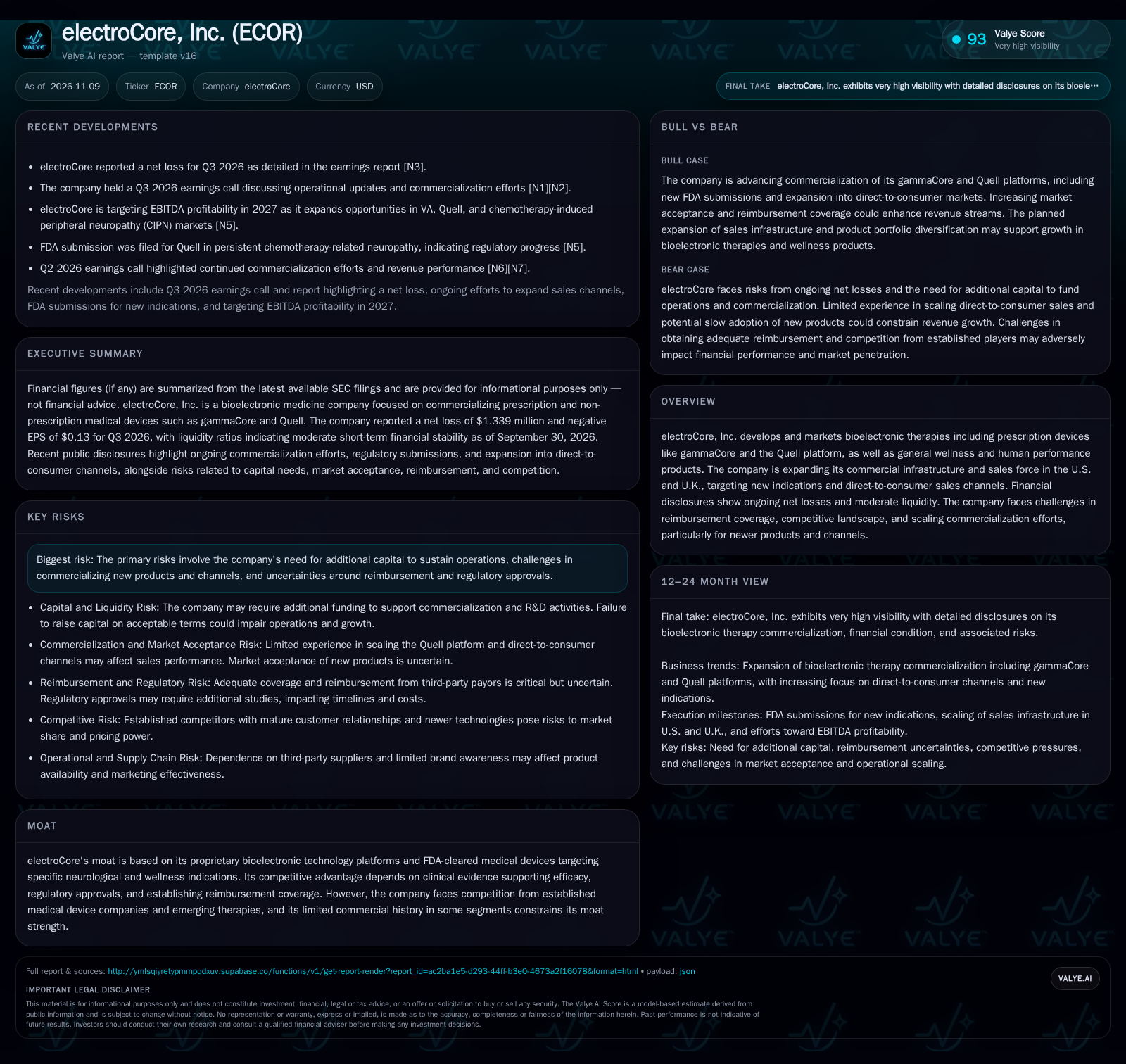
electroCore is expanding its U.S. and U.K. commercialization efforts for bioelectronic therapies like gammaCore and Quell, but reported a Q3 2026 net loss of $1.339 million and faces reported liquidity position with $6.3 million in cash. The path to 2027 EBITDA profitability depends on reimbursement, adoption, and funding execution as the company navigates capital needs and strong competition. [S2] [N3] [N5]
electroCore, Inc. is at a crossroads as it seeks to commercialize its bioelectronic therapies in both prescription and consumer health markets. With $6.3 million in cash and ongoing quarterly losses as of September 2026, the company is pushing for broader adoption of its gammaCore and Quell platforms while facing fundamental questions about reimbursement, competitive response, and its ability to secure additional funding. The next 12–24 months will test whether electroCore can convert its technology and early clinical traction into a sustainable business—and whether it can do so before capital constraints force a strategic pivot.
Where electroCore Stands: Losses, Liquidity, and Growth Ambitions
As of September 30, 2026, electroCore reported a net loss of $1.339 million for the quarter and cash and cash equivalents of $6.3 million, with a current ratio of 1.34 and a cash ratio of 5.62. These figures point to moderate short-term liquidity but ongoing operational losses. The company is actively expanding commercialization efforts for its Quell platform, including plans for a direct-to-consumer relaunch in 2026, and is targeting EBITDA profitability in 2027. However, management acknowledges the need for additional capital to support these activities, with a shelf registration allowing up to $100 million in potential securities issuance. [S2] [N3] [N5]
Revenue Potential and the Structural Challenges of Bioelectronic Commercialization
electroCore’s business model is built around proprietary medical devices—gammaCore (primarily prescription-based) and Quell (with both prescription and planned OTC variants)—targeting neurological and pain-related indications. Revenue can be generated through device sales, recurring disposable or software subscriptions (if implemented), and potentially through broader wellness products. Pricing power in the prescription device segment is heavily influenced by reimbursement rates and clinical evidence, while consumer health devices are exposed to out-of-pocket price sensitivity and require significant marketing investment.
Fixed costs include R&D, regulatory submissions, and the buildout of a sales force, while variable costs are driven by device manufacturing, distribution, and (for DTC channels) marketing spend. The company’s negative operating leverage is currently evident in its net losses, reflecting subscale revenues relative to its fixed cost base. Achieving sustainable margins will likely require substantial volume growth—especially in the U.S.—and successful navigation of reimbursement hurdles. Access to capital is a persistent need, as commercialization and R&D activities are cash-intensive and the company does not yet generate positive cash flow from operations. [S2] [N5]
If electroCore can secure reimbursement for new indications or expand into covered populations (e.g., veterans, migraine, CIPN), it could unlock higher-margin recurring revenue streams and reduce customer acquisition frictions. However, these outcomes are not yet certain.
Navigating Incumbents and New Entrants in a Crowded Device Landscape
electroCore’s competitive environment includes established medical device companies with deep sales relationships, regulatory experience, and reimbursement expertise, as well as emerging digital health and neuromodulation players. In the prescription channel, competition is driven by clinical efficacy, regulatory approvals, payor coverage, and clinician adoption. In the consumer wellness and performance space, the company faces a fragmented market with low switching costs and heavy marketing requirements.
While electroCore’s proprietary vagus nerve stimulation technology and FDA-cleared devices offer a potential moat, the durability of this advantage depends on ongoing clinical validation, successful regulatory expansion, and achieving reimbursement parity or superiority. The company’s limited commercial history in scaling direct-to-consumer channels is a vulnerability, as is its reliance on third-party suppliers for hardware production. Brand awareness and market education are further challenges, particularly for conditions where device-based therapies compete with pharmaceuticals or other non-invasive alternatives.
What If Reimbursement and Adoption Accelerate?
In a favorable scenario, electroCore secures broad reimbursement for its prescription therapies (gammaCore and Quell) across key indications, such as migraine and chemotherapy-induced peripheral neuropathy (CIPN). This drives increased physician adoption and patient access, enabling the company to scale U.S. sales more efficiently and leverage its fixed cost base. Concurrently, the planned 2026 OTC relaunch of Quell resonates with consumers, resulting in a successful direct-to-consumer ramp that diversifies revenue streams and reduces reliance on payor cycles.
This outcome would likely be confirmed by consecutive quarters of accelerating revenue growth, expansion of gross margins, and evidence of declining cash burn as operating leverage improves. Early signs could include new payor coverage decisions, published clinical outcomes supporting device efficacy, and strong reorder rates in consumer channels. If, however, major payors decline coverage or consumer adoption stalls, this scenario would be difficult to realize. [N5]
Incremental Progress Amid Funding and Execution Risks
The most plausible near-term trajectory is one of gradual revenue growth as electroCore expands its U.S. and U.K. sales force, launches new indications, and pursues both prescription and consumer health channels. The company will likely continue to report net losses through most of 2027, as fixed costs remain elevated and the direct-to-consumer relaunch requires upfront marketing investment. Reimbursement progress may be uneven, with some wins in targeted populations (e.g., VA, select insurers) but ongoing friction in broader commercial coverage.
This scenario would be confirmed by moderate sequential revenue gains, ongoing net losses (albeit potentially narrowing), and periodic capital raises to sustain operations. If revenue growth fails to materialize or cash runway shortens faster than expected, the company could be forced to scale back commercialization or seek strategic alternatives. Conversely, a sharp acceleration in sales or a major coverage win would tilt the case toward the upside.
When Reimbursement Friction and Capital Constraints Collide
The adverse scenario unfolds if electroCore is unable to secure adequate reimbursement for its prescription therapies, resulting in slow physician adoption and limited access for patients. Meanwhile, the Quell OTC relaunch may underperform due to weak consumer demand, high acquisition costs, or competitive pressure from better-capitalized brands.
This scenario would be confirmed by stagnating or declining revenue, persistent or widening net losses, and negative working capital trends. Watchpoints include failed payor negotiations, missed commercialization milestones, and evidence of supplier or operational disruptions. If electroCore cannot bridge to positive cash flow or demonstrate a clear path to sustainable growth, it may need to pursue a strategic sale, partnership, or restructuring. [S2] [N3]
Milestones and External Triggers That Could Shift electroCore’s Trajectory
Quarterly revenue growth trends, particularly in the prescription channel and the upcoming Quell OTC relaunch.
Updates on payor coverage decisions, especially for gammaCore and Quell in migraine, VA, and CIPN indications.
Gross margin evolution, which would indicate improved scale and/or pricing power.
Cash burn rate and runway—specifically, whether operational cash outflows are narrowing or accelerating.
New capital raises or drawdowns against the $100 million shelf registration, and the terms of any financing.
Commercialization milestones, such as expanded U.S. sales force deployment or new distribution agreements.
Clinical publication or regulatory submission updates for new indications that could unlock additional markets.
If disclosed, metrics on consumer reorder rates and customer acquisition costs for the Quell OTC channel.
Disclaimer: This is research-only, informational analysis and not investment advice. It may include AI-generated interpretation and general industry context. Always verify important details using primary sources.

Comments