
Hawthorn Bancshares: Margin Expansion, Acquisition Integration, and the Economics of Regional Banking Growth
Hawthorn Bancshares has delivered consistent net interest margin gains and net income growth through 2026, recently completing the FSC Bancshares acquisition. The company’s challenge now lies in extracting value from its enlarged footprint while navigating credit, integration, and rate risks in a competitive regional banking landscape.
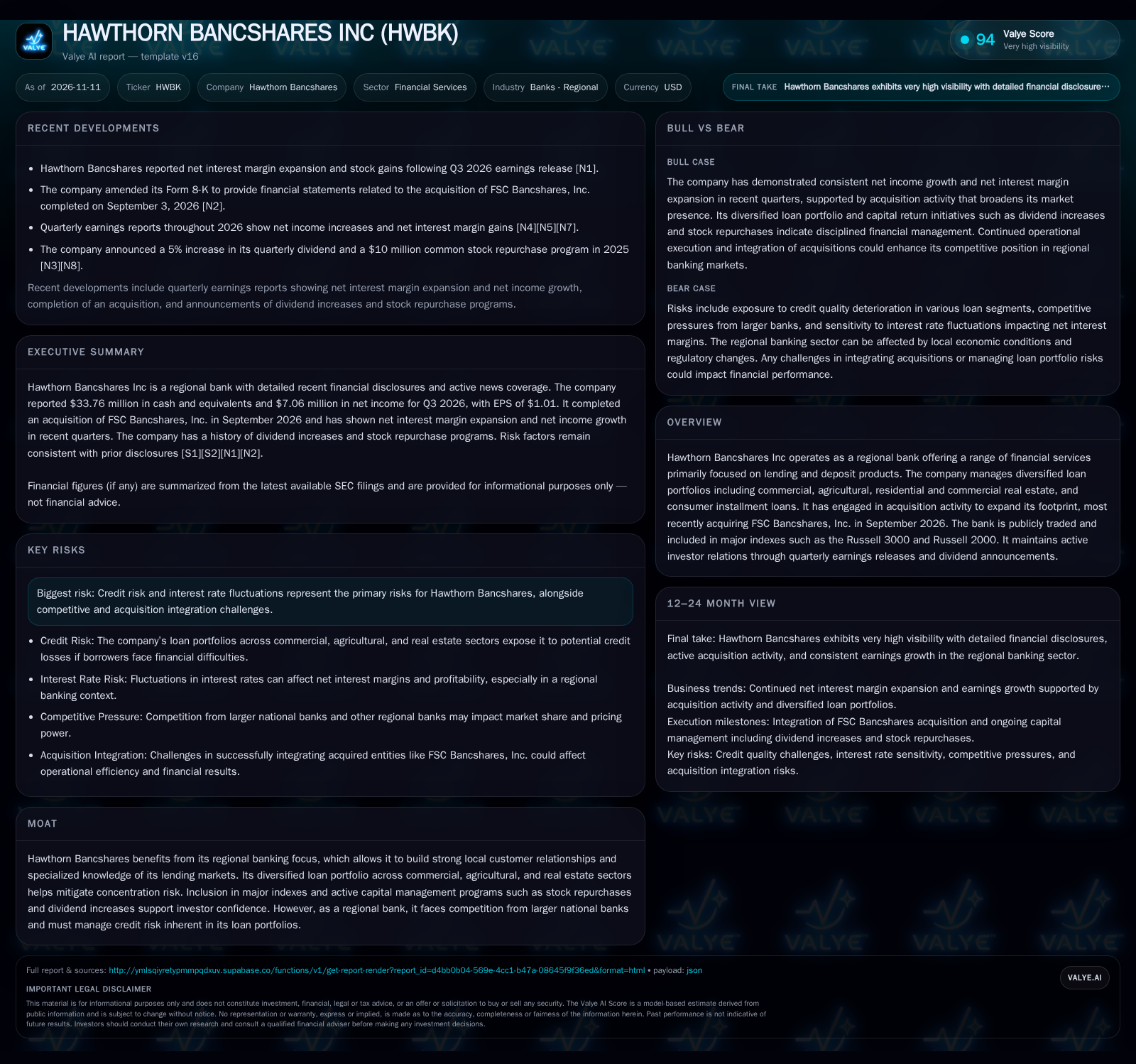
Hawthorn Bancshares reported Q3 2026 net income of $7.06 million and EPS of $1.01, alongside continued net interest margin expansion and the completed acquisition of FSC Bancshares. The company’s ability to sustain earnings momentum will depend on successful integration, credit quality management, and its response to shifting rate and competitive dynamics. Watch for loan performance, realized acquisition synergies, and deposit cost control as key forward tests. [S2] [N1] [N2]
Hawthorn Bancshares has moved assertively to expand its regional banking presence, reporting strong net interest margin gains and steady net income growth through 2026. The September acquisition of FSC Bancshares adds scale and balance-sheet heft, but also puts the spotlight on integration execution and the durability of recent margin improvements. In a sector where credit quality, deposit costs, and competitive dynamics can shift rapidly, Hawthorn’s next phase will test its ability to translate acquisition-driven growth into lasting shareholder value.
Recent Performance and Acquisition Shape the Next Phase
Hawthorn Bancshares reported net income of $7.06 million for Q3 2026, with basic and diluted earnings per share of $1.01 and cash and cash equivalents totaling $33.76 million as of September 30, 2026. The company has demonstrated consistent net interest margin (NIM) expansion and sequential net income growth over recent quarters. A major development was the acquisition of FSC Bancshares, completed on September 3, 2026. The deal brought $290 million in loans and $325 million in deposits onto Hawthorn’s balance sheet, with total consideration of $33.3 million split between cash and stock. Purchase accounting for the acquisition is not yet finalized, introducing some uncertainty to post-acquisition financials. No material changes in risk factors have been disclosed since the last 10-Q. [S2] [N1] [N2]
How Hawthorn Generates Returns: The Levers of Regional Bank Profitability
As a regional bank, Hawthorn Bancshares’ core earnings engine is net interest income—the spread between interest earned on loans and investment securities and interest paid on deposits and borrowings. The company’s recent net interest margin expansion suggests either a more favorable asset mix, improved pricing discipline, or slower repricing of deposit costs relative to loan yields. Operating leverage can be achieved through both organic growth and acquisitions that add scale without proportionate increases in fixed costs. However, regional banks face a constant balancing act: deposit growth and retention often require competitive rates, while lending growth must be weighed against credit risk.
The FSC Bancshares acquisition adds significant loan and deposit volume, potentially allowing Hawthorn to spread fixed costs across a larger base and negotiate better funding or service terms. However, integration costs, potential credit quality issues in the acquired portfolio, and the risk of customer attrition could offset these benefits. The company’s diversified loan book—spanning commercial, agricultural, real estate, and consumer segments—may help smooth volatility across credit cycles but also exposes the bank to multiple sources of sector-specific risk.
Capital requirements and regulatory constraints shape the pace at which Hawthorn can expand its balance sheet, particularly as new portfolios are integrated and as the bank remains subject to stress testing and minimum capital ratios. Deposit cost control and prudent loan underwriting will be critical to maintaining profitability if interest rates or local economic conditions shift.
Assessing Hawthorn’s Edge in a Crowded Regional Landscape
Hawthorn Bancshares operates in an intensely competitive arena, facing not just other regional banks but also community banks and the local arms of national financial institutions. Its traditional strengths lie in local market knowledge, relationship-based lending, and a diversified loan mix that can insulate against single-sector downturns. The recent acquisition of FSC Bancshares may enhance scale and provide cross-sell opportunities, but it also brings the challenge of cultural and systems integration.
Larger banks often have cost-of-capital and technology advantages, allowing them to offer more sophisticated digital platforms or undercut on pricing. Conversely, smaller banks may be nimbler in tailoring products to local customers. Hawthorn’s ability to maintain or grow share will likely hinge on its customer retention post-acquisition, the effectiveness of its underwriting, and its agility in adapting to digital banking trends.
Substitution risk is present in both the lending and deposit arenas: fintech lenders, credit unions, and digital-only banks continue to target profitable segments of the traditional banking market, potentially eroding fee income and compressing loan margins. To preserve its competitive position, Hawthorn must demonstrate not only credit discipline but also operational efficiency and customer service quality that justifies its regional focus.
Unlocking Acquisition Synergies and Sustaining Margin Gains
A favorable outcome for Hawthorn would involve seamless integration of FSC Bancshares, with minimal customer attrition, successful realization of cost synergies, and accretive contribution to earnings. Sustained net interest margin expansion—driven by disciplined loan pricing, prudent deposit cost management, and effective cross-selling into the enlarged customer base—could reinforce the company’s earnings trajectory.
Confirmation of this scenario would come from continued sequential growth in net income and NIM, positive trends in non-interest income (if disclosed), and stable or improving credit quality metrics in the consolidated loan portfolio. Evidence of rising operating leverage, such as declining efficiency ratios post-acquisition, would further support the thesis. If Hawthorn demonstrates above-peer growth in loan and deposit balances while holding credit losses below industry averages, it would suggest successful execution and potential for further value creation through future acquisitions or organic expansion.
Integration Delivers Mixed Results Amid Normalizing Margins
The most plausible outcome is that Hawthorn’s acquisition of FSC Bancshares delivers incremental scale benefits and modest earnings accretion, but with some frictional costs and short-term margin compression as integration proceeds. Net interest margin may plateau or even retreat slightly if deposit costs rise faster than loan yields or if competitive intensity increases in key markets.
In this scenario, the company’s diversified loan book helps mitigate material credit losses, but occasional non-performing loan upticks or integration hiccups could dampen profitability. Operating expenses may trend higher in the near term due to integration-related costs and investments in systems or compliance. The company maintains its regional competitive position but does not materially outpace peers on growth or profitability metrics.
Evidence for this trajectory would be relatively stable or mildly fluctuating quarterly earnings, NIM stabilization, and efficiency ratios that remain flat or improve only modestly. Any signs of increased credit provisioning or staff turnover in acquired operations would also signal a less-than-seamless integration.
Credit Deterioration or Integration Failures Pressure Returns
A negative scenario for Hawthorn would involve material credit deterioration—either from legacy or acquired loan portfolios—leading to elevated provisioning, higher charge-offs, and net income declines. If the integration of FSC Bancshares encounters operational, cultural, or systems challenges, customer attrition or loss of key personnel could erode the expected benefits of the deal.
This scenario could be triggered by adverse local economic developments, sector-specific shocks (such as agricultural or commercial real estate downturns), or a rapid rise in deposit costs that compresses net interest margins. Unanticipated expenses from integration or regulatory compliance could further pressure efficiency ratios and overall profitability.
Confirmation would come from sequential declines in net income and NIM, rising non-performing asset ratios, and higher credit loss provisions. A spike in integration-related costs, negative trends in customer retention (if disclosed), or downgrades to risk disclosures would also point to downside realization.
Forward Tests for Hawthorn’s Post-Acquisition Value Creation
Quarterly net interest margin (NIM) trends: Sustained or expanding NIM would indicate continued pricing discipline and funding cost management.
Sequential net income growth and per-share earnings: Consistency here would signal effective integration and healthy underlying economics.
Non-performing loan and charge-off ratios (if disclosed): Deterioration would suggest rising credit risk in the enlarged loan portfolio.
Deposit growth and cost of deposits: A useful metric would be the rate of change in deposit costs relative to peers, testing funding competitiveness.
Efficiency ratio progression: Improvement post-acquisition would confirm operating leverage and successful cost integration.
Acquisition-related expense disclosures and realized synergies: Updates on integration costs and synergy capture would help test management execution.
Staff turnover or customer attrition in acquired markets (if disclosed): These would provide early warning of integration friction or cultural misalignment.
Updates to risk factors or regulatory findings: Any material changes would affect the long-term thesis and risk profile.
Disclaimer: This is research-only, informational analysis and not investment advice. It may include AI-generated interpretation and general industry context. Always verify important details using primary sources.

Comments