
GeneDx in 2026: Genomic Data Scale, Adoption Opportunity, and the Reimbursement Squeeze
GeneDx Holdings Corp. leverages a rare-disease genomic dataset and AI tools to accelerate precision diagnostics in pediatric care, but faces mounting reimbursement risk, supplier concentration, and the challenge of scaling new revenue streams beyond core diagnostic testing.
GeneDx’s vast rare disease genomic database and FDA-designated exome/genome tests underpin its leadership in pediatric diagnostics, but persistent net losses, heavy reliance on a few suppliers, and looming 2027 reimbursement cuts cast uncertainty over its ability to convert scientific advantage into sustainable profits. The next phase depends on expanding adoption in newborn and prenatal care, commercializing its data/biopharma partnerships, and weathering external payment shocks.
GeneDx Holdings Corp. stands at a pivotal juncture in 2026, balancing a leadership position in rare pediatric disease genomics against persistent financial losses and looming reimbursement headwinds. Its proprietary dataset and AI-driven interpretation capabilities offer meaningful clinical differentiation, especially as first-tier exome and genome sequencing gains traction in pediatric, NICU, and prenatal care. Yet, the company remains heavily reliant on diagnostic testing revenues while facing supplier concentration and the risk of reduced CMS payments in 2027. The next year will test whether GeneDx can translate scientific and data-driven advantages into commercial scale and resilience, or whether external pressures will constrain its growth ambitions.
Recent Financial Results and External Pressures Set the Stage
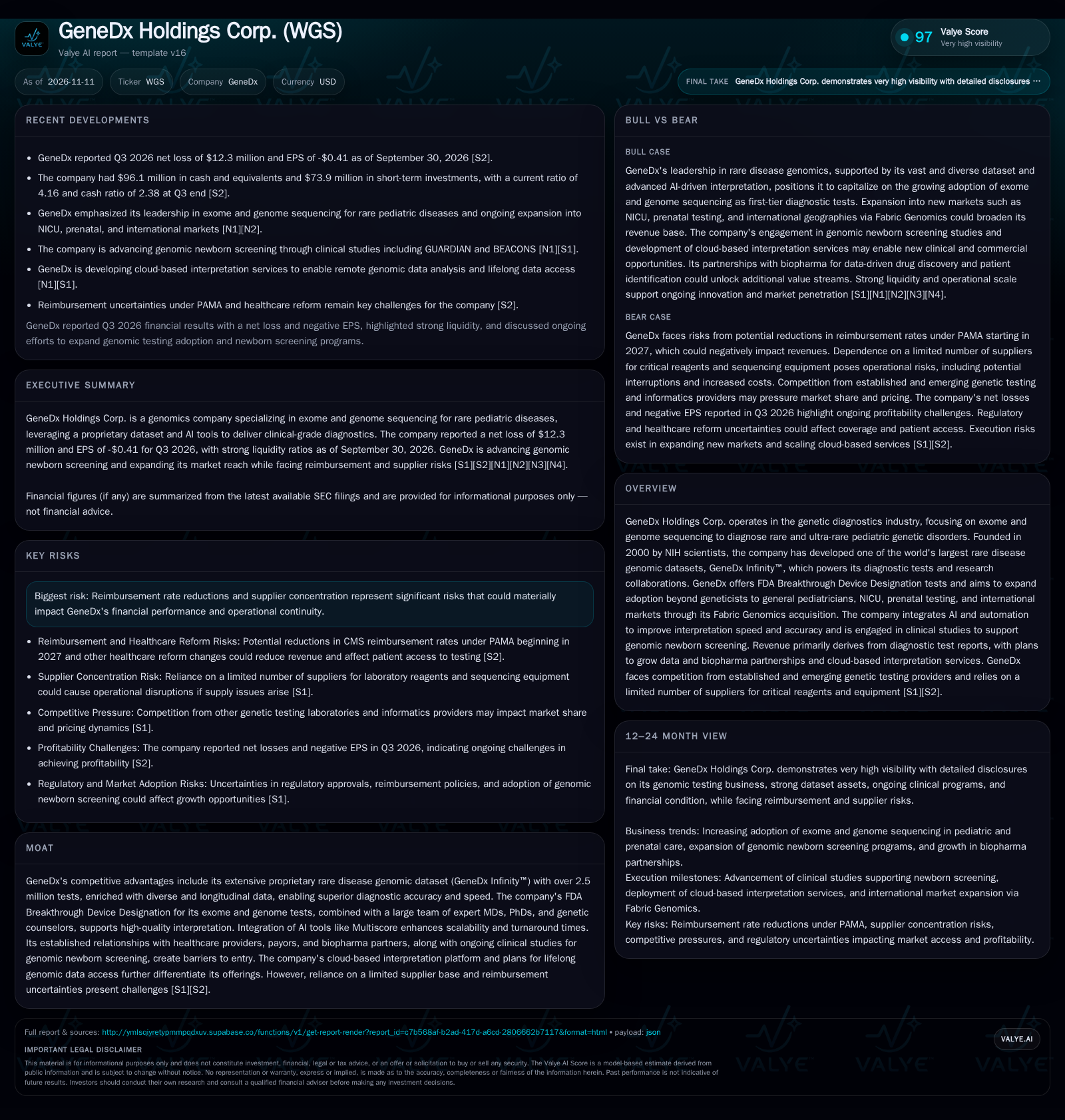
GeneDx reported a net loss of $12.3 million for Q3 2026, with basic and diluted EPS of -$0.41, continuing a trend of unprofitable operations [S2]. The company reported cash and liquidity metrics for the period; these figures do not by themselves establish operating runway, investment capacity, financial flexibility, or financing capacity. [S2] The company’s core business continues to center on clinical-grade exome and genome sequencing for rare and ultra-rare pediatric disorders, leveraging the GeneDx Infinity™ dataset [S1].
Externally, two forces are converging: first, the company faces potential reductions in CMS reimbursement rates under PAMA starting January 2027, which could directly impact top-line revenue from government-paid diagnostics [S2]. Second, GeneDx’s reliance on a limited number of suppliers for critical lab reagents and sequencing equipment—including names like Illumina and Agilent—remains an operational vulnerability [S1]. These factors will materially shape the company’s ability to sustain and scale its current business model.
How GeneDx’s Model Converts Genomic Insight into Revenue
GeneDx’s primary revenue stream is the sale of diagnostic test reports based on exome and genome sequencing, with a focus on rare pediatric disorders [S1]. Most of these tests are reimbursed through a patchwork of commercial and government payors, exposing the business to both pricing and volume risk tied to coverage decisions and reimbursement rates. Unit economics in genomic diagnostics are characterized by high fixed costs—laboratory infrastructure, data storage, software development, and a substantial workforce of MDs, PhDs, and genetic counselors—juxtaposed against variable costs for reagents and sequencing consumables.
Operating leverage is plausible if volume grows meaningfully; incremental tests can be processed with relatively modest increases in variable costs, especially as AI-assisted interpretation scales. However, price compression or reimbursement cuts can quickly erode margins, as fixed costs are not easily reduced. GeneDx’s secondary business lines—cloud-based interpretation services, data solutions, and biopharma partnerships—offer potential for higher-margin, recurring revenue, but these are not yet the main revenue drivers.
Genomic Data Scale as a Differentiator—But Not a Moat by Itself
GeneDx’s competitive strength lies in the breadth and diversity of its GeneDx Infinity™ dataset, which enables improved diagnostic yield, especially for underrepresented populations [S1]. The company’s FDA Breakthrough Device Designation for its exome and genome tests supports clinical credibility and may facilitate payer adoption. Its team of over 100 MDs/PhDs and 150 genetic counselors, together with proprietary AI tools, enables faster and potentially more accurate case interpretation.
However, competitive pressures are intensifying. Other genetic testing labs and informatics providers—such as Baylor Genetics, Tempus (Ambry Genetics), Variantyx, and Rady Children’s Hospital—are also investing in data platforms, AI interpretation, and partnerships with health systems [S1]. Switching costs for hospitals and providers are moderate, as integration and data portability improve. The risk is that advances in sequencing technology and falling costs could erode pricing, while payors may increasingly treat diagnostic genomics as a commodity. GeneDx’s supplier concentration further limits its bargaining power and operational flexibility.
Winning the First-Tier Test Battle and Unlocking Data Monetization
If GeneDx succeeds in driving the adoption of exome and genome sequencing as the default first-tier test in pediatric outpatient, NICU, and prenatal settings, the company could see a step-change in test volume and revenue. This scenario depends on clinical studies (such as GUARDIAN and BEACONS) producing compelling evidence for improved outcomes and cost-effectiveness of genomic newborn screening [S1]. Payer coverage would need to expand, and reimbursement rates would need to remain stable or improve.
Further upside could come from successful commercialization of cloud-based interpretation services and data analytics offerings—providing remote analysis and lifelong genomic data access not just in the U.S. but also through international expansion via the Fabric Genomics platform. Partnerships with biopharma for clinical trial recruitment and drug discovery analytics could unlock new, higher-margin revenue streams. Confirmation would come from accelerating test volumes, growing non-diagnostic revenue, new long-term contracts with health systems and payors, and evidence of margin expansion even as the business scales.
Sustaining Diagnostic Growth While Managing Margin and Policy Risks
The most plausible near-term scenario is that GeneDx maintains or modestly grows its core diagnostic testing volume, supported by incremental adoption in pediatric, NICU, and prenatal markets. Revenue mix continues to be dominated by test reports, with cloud-based and biopharma offerings contributing but not transforming the P&L in 2026-2027.
Profitability remains elusive due to ongoing investment in R&D, data infrastructure, and clinical studies, as well as pricing pressure from both competitors and payors. A useful test would be the company’s ability to offset reimbursement declines through operational efficiencies or new contracting models.
Reimbursement Cuts and Supplier Disruptions Trigger a Profitability Crisis
A negative spiral could be triggered if PAMA-driven CMS reimbursement reductions take effect in January 2027 and are not offset by higher commercial volumes or new revenue streams [S2]. This would compress margins on the company’s largest revenue segment and could force GeneDx to cut costs, reduce R&D, or even seek additional capital under unfavorable terms. Supplier concentration risk could be realized if a key vendor (e.g., Illumina) raises prices, experiences a supply disruption, or shifts terms, further increasing variable costs and operational complexity.
Competitive responses—such as price cuts from other labs or rapid adoption of more commoditized testing models—could accelerate market share loss. In this scenario, evidence would include declining test volumes, contracting gross margins, rising cash burn, and negative revisions to revenue guidance. Regulatory or operational setbacks in new programs or international expansion would further reinforce the downside.
Signals That Will Determine If GeneDx Converts Leadership Into Profitable Scale
Quarterly test volume growth in core pediatric, NICU, and prenatal sequencing segments—if disclosed—will reveal whether GeneDx is gaining share or merely defending its installed base.
The pace and scale of non-diagnostic revenue from cloud-based interpretation services, data solutions, and biopharma partnerships; a useful metric would be segment revenue breakout or announced multi-year contracts.
Updates on the outcomes and adoption of clinical studies like GUARDIAN and BEACONS, which underpin the clinical and economic case for genomic newborn screening.
Any disclosed changes in average reimbursement rates or payer mix, especially in light of anticipated PAMA cuts in 2027.
Gross margin trends and operating expense discipline as new products and services are brought to market.
Supplier risk disclosures or events—such as changes in terms with Illumina or other key reagent/equipment vendors—that could impact cost structure or operational continuity.
Progress in international expansion and Fabric Genomics platform adoption, evidenced by new customer announcements or country launches.
Disclaimer: This is research-only, informational analysis and not investment advice. It may include AI-generated interpretation and general industry context. Always verify important details using primary sources.

Comments