
ImageneBio After Its Merger: Capital, Clinical Focus, and the Path Through Biotech Volatility
ImageneBio’s post-merger profile centers on IMG-007 (olevaprubart), a single drug candidate targeting immunological conditions.
ImageneBio’s business is currently defined by its focus on the development of IMG-007, reported liquidity position following a $30 million capital raise, and the integration of new leadership post-merger. The key challenge is translating this financial cushion into clinical and regulatory progress before further dilution is needed.
ImageneBio, Inc., newly reconstituted from the merger of Ikena Oncology and Inmagene Biopharmaceuticals, is navigating the volatile landscape of clinical-stage biopharma with a singular focus: the advancement of IMG-007 (olevaprubart) for immunological and inflammatory diseases. The company’s risk/reward profile remains sharply defined by the binary nature of drug development and the capital intensity of the sector.
Recent Capital Raise, Leadership Shift, and a Singular Pipeline Focus
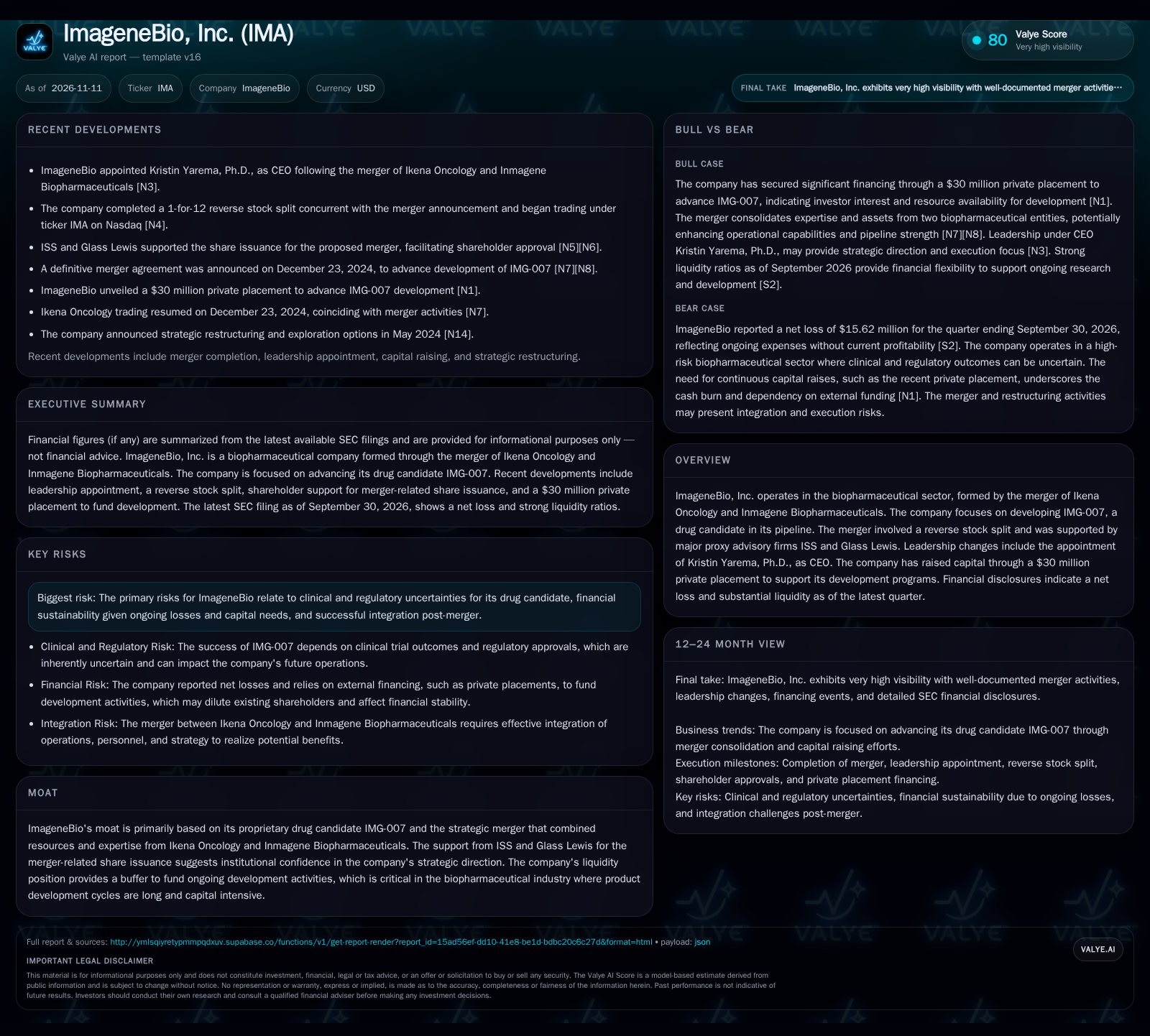
ImageneBio’s current state is shaped by several material developments: the appointment of Kristin Yarema, Ph.D., as CEO following the merger of Ikena Oncology and Inmagene Biopharmaceuticals [N3]; the completion of a 1-for-12 reverse stock split and the adoption of the new ticker IMA [N4]; and the successful closing of a $30 million private placement aimed at advancing IMG-007, now named olevaprubart [N1]. As of September 30, 2026, the company reported $84.85 million in cash and equivalents and $41.74 million in short-term investments, with a current ratio of 16.17 [S2]. However, the company posted a net loss of $15.62 million for the quarter, highlighting ongoing R&D expenditure and a lack of commercial revenue [S2]. These facts underscore ImageneBio’s position as a well-capitalized, yet loss-making, clinical-stage biopharma betting its future on a single asset.
Beyond the headline liquidity figures, a deeper examination of the company’s capital structure and burn profile is critical to understanding its operational runway. Additionally, the timing and terms of the recent private placement may affect shareholder dilution and investor appetite for future raises. The post-merger leadership change also signals a potential shift in strategic priorities and resource allocation, which could impact the pace and focus of clinical development. Understanding how these elements align will help assess the sustainability of the company’s current trajectory.
Funding the Clinical Gamble: ImageneBio’s Cash Burn and Operating Leverage
ImageneBio’s business model is typical of early-stage biopharma: it absorbs significant R&D and G&A expenses without offsetting revenue, relying on periodic equity raises to fund operations. The $15.62 million quarterly net loss reflects high fixed costs, especially as the company advances IMG-007 through costly clinical trials [S2]. Variable costs are largely tied to trial scale and complexity, while fixed costs include personnel, regulatory, and infrastructure overhead.
The economics of success in this sector are highly nonlinear: successful clinical outcomes and regulatory approvals can transform a persistent cash burn into a high-margin, royalty- or sales-driven revenue stream with significant operating leverage. However, failure at any stage can quickly erode value, leaving a cash-dependent entity with limited salvage options. The company’s reliance on contract manufacturers for clinical supply suggests future gross margins—if commercialization is achieved—could be pressured by third-party costs, at least initially.
Navigating a Crowded Immunology Space: Competitive Threats and Differentiation Hurdles
ImageneBio is developing IMG-007 (olevaprubart) for atopic dermatitis, alopecia areata, and potentially other immunological indications, targeting markets already served by established and emerging therapies. The company faces competition from large pharmaceutical and biotech firms with deeper pipelines, greater commercial infrastructure, and extensive clinical experience. Durable differentiation in this space typically requires either a clear efficacy or safety advantage, a novel mechanism of action, or superior dosing/convenience.
Switching costs for prescribers and patients are typically low unless a therapy demonstrates significant benefits over standard of care. If IMG-007’s clinical data can establish meaningful advantages in efficacy, safety, or patient-reported outcomes, the company might secure a foothold. However, without clear clinical superiority or a unique value proposition, payer and provider adoption could be slow, and pricing power limited. The company’s future competitive position will be shaped by the quality of its clinical data, regulatory outcomes, and the evolving landscape of immunology drug development.
What Could Unlock Value: Successful Data and the Potential for Strategic Partnerships
The most favorable scenario for ImageneBio is a positive clinical readout for IMG-007, which could validate the drug’s mechanism and safety profile in its lead indication and potentially open doors for additional indications or strategic partnerships. Such a result could catalyze interest from larger biopharma partners seeking to in-license or co-develop the asset, bringing non-dilutive capital and commercial expertise.
Confirmation of this scenario would require: 1) robust, statistically significant efficacy and safety data from ongoing or upcoming trials; 2) clear communication of regulatory milestones and timelines; and 3) evidence of interest from potential partners or acquirers. If the company can also demonstrate prudent cash management and a clear development path, the probability of value inflection—through either M&A or out-licensing—would rise. The thesis would be weakened if clinical data are equivocal, timelines slip, or no external validation emerges.
Clinical Timelines Dominate: Progress, Delays, and the Capital Clock
The most plausible outcome is that ImageneBio continues to advance IMG-007 through planned clinical milestones, experiencing the typical mix of incremental progress, timeline adjustments, and capital consumption seen in clinical-stage biotech.
This scenario would be confirmed by steady clinical trial enrollment, timely data releases, and transparent communication regarding cash runway and future financing needs. It would be challenged if trial enrollment lags, unexpected safety or efficacy concerns arise, or if the company faces difficulty accessing additional capital on acceptable terms.
If Clinical Setbacks or Funding Gaps Emerge: The Risk of Value Erosion
ImageneBio’s downside is defined by the binary risk embedded in clinical-stage biopharma. If IMG-007 fails to meet primary endpoints in ongoing trials or demonstrates an unfavorable safety profile, the company could see its investment case collapse, with limited alternative assets to pivot toward. Similarly, if the company is unable to raise additional capital as the cash runway shortens, it could be forced into asset sales, program discontinuations, or strategic restructuring under duress.
Signs of this scenario would include negative or inconclusive clinical data, regulatory delays, or failed financing attempts. An extended period of weak clinical or capital markets news flow could also result in market cap erosion and reduced strategic options, given the company’s dependence on a single pipeline asset.
Milestones That Will Shape ImageneBio’s Future Trajectory
Clinical trial enrollment rates and data readout timelines for IMG-007: Slippage or acceleration here would materially affect both capital needs and investor confidence.
Cash burn rate and updated runway guidance: Management’s ability to manage expenses against available liquidity will determine the need and timing for further dilution.
Any disclosed partnership, licensing, or M&A discussions: External validation or non-dilutive capital could shift the risk/reward profile.
Regulatory feedback on IMG-007’s clinical progress, including feedback from the FDA or other agencies, would help clarify approval pathways and risks.
Progress in expanding IMG-007 into additional indications: Early signals of pipeline breadth could bolster long-term optionality.
Management commentary on integration progress post-merger: Clear articulation of cost synergies or strategic focus would help assess execution risk.
If disclosed, manufacturing or supply chain updates: Delays or cost overruns could affect trial timelines and future gross margin structure.
Market reaction and volume around trial milestones: Unusual volatility could signal shifting investor expectations or insider views.
Disclaimer: This is research-only, informational analysis and not investment advice. It may include AI-generated interpretation and general industry context. Always verify important details using primary sources.

Comments