
AlTi Global: Scaling a Diversified Wealth Platform While Navigating Volatility and Reporting Challenges
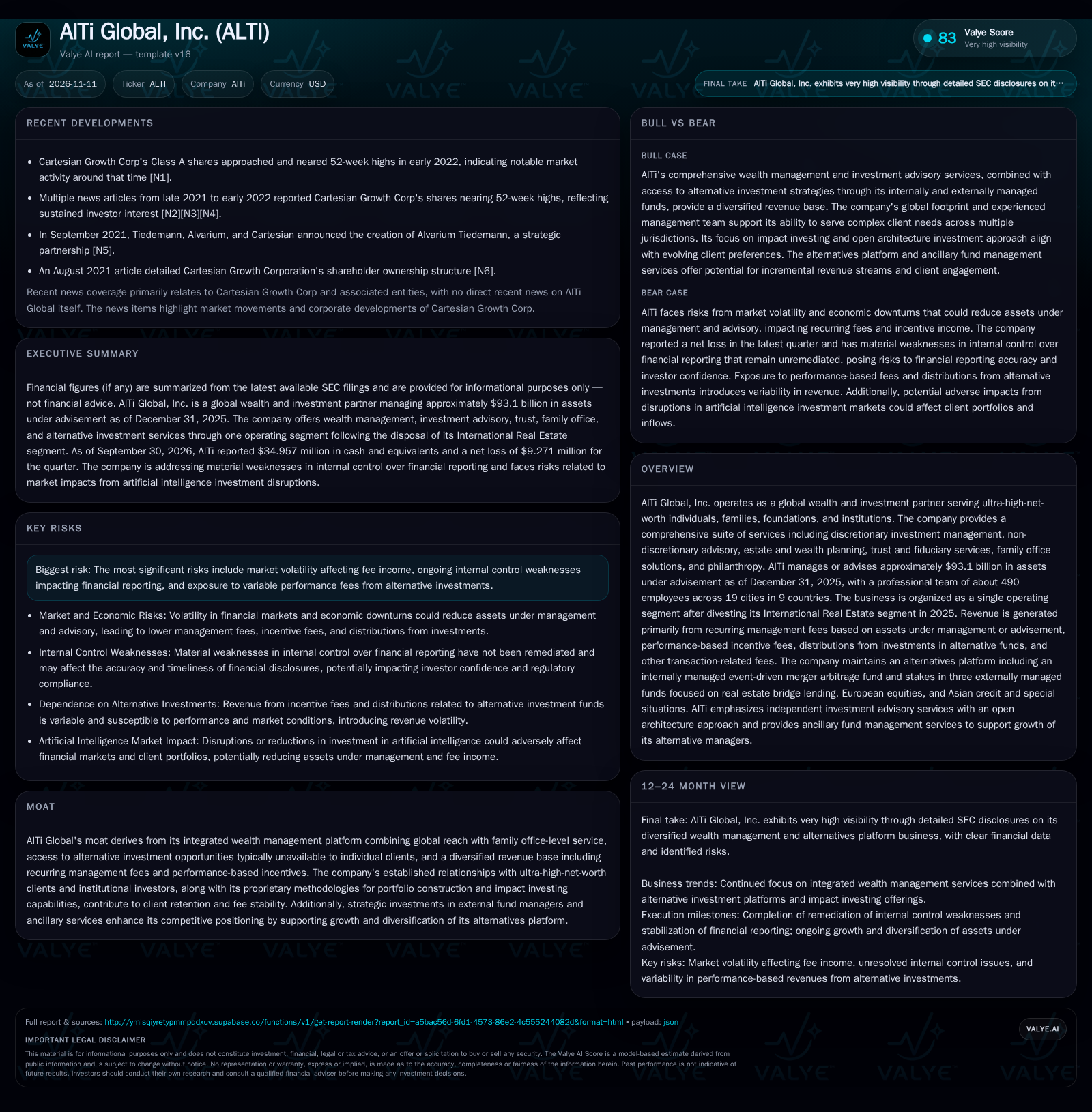
AlTi Global, Inc. stands at the intersection of global wealth management and alternative investments, serving ultra-high-net-worth clients with a $94.5 billion advisory platform. The company’s recurring fee model and alternatives push offer strategic breadth, but persistent net losses and unresolved internal control weaknesses highlight the need for operational discipline as market headwinds and revenue variability test the business model.
AlTi Global manages or advises on $94.5 billion in assets for ultra-high-net-worth clients, with revenues anchored in recurring management fees and supplemented by performance-based and alternative investment income. Despite its global scale and service breadth, the company reported a net loss and continues to address material weaknesses in financial reporting, underscoring execution risks as it seeks to grow its alternatives platform and maintain client trust amid volatile markets. [S2]
AlTi Global, Inc. is attempting to carve out a durable niche at the high end of wealth management by combining a global footprint, open-architecture advisory, and access to exclusive alternative investments. With $94.5 billion in assets under advisement as of September 30, 2026, and a presence spanning 19 cities across three continents, AlTi offers a compelling value proposition for ultra-high-net-worth clients seeking both customized service and institutional-caliber investment options. Yet, the company’s latest quarter saw a net loss and persistent material weaknesses in financial reporting, raising questions about its ability to balance ambitious platform growth with operational rigor—especially as volatile markets test both client loyalty and earnings stability. [S2]
Current Operating Posture: Scale, Diversification, and Persistent Execution Gaps
As of September 30, 2026, AlTi Global managed or advised on $94.5 billion in combined assets, serving a global client base of ultra-high-net-worth individuals, families, and institutions from 19 cities in 9 countries. The company reported a net loss of $9.271 million for the quarter ended September 30, 2026, and held $34.957 million in cash and equivalents. Notably, AlTi continues to remediate material weaknesses in internal control over financial reporting, an effort expected to extend through 2026. These facts highlight a business with significant scale and a diversified service offering, but also underscore the operational and financial challenges that could constrain near-term value creation. [S2]
Revenue Model Dynamics: Recurring Fees Anchor, Alternatives Drive Upside (and Volatility)
AlTi’s core economic engine is recurring management, advisory, trustee, and administration fees, which are typically charged as a percentage of assets under management or advisement and billed quarterly in arrears. This structure provides a relatively predictable baseline of revenue, especially valuable in turbulent markets. However, the company’s push into alternative investments—via its internally managed TIG Arbitrage fund and stakes in externally managed funds—adds a performance-driven layer to its income, with incentive fees and distributions dependent on fund results and market cycles. This introduces revenue variability and tightens the link between market performance and profitability.
Operating leverage is plausible: as assets and client relationships scale, the incremental cost of servicing new AUM should decline, especially for advisory and administrative functions. However, growth in alternatives may require specialized talent and infrastructure, raising fixed costs. Capital needs are moderate for a wealth manager, but the company’s net losses and the necessity to invest in compliance and controls could constrain reinvestment in growth initiatives if not addressed.
Where AlTi Fits in the Global Wealth and Alternatives Landscape
AlTi operates in a highly competitive wealth management market, contending with global private banks, independent multi-family offices, and specialist OCIO providers. Its global reach and open-architecture approach—eschewing proprietary product pushes for independent advice—are attractive to sophisticated clients wary of conflicts of interest. The ability to offer access to exclusive alternative investments (such as event-driven arbitrage, real estate bridge lending, and Asian special situations) may differentiate its value proposition, especially for clients seeking diversification beyond traditional assets.
However, barriers to entry are not absolute. Large incumbents can replicate open architecture, and alternative fund access is increasingly available via platforms and feeder funds. Client switching costs are moderate: while relationship depth and customized service foster loyalty, ultra-wealthy clients are discerning and may move assets if service, performance, or trust in financial controls falters.
Leveraging Alternatives and Remediation Success to Unlock Profitable Growth
A favorable trajectory for AlTi would see continued AUM growth from new and existing clients, particularly in the alternatives platform where performance fees and distributions can significantly enhance margins. If internal control weaknesses are successfully remediated on schedule, this could restore investor confidence, support more efficient operations, and enable management to focus on client acquisition and product innovation.
Upside confirmation would come from a return to sustained profitability, visible increases in incentive fees from outperforming alternative strategies, successful onboarding of new ultra-high-net-worth families, and positive regulatory or third-party validation of internal control effectiveness. Additionally, evidence of net inflows into both traditional and alternative mandates—even during periods of market stress—would suggest the platform’s resilience and appeal.
Steady-State Wealth Management Anchored by Recurring Fees, with Alternatives as a Swing Factor
The most plausible outcome is that AlTi maintains its core client base and AUA/AUM around current levels, generating stable recurring management fees while experiencing episodic swings in performance-based and alternatives-related revenues. Internal control remediation may proceed gradually, with operational costs elevated until completion. Modest inflows from new clients and incremental growth in alternatives may offset outflows or fee compression from competitive pressure.
This scenario would be confirmed by relatively flat AUM/AUA, muted but persistent net losses or break-even results, and ongoing disclosures about progress (but not completion) of control remediation. A lack of major client losses, headline regulatory events, or sharp drops in management fee revenue would support the base case.
Market Turbulence and Control Failures Amplify Outflows and Fee Compression
A negative chain of events could see market volatility or adverse macro shocks driving down client asset values and triggering outflows, shrinking both management and performance fee revenue. If internal control weaknesses persist or worsen, regulatory scrutiny could intensify, eroding client trust and making new asset gathering difficult. Underperformance in alternative funds would depress incentive fee income and potentially result in client redemptions from those strategies.
Downside confirmation would include a material decline in AUA/AUM, sharp drops in recurring fee revenue, negative press or regulatory action related to controls, and accelerated net losses. Client attrition, especially among flagship relationships, and the loss of key professionals would also reinforce a bear case.
What Will Reveal AlTi’s Long-Term Value Creation Potential
Net new asset flows, both gross and net of outflows, by client segment and geography—if disclosed—will indicate whether AlTi is gaining share or struggling to retain core relationships.
Progress updates and eventual completion of internal control remediation, including auditor or regulatory validation, would materially affect investor confidence and growth capacity.
Breakdown of revenue by type—particularly the proportion and volatility of incentive fees—would help gauge earnings stability versus risk.
Performance of the internally managed and externally managed alternative funds, including realized incentive fees and distributions, would clarify the alternatives platform’s contribution and sensitivity to market cycles.
Retention of key professionals, especially relationship managers and alternatives specialists, will be critical to maintaining client trust and platform expertise.
Any significant client wins, flagship mandate renewals, or high-profile client departures would be important signals for competitive positioning.
Disclosures on operational and technology investments, particularly those aimed at compliance and risk management, would help assess management’s commitment to robust infrastructure.
A useful metric would be client satisfaction or net promoter scores, if made public, as a leading indicator of future asset retention and referral growth.
Disclaimer: This is research-only, informational analysis and not investment advice. It may include AI-generated interpretation and general industry context. Always verify important details using primary sources.

Comments