
ZipRecruiter’s AI Marketplace: Durable Data, Competitive Pressures, and the Next Phase of Hiring Platform Economics
ZipRecruiter posted Q3 2026 revenue of $124.4 million and net income of $5.1 million, with reported liquidity position and a metrics-driven approach.
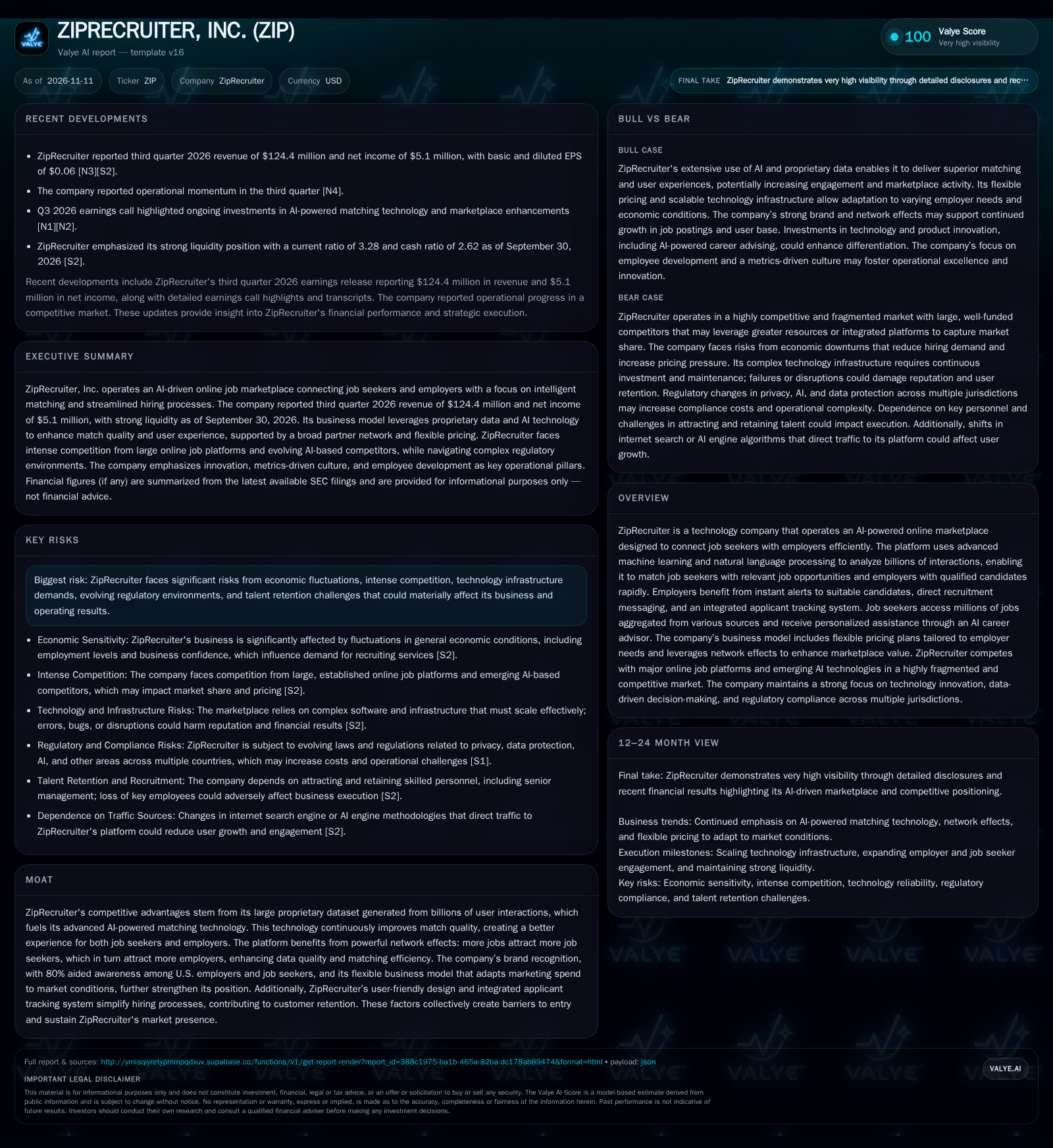
ZipRecruiter posted Q3 2026 revenue of $124.4 million and net income of $5.1 million, with reported liquidity position and a metrics-driven approach [S2] [N3]. Its AI-driven job marketplace leverages proprietary data and network effects to match job seekers and employers. The company faces intense competition from large platforms and emerging AI challengers, and must continually invest in technology and compliance. The durability of its matching advantage and ability to adapt to economic cycles and regulatory shifts will determine future performance.
ZipRecruiter has emerged as a major player in the online hiring ecosystem, blending AI-driven matching with a flexible, metrics-based business model. Its Q3 2026 results highlight both operational strength—evidenced by profitability and reported liquidity position—and the ongoing need to defend its competitive position against larger, resource-rich rivals and fast-moving AI entrants. The company’s future will be defined by how effectively it can leverage its proprietary data and network effects, while adapting to cyclical hiring demand and regulatory complexity.
Q3 2026: Profitability, Liquidity, and Technology Investment Define the Moment
ZipRecruiter reported Q3 2026 revenue of $124.4 million and net income of $5.1 million, with basic and diluted EPS of $0.06 [S2] [N3]. These results demonstrate that the company is not only growing its top line but also maintaining profitability, a notable achievement in the competitive HR tech sector. As of September 30, 2026, ZipRecruiter held $174.7 million in cash and equivalents, with a current ratio of 3.28 and a cash ratio of 2.62 [S2]. The company reported cash and liquidity metrics for the period; these figures do not by themselves establish operating runway, investment capacity, financial flexibility, or financing capacity.
The company continues to prioritize AI-powered matching technology and marketplace enhancements, as highlighted in recent earnings calls [N1] [N2]. This focus on product innovation underpins its differentiation strategy but also demands consistent capital allocation and operational discipline. With operational momentum cited in the most recent quarter [N4], the near-term context is one of financial stability and active investment in core capabilities.
Marketplace Economics: Pricing, Scale, and the Leverage of Data-Driven Matching
ZipRecruiter’s business model is built around a two-sided online marketplace connecting employers and job seekers, monetized primarily through flexible pricing plans tailored to employer needs [S1]. While the report does not disclose precise contract structures or take rates, the platform’s ability to dynamically adjust sales and marketing spend introduces variable cost flexibility, helping to protect margins during demand fluctuations.
The core economic engine is the proprietary AI matching algorithm, which leverages data from billions of interactions to improve the relevance and speed of matches [S1]. This creates potential for higher employer conversion rates and greater job seeker engagement, which could support pricing power if differentiation holds. The company’s broad distribution network—including its own properties and third-party job boards—expands reach and can help drive volume, while its integrated applicant tracking system may reduce employer friction and churn.
Operating leverage is plausible as the platform scales: incremental matches and job postings can be handled with relatively modest increases in infrastructure and support costs, provided technology investments keep pace with growth. However, continuous investment in AI, security, and compliance is likely to remain a material fixed cost, moderating margin expansion even as revenues rise.
Data Moats, Network Effects, and the Battle for Employer Mindshare
ZipRecruiter’s principal competitive advantages are its large proprietary dataset—fueled by billions of user interactions—and its AI-driven matching technology, which is designed to continuously improve as more activity flows through the marketplace [S1]. These network effects can create a flywheel: more employers mean more jobs, which attract more job seekers, which in turn draw in additional employers.
However, the strength and sustainability of this moat are contested by several factors. The company faces direct competition from established online job platforms (e.g., Indeed, LinkedIn, Glassdoor) and large-scale aggregators (such as Google and Meta), all of which possess significant user bases, brand awareness, and technology investments [S1]. Emerging AI-first platforms—potentially leveraging novel models or new data sources—also threaten to erode ZipRecruiter’s matching advantage.
Switching costs for employers and job seekers are not inherently high in this category. While integrations with applicant tracking systems and workflow tools may increase stickiness, the commoditization of job postings and the ease of multi-homing across platforms mean that ZipRecruiter must continually defend its position through product innovation, service reliability, and sustained marketing investment.
AI-Driven Matching Yields Defensible Differentiation and Margin Expansion
A favorable scenario for ZipRecruiter is one in which its ongoing investments in AI and proprietary data yield a sustained competitive edge in match quality and hiring efficiency. If the platform’s algorithms consistently deliver more relevant candidate recommendations—translating into faster, higher-quality hires for employers—ZipRecruiter could see increased employer retention, higher average revenue per user, and greater share of wallet.
Confirmation of this scenario would involve evidence of rising customer lifetime value, reduced employer churn, and positive feedback on match quality relative to competitors (if disclosed). Further, as scale increases, operating leverage could drive margin expansion, provided technology costs do not scale linearly with revenue. Signals would include continued profitability, growing net income margins, and the ability to reinvest in product innovation without diluting returns.
Falsification would occur if product differentiation erodes—e.g., if employers report negligible improvements over alternatives, or if new AI-native platforms achieve parity in match outcomes and user experience.
Sustained Relevance Amid Cyclical Hiring and Evolving Platform Dynamics
The most plausible path is one where ZipRecruiter maintains relevance as a top-tier online hiring marketplace, but faces persistent margin pressures and periodic volatility due to macroeconomic cycles and competitive pricing. The company continues to win business from a broad base of employers, leveraging its AI engine and broad distribution network, but must regularly invest to keep pace with evolving best practices in matching, compliance, and user experience.
In this scenario, revenue growth tracks broader employment trends, with periodic slowdowns during economic contractions. Operating margins are positive but not structurally expanding, as technology and compliance costs absorb some of the incremental gains from scale. Evidence would include steady but not accelerating revenue growth, continued profitability, and ongoing product launches or enhancements.
This scenario could be falsified by a material loss of market share to existing giants or new AI disruptors, or by a step-change increase in regulatory or technology costs that compress margins.
Commoditization, Customer Churn, and the Risks of Platform Disruption
A negative sequence would see ZipRecruiter’s AI matching advantage neutralized by advances from larger competitors or new entrants, resulting in commoditization of the core job-matching function. In this environment, employers may increasingly multi-home across platforms, driving down pricing and increasing customer churn.
Further, external shocks—such as a prolonged economic downturn, significant regulatory changes in data or AI governance, or major technology failures—could compound these pressures. High fixed costs for technology and compliance would squeeze margins, potentially eroding the company’s ability to invest in innovation or marketing.
Evidence supporting this scenario would include declining employer and job seeker engagement (if disclosed), falling renewal rates, negative operating leverage, or sustained periods of negative profitability.
Milestones and Metrics That Will Shape ZipRecruiter’s Competitive Trajectory
Customer retention and renewal rates for employers—if disclosed—would provide insight into the stickiness of the platform and the strength of its differentiation.
Changes in average revenue per employer or job posting could reveal shifts in pricing power or competitive pressure.
Reported engagement metrics from job seekers (such as application rates, time-to-hire, or repeat usage) would help test the efficacy of the AI matching engine.
Evidence of continued investment in AI and technology infrastructure, including capitalized R&D or product launch cadence, would indicate the company’s ability to sustain its innovation lead.
Any disclosed major customer wins, losses, or strategic partnerships could signal changing competitive dynamics or channel dependence.
Updates on regulatory or compliance costs, especially related to data privacy or AI governance, would clarify the evolving risk profile.
Trends in operating margin and net income, especially during periods of hiring volatility, would test the resilience of the business model.
If disclosed, employer and job seeker Net Promoter Scores or satisfaction ratings relative to competitors would provide external validation of match quality and user experience.
Disclaimer: This is research-only, informational analysis and not investment advice. It may include AI-generated interpretation and general industry context. Always verify important details using primary sources.

Comments