
Maze Therapeutics: Clinical Ambition, Capital Endurance, and the Road to Value Inflection
With nearly $390 million in liquid assets and robust analyst optimism, Maze Therapeutics faces the classic biotech dilemma: can its cash-rich balance sheet and pipeline momentum outpace development risk and the uncertainties of clinical-stage value creation?
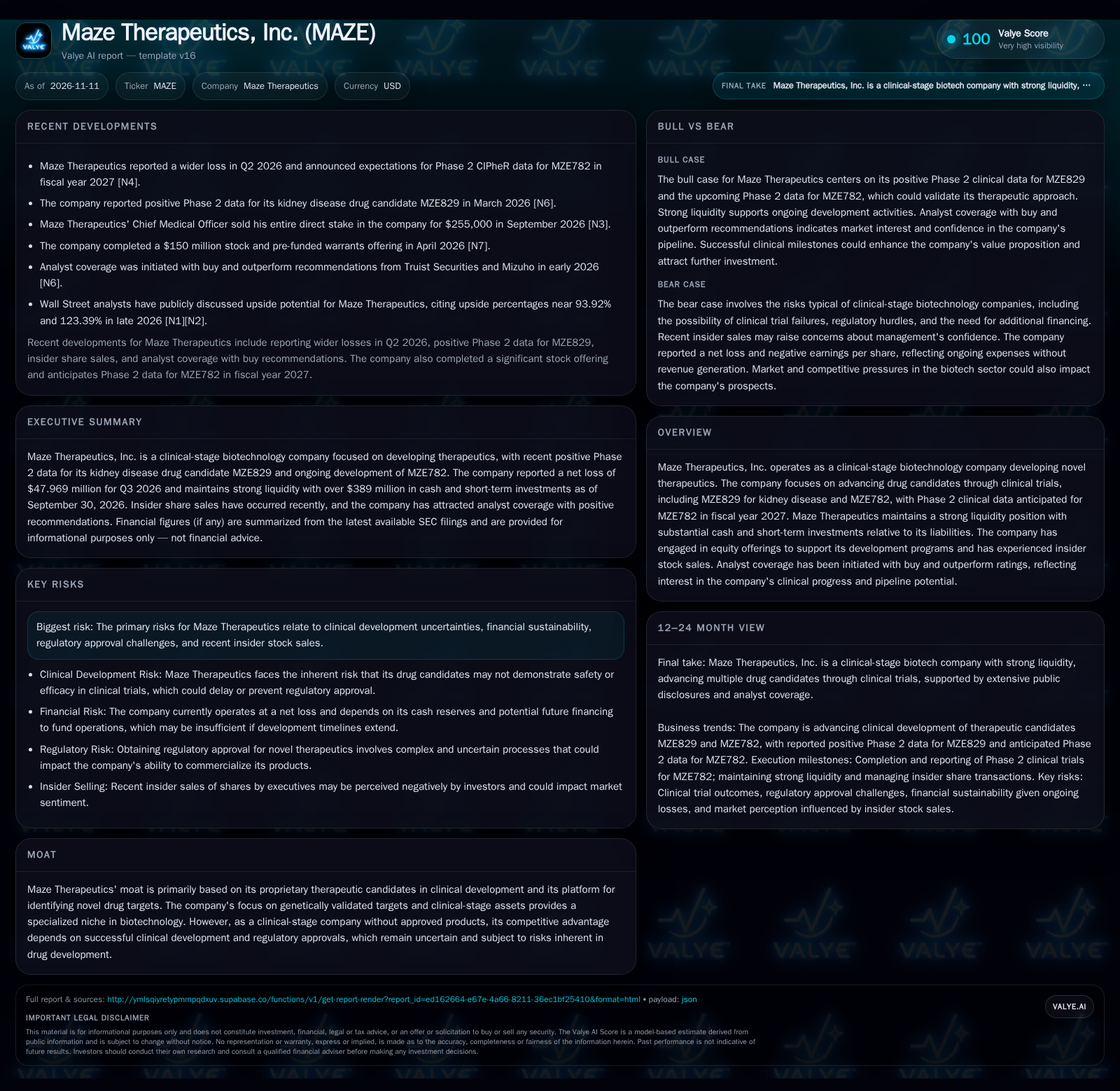
Maze Therapeutics enters late 2026 with reported liquidity position, a substantial quarterly net loss, and high analyst expectations for upside. The company’s future will hinge on clinical trial progress, regulatory outcomes, and its ability to translate R&D spending into approvable, differentiated therapeutics. Insider stock sales and ongoing losses spotlight execution and capital allocation risks, even as recent equity offerings and analyst coverage support continued development.
As of September 2026, the company reported a net loss of nearly $48 million for the quarter, but with almost $390 million in liquid assets and a recent $150 million equity infusion, Maze is positioned to sustain its clinical ambitions. Wall Street’s bullish price targets underscore the sector’s appetite for high-risk, high-reward stories, but insider selling and the perennial uncertainty of clinical outcomes remain central to the Maze Therapeutics thesis.
Maze Therapeutics’ Financial Foundation and Investor Expectations in Late 2026
Maze Therapeutics closed the third quarter of 2026 with a net loss of $47.969 million and reported basic and diluted EPS of -$0.79, reflecting the cost-intensive nature of clinical-stage biotech operations without commercialized products [S2]. Despite these losses, Maze’s liquidity position is a material differentiator: $154.156 million in cash and $235.502 million in short-term investments, totaling $389.658 million, with a current ratio of 14.14 [S2]. This strong financial position is further reinforced by a $150 million stock and pre-funded warrants offering in April 2026 [N7]. Recent analyst coverage has been notably bullish, with upside projections of 93.92% and 123.39% cited by Wall Street in late 2026 [N1] [N2]. However, insider sales, including the Chief Medical Officer’s full divestment of direct holdings, introduce a counter-narrative of possible internal caution or personal liquidity management [N3] [N8].
How Maze Therapeutics’ Cash Burn and Capital Model Shape Its Economic Outlook
Maze’s economics are defined by the biotech archetype: high upfront R&D investment, extended periods of negative cash flow, and the absence of product revenue until (and if) lead candidates achieve regulatory approval. The company’s $48 million quarterly net loss is consistent with a portfolio of clinical programs advancing through costly trials [S2]. With nearly $390 million in liquid assets and a history of equity raises, Maze appears capable of funding operations through multiple clinical milestones, assuming no dramatic increase in burn rate or unexpected setbacks [S2] [N7].
The capital model here is equity-driven: periodic public offerings provide the financial runway needed to sustain R&D, with the expectation that positive clinical data or strategic partnerships will eventually unlock non-dilutive capital or commercial cash flows. Fixed costs are dominated by research personnel, laboratory infrastructure, and clinical trial expenses, while variable costs scale with the number and complexity of active studies. Operating leverage is largely negative until commercialization, at which point successful product launches could drive rapid margin improvement—if Maze’s candidates reach market. The key lever is the timing and probability of clinical success; protracted or failed trials can rapidly erode the reported cash balance, prompting further dilution or even strategic pivots.
Assessing Maze’s Platform, Pipeline, and the Realities of Biotech Competition
Maze Therapeutics’ competitive position is rooted in its proprietary clinical-stage assets and a drug discovery platform focused on genetically validated targets. This approach may offer a defensible niche, as genetically guided programs can improve target validity and reduce clinical attrition rates relative to less differentiated strategies. However, Maze operates in a crowded and capital-intensive sector where larger biopharma incumbents, emerging platform players, and academic spinouts all vie for overlapping indications and mechanisms.
The absence of approved products limits Maze’s ability to create durable switching costs or network effects at this stage. Any competitive advantage is contingent on demonstrating superior clinical efficacy, safety, or convenience versus current standard-of-care and rival pipeline assets. Technology substitution risk is omnipresent in biotech: advances in gene editing, RNA therapeutics, or next-generation biologics could leapfrog Maze’s programs if the company cannot move quickly enough through development and regulatory gates. In this environment, speed of execution, IP protection, and the ability to secure strategic partnerships or licensing deals are as critical as scientific differentiation.
If Clinical Data Validates Maze’s Platform, Value Inflection Could Be Dramatic
The most favorable outcome for Maze would involve one or more lead candidates delivering positive late-stage clinical trial results, thereby validating the company’s platform and unlocking either regulatory approval or lucrative partnership/licensing deals. Such an event would not only justify the high analyst price targets (upside projections of 93-123% [N1] [N2]), but could also provide the basis for non-dilutive capital inflows and a step-change in valuation.
Evidence that would confirm this scenario includes: clear, statistically significant efficacy and safety data in pivotal trials (if disclosed); rapid progression to regulatory submission; and the announcement of major licensing or co-development agreements with established biopharma partners. Conversely, failure to achieve clinical milestones, regulatory rejections, or the absence of commercial partnerships would directly falsify this upside narrative.
Sustained Development, Dilution, and the Waiting Game for Clinical Proof
The most plausible near-term outcome is that Maze continues to burn cash at a similar rate while advancing its pipeline through early- and mid-stage trials. The company’s large cash balance and current ratio afford it time to pursue clinical data readouts into 2027, but the absence of near-term commercial revenue and the inevitability of ongoing losses mean periodic equity raises are likely until a major value inflection occurs [S2] [N7].
In this scenario, investor sentiment will swing with each clinical update, analyst revision, or insider transaction. Analyst optimism may persist in the absence of negative surprises, but the company’s valuation will remain highly sensitive to any signs of clinical delay, trial failure, or dilution risk. Confirmation would come from steady clinical enrollment, on-track trial timelines, and transparent communication around cash burn and capital allocation. Evidence that would challenge this base case includes a sudden acceleration in cash burn, unexpected trial terminations, or a shift in management/insider behavior suggesting waning confidence.
When Clinical or Capital Setbacks Accelerate Value Erosion
The most adverse scenario for Maze would be a material clinical setback—such as a failed or discontinued lead program—or a sharp increase in cash burn that brings funding risk forward. Clinical failure would likely prompt a collapse in market capitalization, limit the company’s ability to raise new equity on acceptable terms, and force difficult pipeline prioritizations or strategic alternatives.
Evidence for this scenario would include: negative or inconclusive clinical data (if disclosed); delays or halts in trial enrollment; significant insider selling not offset by new insider purchases; and a rapid decline in cash reserves without offsetting partnership income. A deteriorating ability to access capital markets—either due to sector-wide risk aversion or company-specific issues—would compound the problem, potentially leading to asset sales, down-round financings, or even a search for acquisition offers under distressed conditions.
Milestones That Will Define Maze Therapeutics’ Trajectory
Pipeline progress: Announcements of clinical trial initiations, completions, or key data readouts (Phase 2/3), especially for lead candidates. If disclosed, these are critical to the investment thesis.
Equity financing cadence: The frequency, size, and pricing of future equity raises, as persistent dilution could erode shareholder value.
Insider trading activity: Patterns of insider sales or purchases, particularly by executive team members, as a potential sentiment signal.
Regulatory interactions: Updates on IND filings, regulatory feedback, and pre-approval milestones, as these signal progress toward commercialization.
Analyst revisions: Shifts in consensus price targets, ratings, or coverage initiation/withdrawal, which can impact market sentiment and liquidity.
Strategic partnerships: Any announced collaborations, licensing deals, or co-development agreements with larger biopharma companies, which could provide non-dilutive funding and external validation.
Competitive pipeline developments: Major clinical or regulatory achievements by direct or adjacent competitors, which may shift the perceived value or risk profile of Maze’s programs.
Disclaimer: This is research-only, informational analysis and not investment advice. It may include AI-generated interpretation and general industry context. Always verify important details using primary sources.

Comments