
ADC Therapeutics: ZYNLONTA’s Expansion Hopes Confront Regulatory Uncertainty and Capital Constraints
Despite strong Q3 revenue growth and a fortified balance sheet, ADC Therapeutics faces a pivotal test: can its lead product ZYNLONTA overcome FDA scrutiny and clinical trial hurdles to unlock broader market potential—or will regulatory and commercial setbacks force further restructuring and delay value realization?
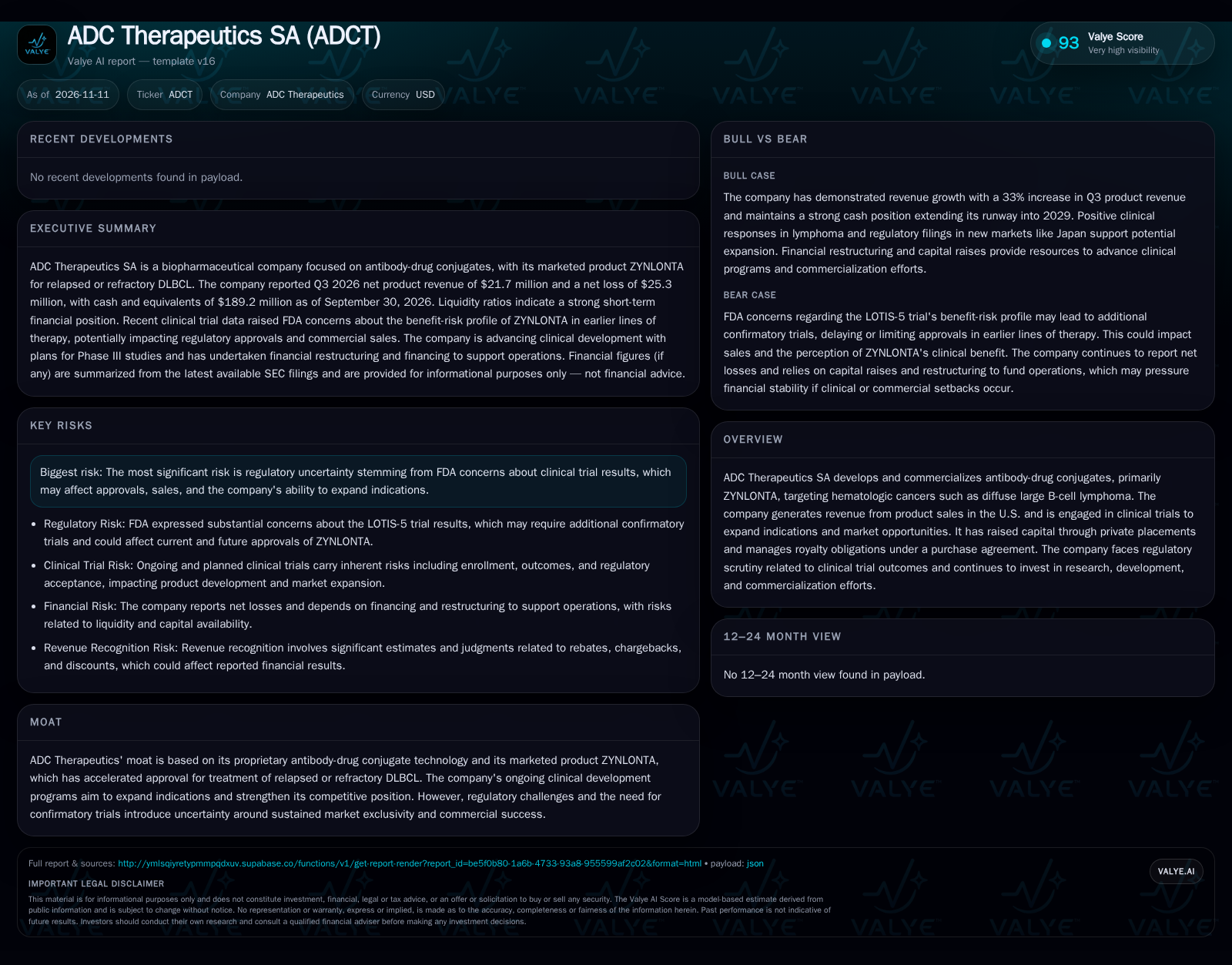
ADC Therapeutics posted a 33% jump in Q3 2026 ZYNLONTA sales and maintains substantial cash reserves, but the FDA’s concerns over pivotal trial data cloud its prospects for label expansion. The company’s future hinges on resolving these regulatory issues, successfully advancing its pipeline, and converting R&D investment into sustainable commercial growth. Investors should focus on regulatory feedback, new clinical milestones, and evidence of market uptake beyond late-line DLBCL.
ADC Therapeutics stands at a crossroads: the company’s Q3 2026 results highlight a business with growing sales and reported liquidity position, yet its future is tethered to the fate of ZYNLONTA, its antibody-drug conjugate for DLBCL. While revenue is climbing and recent financing has extended the company’s cash runway, regulatory scrutiny over clinical trial outcomes introduces high-stakes uncertainty. The company’s ability to expand ZYNLONTA’s label and capture new markets depends on addressing FDA concerns and demonstrating clear clinical benefit—outcomes that will shape both the commercial opportunity and ADC’s long-term viability.
Recent Performance and Regulatory Headwinds Define the Near-Term Landscape
ADC Therapeutics reported Q3 2026 net product revenue of $21.7 million, representing a 33% year-over-year increase, but continued to post net losses ($25.3 million in Q3) as operating expenses outpaced sales [S2] [N2] [N3]. The company’s cash and equivalents stood at $189.2 million at quarter-end, bolstered by $150.7 million in private placement proceeds during 2025 [S2] [N2].
A critical development is the FDA’s raised concerns regarding the clinical benefit and risk profile in the LOTIS-5 trial, which could result in delayed or denied regulatory approvals for ZYNLONTA in earlier lines of therapy. This regulatory uncertainty directly affects ADC’s growth trajectory and ability to expand its addressable market [S2] [N5].
Meanwhile, the company is advancing clinical programs and has filed for regulatory approval in Japan, aiming to diversify revenue sources and mitigate U.S. concentration risk. However, the necessity for potential additional confirmatory trials may require further capital and extend time to market for new indications [N6] [N7].
How ZYNLONTA’s Economics Shape ADC’s Value Creation Path
ADC’s current revenue stream is almost entirely derived from U.S. sales of ZYNLONTA in third-line or later DLBCL, a niche but high-value oncology segment. Pricing in this space is typically premium, reflecting the unmet need and limited alternatives, but volume is constrained by the small eligible patient population. Gross-to-net deductions (rebates, discounts, chargebacks) and the complexity of oncology reimbursement add further variability to realized revenue [S2].
The company’s cost structure remains R&D-heavy, with significant fixed expenses tied to ongoing clinical development, regulatory affairs, and commercialization. This creates operating leverage potential if new indications for ZYNLONTA or pipeline assets are approved and commercialized, but also exposes the business to prolonged losses if revenue does not scale quickly.
ADC’s capital needs are elevated by the requirement to fund additional clinical trials—especially if the FDA mandates confirmatory studies for broader ZYNLONTA use. The deferred royalty obligation, structured as debt, further commits future revenue streams to third-party payments, which may dampen incremental cash flow from any expansion [S2].
A critical factor influencing ADC’s value creation is the scalability of ZYNLONTA’s commercial model beyond its initial niche indication. Given the high fixed costs associated with oncology drug commercialization—such as specialized sales forces, medical affairs, and patient support programs—achieving a larger patient base through label expansion is essential to improve operating leverage. However, this scaling is contingent on overcoming regulatory hurdles and payer acceptance, which in turn depend on robust clinical evidence demonstrating meaningful improvements over existing therapies. Without such validation, pricing pressures and reimbursement challenges could compress margins, limiting the financial benefits of volume growth.
Navigating a Crowded Lymphoma Market and the Race for Therapeutic Differentiation
ADC’s competitive moat rests on its proprietary antibody-drug conjugate technology and ZYNLONTA’s accelerated approval for relapsed/refractory DLBCL. However, this market segment is marked by intense competition from established chemotherapies, CAR-T cell therapies, bispecific antibodies, and other targeted agents. Larger biopharma players often have greater resources for clinical development, marketing, and payer negotiation.
ZYNLONTA’s commercial success will depend on demonstrating clear clinical advantages—such as improved efficacy, safety, or convenience—over these alternatives. The risk is that if confirmatory trials do not validate a superior benefit-risk profile, prescribers may default to more established or newly approved therapies, limiting ZYNLONTA’s uptake and pricing power.
International expansion, such as the Japan filing, could help diversify revenue and reduce dependency on the U.S. DLBCL market. However, regulatory standards and competitive dynamics may differ, and success abroad will require localized evidence and commercial strategy.
In addition to clinical differentiation, ADC’s competitive positioning depends on its ability to navigate complex reimbursement environments across diverse healthcare systems. Oncology therapies often face rigorous health technology assessments and pricing negotiations, especially for new or expanded indications. ADC’s success will hinge not only on demonstrating clinical value but also on effectively engaging with payers to secure favorable coverage terms that support patient access and revenue predictability. Failure to achieve this could lead to restricted market penetration despite regulatory approval, undermining the commercial rationale for ongoing investment.
What a Positive Regulatory Turn Could Unlock for ADC Therapeutics
If ADC can address the FDA’s concerns—either through additional data analysis, successful completion of required confirmatory trials, or demonstrating a robust benefit-risk profile—ZYNLONTA’s label could be expanded into earlier lines of therapy or broader lymphoma indications. This would materially increase the eligible patient pool and drive higher revenue and operating leverage.
Evidence that would confirm this scenario includes positive regulatory feedback, successful Phase III trial results, and new approvals in larger or international markets (such as Japan). A ramp in ZYNLONTA sales outside of late-line DLBCL, alongside improved gross margins and reduced R&D intensity as pipeline assets mature, would further validate the thesis.
A favorable outcome would also enhance ADC’s strategic flexibility, enabling partnership opportunities, pipeline investment, or even M&A interest from larger oncology players seeking differentiated assets.
Most Likely Trajectory: Incremental Progress and Persistent Uncertainty
The most plausible path forward involves modest growth in ZYNLONTA’s core DLBCL market, with regulatory and clinical progress occurring gradually. ADC will likely continue to invest heavily in R&D and clinical trials, supporting both ZYNLONTA expansion and pipeline development, while navigating a high degree of regulatory risk.
Revenue growth may be uneven, tied to the pace of new indication approvals and market adoption.
Confirmation of this scenario would be steady but unspectacular revenue increases, continued net losses, and periodic financing events. Any incremental positive clinical or regulatory news would support upside, while persistent regulatory delays or negative trial outcomes would tilt the balance toward downside risk.
How Regulatory Setbacks Could Trigger a Strategic Reset
If the FDA’s concerns are not resolved and additional confirmatory trials fail to demonstrate compelling benefit, ZYNLONTA’s use could be restricted to late-line patients or even face withdrawal from some markets.
Signs of this scenario playing out would include negative regulatory decisions, disappointing Phase III results, or declining ZYNLONTA sales due to competitive displacement. In this case, ADC may be forced to undertake deeper cost-cutting, restructure its pipeline, or seek strategic alternatives to preserve value.
Ongoing net losses, inability to raise additional capital on favorable terms, or a shift in management’s language toward prioritizing ‘strategic options’ would further confirm mounting downside pressure.
What Will Ultimately Test ADC Therapeutics’ Investment Case
Regulatory decisions and feedback from the FDA and other global agencies regarding ZYNLONTA’s label expansion and confirmatory trial requirements.
Timing, enrollment progress, and outcomes of ongoing and planned Phase III studies for ZYNLONTA and pipeline assets.
Quarterly ZYNLONTA sales trends, including any evidence of adoption beyond third-line DLBCL, and gross-to-net realization rates if disclosed.
Cash burn rate, R&D and SG&A spending trends, and any guidance on operational runway or additional capital needs.
Updates on the Japan regulatory filing and progress toward approval or launch in other international markets.
Emergence of new competitors, approvals of rival therapies, or changes in standard of care for DLBCL and related indications.
Any strategic transactions, partnerships, or shifts in management commentary regarding the company’s long-term direction.
Disclaimer: This is research-only, informational analysis and not investment advice. It may include AI-generated interpretation and general industry context. Always verify important details using primary sources.

Comments