
Copper Property CTL Pass Through Trust: Triple-Net Stability, Concentration Exposure, and the Tenant Reliance Dilemma
Copper Property CTL Pass Through Trust delivers predictable income through long-term triple-net leases, but its substantial reliance on a single tenant—Penney Intermediate Holdings LLC—shapes both its risk profile and its future trajectory. Investors must weigh the benefits of operational simplicity against the vulnerabilities of tenant concentration and limited oversight of lessee financial health.
Copper Property CTL Pass Through Trust generates stable net income through long-term, triple-net leases primarily with Penney Intermediate Holdings LLC, reducing operational risk but creating substantial tenant concentration. The core thesis hinges on the durability of these lease payments and the lessee’s ongoing viability. [S2]
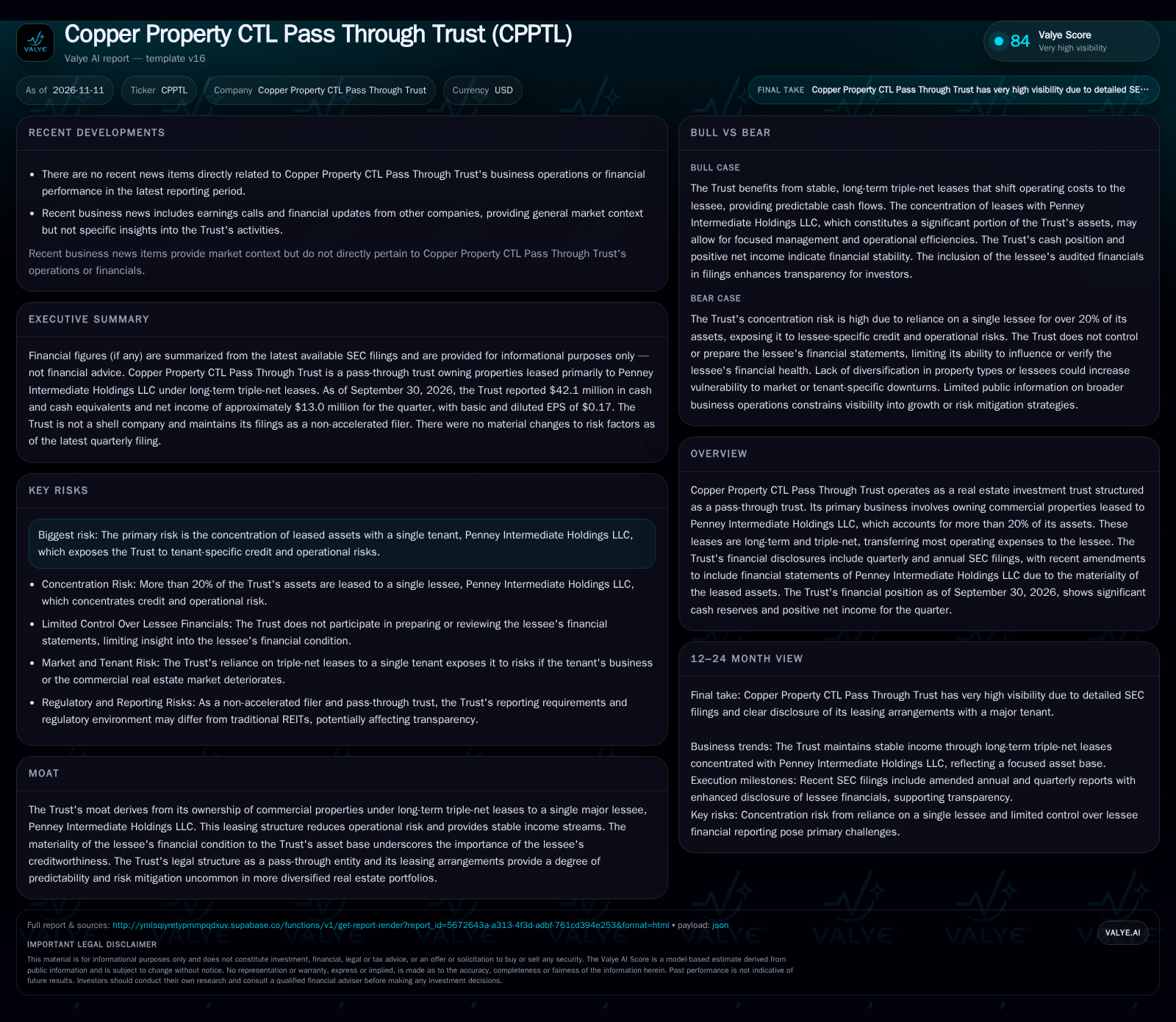
Copper Property CTL Pass Through Trust (CPPTL) exemplifies the high-visibility, low-operating-risk model of a pass-through real estate trust, deriving its returns almost entirely from long-term, triple-net leases to a single major tenant—Penney Intermediate Holdings LLC. This structure enables the Trust to offload most property-level expenses and produce consistent net income, as demonstrated by its latest quarterly results. However, this operational simplicity is counterbalanced by a pronounced concentration risk: the Trust’s cash flows and asset value are closely tied to the financial health and ongoing lease performance of its primary lessee. As the Trust enhances its transparency with expanded financial disclosures, the core investment debate centers on whether these stable lease payments can endure tenant- or market-specific shocks. [S2]
Recent Financial Results Spotlight Concentration and Predictability
As of September 30, 2026, Copper Property CTL Pass Through Trust reported cash and cash equivalents of $42.1 million and net income of $13.0 million for the quarter, with basic and diluted EPS of $0.17. More than 20% of the Trust's assets are leased to Penney Intermediate Holdings LLC through long-term, triple-net leases, which shift nearly all property-level expenses to the tenant. The Trust’s amended filings now include the lessee’s consolidated financial statements, enhancing transparency but also highlighting the materiality of this relationship. There were no material changes to risk factors as of the latest 10-Q filing. [S2]
Triple-Net Lease Model Drives Cash Flow, but Growth Is Constrained by Lease Terms
Copper Property CTL Pass Through Trust's economics are defined by the triple-net lease model: tenants are responsible for taxes, insurance, and maintenance, allowing the Trust to recognize rental income with minimal operating expenses. This structure typically delivers high operating margins and predictable cash flows, as fixed costs are low and lease payments are contracted over long terms.
However, these advantages come with inherent constraints. The Trust’s revenues are capped by the terms of existing leases, limiting upside from rent escalations unless contracts provide for periodic increases. The pass-through entity structure means profits are distributed rather than reinvested for growth, and the concentrated tenant base restricts diversification opportunities. The Trust’s capital needs are modest due to minimal property-level obligations, but any tenant distress could quickly impair cash flow—there is little buffer or alternate revenue source if Penney Intermediate Holdings LLC falters.
The triple-net lease model inherently balances risk transfer and revenue predictability, but its effectiveness depends critically on the lessee's operational stability. Because the tenant assumes responsibility for variable expenses, the Trust's exposure to property-level cost volatility is minimal, which simplifies financial forecasting. However, this also means that the Trust forfeits potential upside from active property management or value-add initiatives that could enhance asset worth or rental income beyond contractual terms. Furthermore, the long-term nature of these leases can create rigidity; if market rents rise significantly, the Trust may be locked into below-market rates until lease renewal, limiting responsiveness to favorable market shifts. This structural characteristic underscores the importance of lease renewal terms and escalation clauses in sustaining income growth.
Concentration as Double-Edged Sword: Focused Management vs. Tenant Dependency
The Trust’s competitive position is shaped by its focused asset base and the stability of long-term, triple-net leases. Compared to more diversified REITs, CPPTL avoids the complexity and risk of multi-tenant management, property turnover, and direct exposure to operating expenses. This can lead to lower overhead and more predictable distributions.
However, the lack of diversification is a vulnerability. In the context of commercial real estate, other trusts and REITs often spread risk across multiple tenants, sectors, or geographies, mitigating the impact of any single tenant’s distress. CPPTL’s reliance on Penney Intermediate Holdings LLC leaves it exposed to tenant-specific shocks, and it lacks the ability to quickly re-lease or repurpose properties should the lessee vacate or default. The Trust’s moat is thus narrow: it is built on contractual stability, not market share or operational flexibility.
While the Trust’s concentrated tenant base streamlines management and reduces operational complexity, it also constrains strategic flexibility. In particular, the inability to diversify tenant risk means that the Trust cannot leverage cross-tenant synergies or mitigate localized tenant-specific downturns through portfolio balancing. Additionally, the Trust’s reliance on a single tenant restricts its bargaining power in lease negotiations, as the tenant holds significant leverage given the Trust’s dependency on their continued occupancy. This dynamic may limit the Trust’s ability to enforce favorable lease amendments or to extract concessions during market downturns. The narrow competitive moat emphasizes contractual enforceability and tenant creditworthiness as primary defenses against income volatility, rather than market positioning or asset differentiation.
If Tenant Health Holds, Predictable Income and Distributions Could Endure
The most favorable scenario for Copper Property CTL Pass Through Trust is the continued financial health and lease performance of Penney Intermediate Holdings LLC. If the lessee remains solvent and current on all obligations, the Trust can maintain its high-margin, low-volatility cash flows, supporting ongoing distributions to beneficiaries. Over time, modest rent escalators—if present—could provide incremental income growth. Enhanced transparency through lessee financial disclosures may also bolster investor confidence and reduce the Trust’s cost of capital.
To confirm this scenario, evidence would include: consistently timely rent payments, stable or improving financials from Penney Intermediate Holdings LLC, no signs of lease renegotiation or default, and steady or growing net income and distributions per share. Conversely, early warning signs would be any missed payments, adverse changes in the lessee’s financial condition, or requests for lease amendments.
If Penney Intermediate Holdings LLC maintains strong financial health, the Trust could benefit from incremental improvements in lease terms over time, such as built-in rent escalations or renewal options that reflect inflation or market conditions. These contractual features, if present and exercised, would provide a modest growth trajectory to otherwise stable cash flows. Moreover, improved transparency and reporting may enhance investor confidence, potentially lowering the Trust’s cost of capital and enabling more efficient capital allocation or distribution policies. In a favorable macroeconomic environment, the tenant’s operational success could also reduce perceived credit risk, allowing the Trust to negotiate more advantageous financing or refinancing terms, thereby preserving or enhancing net income margins.
Stable Cash Flows, but No Growth Catalyst Without Tenant Diversification
The most likely scenario for CPPTL is a continuation of current trends: stable, predictable income underpinned by the existing lease structure, but little organic growth and persistent exposure to tenant concentration risk. Distributions to beneficiaries remain steady as long as Penney Intermediate Holdings LLC meets its obligations. The Trust’s reporting enhancements improve transparency but do not fundamentally alter the risk profile.
Supporting evidence would be ongoing profitability, continued healthy cash balances, and no changes to lease terms or tenant status. This scenario would be challenged if the lessee’s financial health deteriorates, if there are signs of weakening commercial real estate demand for the Trust’s property types, or if new lease negotiations introduce less favorable terms.
Absent significant changes in tenant composition or lease structure, the Trust’s income profile is likely to remain steady but constrained. The lack of organic growth drivers means that distributions may track closely with inflation only if rent escalators are embedded and effective. External market factors, such as shifts in commercial real estate demand or tenant credit trends, could introduce volatility but may not materially alter the Trust’s income unless they precipitate tenant distress. The Trust’s passive operational model limits its ability to respond proactively to market changes, placing emphasis on monitoring tenant financial health and lease compliance as primary risk management tools. This scenario underscores the importance of maintaining reported liquidity position buffers to weather potential short-term disruptions.
Tenant Distress or Default Would Directly Jeopardize Cash Flows
The principal risk to the Trust is adverse developments with Penney Intermediate Holdings LLC. If the tenant experiences financial distress, seeks to renegotiate or terminate leases, or defaults, the Trust’s primary income stream could be disrupted or lost. Given the lack of diversification, there is limited capacity to absorb such a shock. Re-leasing the properties could prove difficult or costly, especially if the assets are specialized or if market demand is weak.
Evidence confirming this downside would include late or missed rent payments, public reports of tenant financial trouble, material impairments or write-downs on leased assets, or sudden declines in net income and distributions. The Trust’s limited operational flexibility and lack of direct control over tenant financials amplify these risks.
Testing the Thesis: What Would Validate or Challenge CPPTL's Income Stability?
Timeliness and consistency of rent payments from Penney Intermediate Holdings LLC, as any delays would indicate emerging tenant risk.
Trends in the lessee’s financial health and liquidity, as disclosed in the consolidated financial statements included in Trust filings.
Any changes to lease terms, such as amendments, rent concessions, or early termination requests, which would signal shifting risk dynamics.
The Trust’s ability, if disclosed, to re-lease or repurpose properties in the event of tenant departure or default.
Actual rent escalators or contractual increases, if present, and their impact on income growth over time.
External signals of weakening demand for the Trust’s property types or geographic locations, which could affect re-leasing prospects.
Disclaimer: This is research-only, informational analysis and not investment advice. It may include AI-generated interpretation and general industry context. Always verify important details using primary sources.

Comments