
Atara Biotherapeutics: Regulatory Reset, Leaner Operations, and the Path to Commercial Viability
Atara Biotherapeutics faces a pivotal moment as it awaits FDA response to its recently resubmitted tabelecleucel BLA, operates with a streamlined cost base, and manages a sizable reported cash balance—all while commercial revenues contract and external manufacturing dependencies rise.
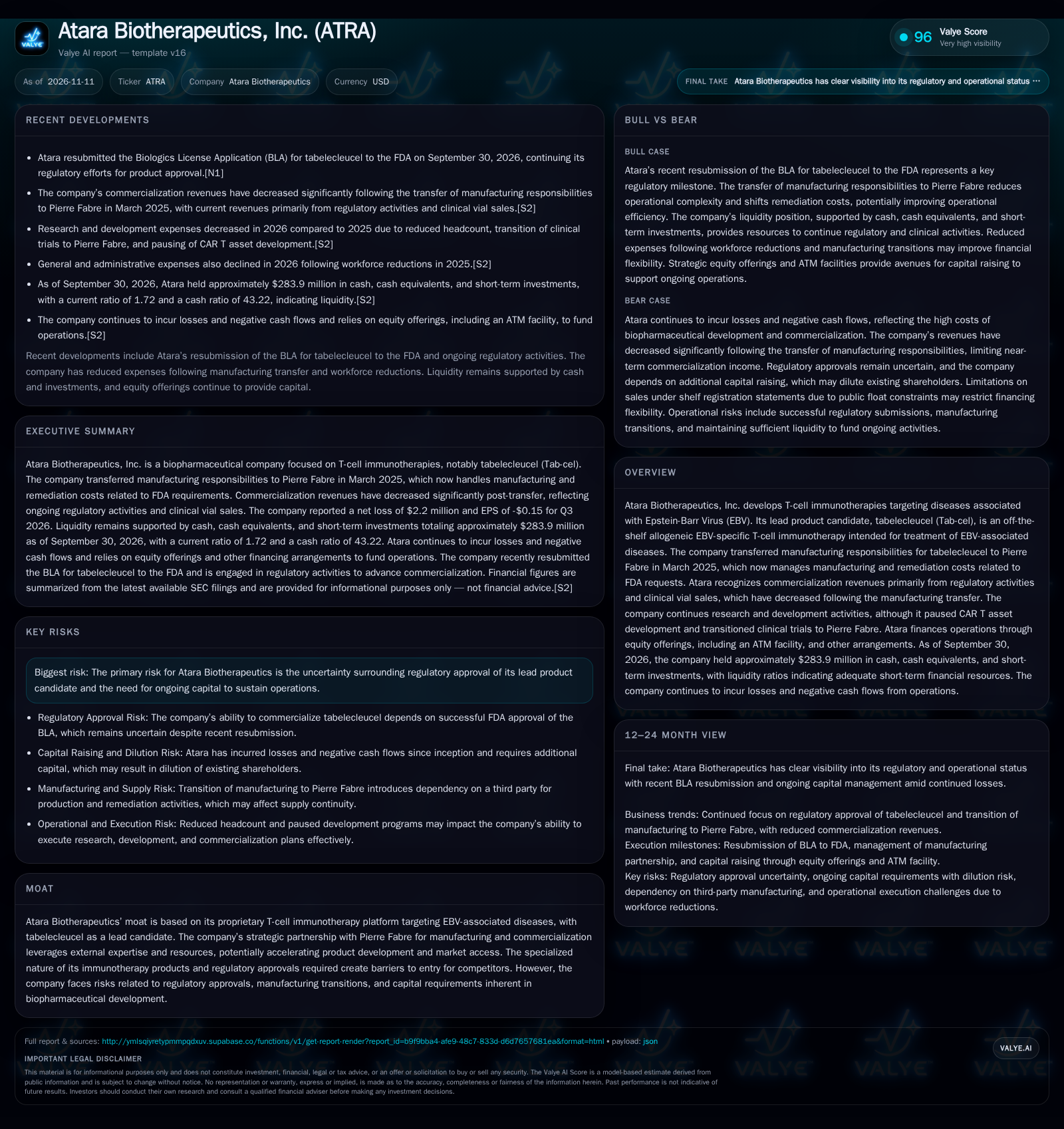
Atara Biotherapeutics has shifted manufacturing and much of its operational burden for tabelecleucel to Pierre Fabre, resulting in sharply reduced commercialization revenues and lower expenses. The company resubmitted its BLA for tabelecleucel to the FDA on September 30, 2026, and holds $283.9 million in cash and equivalents. Despite these moves, Atara continues to post losses and will need to secure additional capital as it navigates regulatory uncertainty and relies on equity offerings to fund operations. [S2] [N1]
Atara Biotherapeutics stands at a critical juncture as it awaits the FDA's decision on its flagship tabelecleucel therapy, an off-the-shelf allogeneic T-cell immunotherapy for EBV-associated diseases. The transfer of manufacturing responsibility to Pierre Fabre has drastically reduced Atara’s direct commercialization revenues and cost base, while simultaneously increasing dependence on an external partner for supply continuity and regulatory remediation. Despite a sizable reported cash balance, Atara continues to operate at a loss and must navigate the dual challenges of regulatory risk and ongoing capital requirements—making its next moves decisive for long-term viability. [S2] [N1]
Recent Shifts: Manufacturing Transfer, BLA Resubmission, and Revenue Compression
Atara Biotherapeutics’ most material recent development is the resubmission of its Biologics License Application (BLA) for tabelecleucel to the FDA on September 30, 2026. This marks a critical step in the company’s regulatory journey, with future commercial prospects now hinging on the FDA's review and potential approval. Manufacturing and supply responsibilities for tabelecleucel were fully transferred to Pierre Fabre as of March 2025, including the cost and execution of FDA-requested manufacturing remediation. While this shift relieves Atara of direct operational and remediation burdens, it has also led to a sharp decline in recognized commercialization revenues—down to $1.2 million in Q3 2026, primarily from regulatory activities and clinical vial sales. Operating expenses have been materially reduced, with both R&D and G&A declining following workforce reductions and the transfer of clinical activities. As of September 30, 2026, Atara held $283.9 million in cash, cash equivalents, and short-term investments, but continues to post net losses, reporting a $2.2 million loss and EPS of -$0.15 for the quarter. [S2] [N1]
Cost Structure, Revenue Drivers, and the Impact of External Manufacturing
Atara’s business model is currently in a transitional phase, moving from an integrated developer-operator to a leaner entity reliant on external manufacturing and commercialization partners. The company’s primary revenue stream—commercialization of tabelecleucel—has been drastically reduced after offloading manufacturing to Pierre Fabre. This means Atara’s near-term revenues are now largely tied to regulatory milestones and limited clinical vial sales, rather than broad commercial uptake. The fixed-cost base has come down as headcount and in-house development efforts have been curtailed, but this also restricts pipeline breadth and internal innovation.
The capital intensity typical of biopharma has not disappeared: Atara still requires significant funding to cover ongoing regulatory, partnership, and residual R&D activities. The ATM facility (with $78.3 million remaining) and planned shelf registration provide equity-raising flexibility, but continued negative cash flow underscores the importance of either regulatory success or further capital infusions. Should tabelecleucel receive FDA approval, Atara’s economics could shift towards milestone payments, royalties, or profit-sharing with Pierre Fabre, depending on the specifics of their commercialization agreement. However, the current structure limits upside from product sales but reduces downside risk from manufacturing scale-up failures or cost overruns. [S2]
Therapeutic Differentiation and the Strategic Leverage of Partnerships
Atara’s core competitive strength lies in its proprietary allogeneic T-cell immunotherapy platform targeting EBV-associated diseases, a relatively underserved niche with high unmet clinical need. Tabelecleucel’s off-the-shelf profile differentiates it from autologous cell therapies, offering potential advantages in speed, scalability, and accessibility. However, the company’s ability to convert this differentiation into sustained commercial advantage depends on successful regulatory approval and the real-world performance of tabelecleucel.
The manufacturing and commercialization partnership with Pierre Fabre provides access to established infrastructure and regulatory expertise, which may accelerate market entry and reduce operational risk compared to a go-it-alone strategy. That said, reliance on a single external partner introduces supply chain and execution risk, and Atara’s bargaining power may be limited if tabelecleucel underperforms or faces delays. Competitive pressure could also emerge from other allogeneic immunotherapy developers, as well as from advances in autologous cell therapy, antibody therapeutics, or small-molecule antivirals targeting EBV or related indications.
FDA Approval Catalyzes Partner-Led Commercial Ramp
A favorable scenario for Atara would see the FDA accept and approve the tabelecleucel BLA within the next review cycle, validating the company’s regulatory and manufacturing strategy. Approval could trigger milestone payments from Pierre Fabre, unlock broader commercialization in the U.S. and possibly ex-U.S. markets, and establish Atara as a first-mover in EBV-specific allogeneic immunotherapy. This could also improve access to non-dilutive capital (e.g., licensing, royalties, or milestone payments), reducing pressure on equity financing.
Confirmation of this scenario would include: a positive FDA decision, public disclosure of commercial launch plans or initial sales, evidence of milestone or royalty revenue, and new partnership announcements for additional indications or geographies. Strong clinical uptake or real-world evidence supporting tabelecleucel’s efficacy and safety would further reinforce the upside case.
Sustained Cash Burn Amid Regulatory and Commercial Uncertainty
Commercialization revenues are likely to remain muted unless and until approval is secured, with Pierre Fabre leading manufacturing and launch preparations. Expenses should remain in check due to reduced headcount and limited in-house R&D, but the lack of near-term product revenue will keep Atara reliant on external capital.
This scenario is confirmed by continued negative cash flow, limited revenue growth, and incremental progress updates on the FDA review process. It would be falsified by an unexpected regulatory approval, new commercial partnerships, or a material change in the company’s expense or revenue trajectory.
Regulatory Setbacks and Capital Constraints Trigger Strategic Contraction
A negative scenario would unfold if the FDA requests further data, issues a complete response letter, or otherwise delays or denies approval of tabelecleucel. Without near-term product revenue or milestones, Atara’s continued losses would erode its cash reserves, potentially forcing additional dilutive equity offerings, strategic asset sales, or further cost reductions. Any disruption or underperformance by Pierre Fabre as the manufacturing partner could exacerbate operational risks.
Evidence for this scenario would include: negative regulatory feedback, extended review timelines, increased cash burn without offsetting capital raises, or public disclosure of additional restructuring, asset divestitures, or going-concern warnings. Deterioration in partnership terms or supply continuity would further confirm the downside case.
Milestones and Events That Could Shift Atara’s Trajectory
Timing and outcome of the FDA’s decision on the tabelecleucel BLA resubmission: acceptance, approval, or requests for further information.
Public disclosure of milestone payments, royalties, or revised partnership economics with Pierre Fabre if tabelecleucel is approved.
Quarterly cash burn rates and updated guidance on cash runway, especially if revenues remain depressed and capital raises are required.
Progress on new shelf registration statement and utilization of the ATM facility for additional equity financing.
Any changes in the manufacturing or supply relationship with Pierre Fabre, including remediation progress and supply chain reliability.
Pipeline updates: resumption or expansion of paused CAR T programs or new product candidates entering development.
Commercial uptake and real-world data (if disclosed) following any regulatory approval, including initial sales or adoption metrics.
Announcements of new partnerships, licensing deals, or geographic expansion beyond the current Pierre Fabre arrangement.
Disclaimer: This is research-only, informational analysis and not investment advice. It may include AI-generated interpretation and general industry context. Always verify important details using primary sources.

Comments