
ETSS: Profitability Without Transparency—Assessing the Business Behind the Numbers
Investors must rely on sparse financial metrics while navigating significant information gaps about the underlying drivers of performance and sustainability.
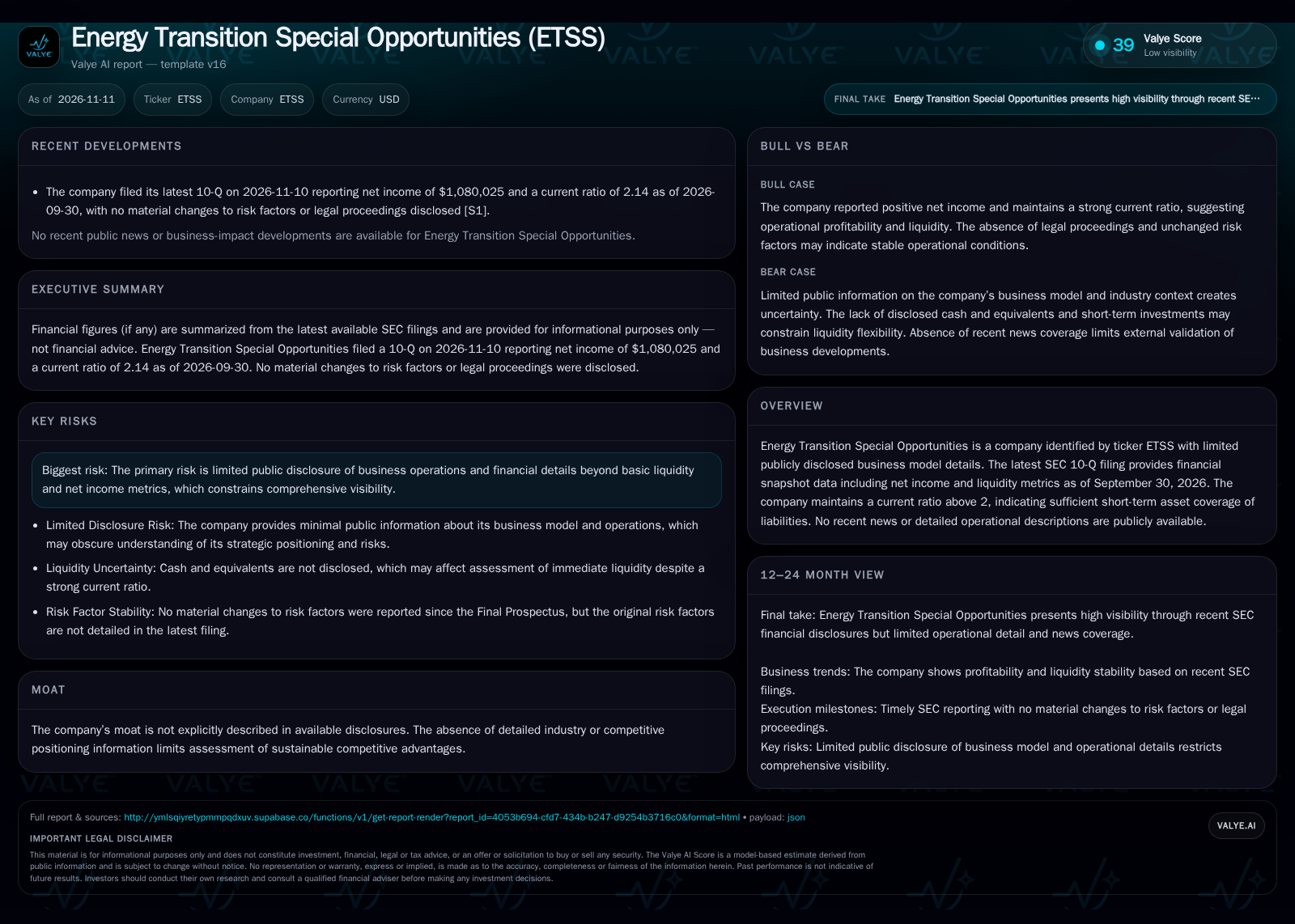
ETSS shows net income and a current ratio above 2.0 as of Q3 2026, but provides almost no public detail on its business model, operating activities, or industry context. This opacity creates uncertainty around the durability and drivers of reported profitability, leaving investors to weigh the value of financial metrics in the absence of operational transparency. [S1]
Energy Transition Special Opportunities (ETSS) presents an unusual profile for public market investors: its recent SEC filing shows positive net income and a reported current ratio, yet nearly all operational and strategic details remain undisclosed. With no clarity on the company’s sector, business activities, or revenue mechanics, the thesis rests on bare financial metrics rather than a cohesive business narrative. This extraordinary opacity shifts analytical attention from typical competitive and execution risks to the more fundamental challenge of understanding what, exactly, is being valued—and whether the current profitability is persistent, repeatable, or at risk of sudden reversal.
What the Numbers Reveal—and What They Conceal
The Q3 2026 10-Q for Energy Transition Special Opportunities (ETSS) discloses net income of $1,080,025 and a current ratio of 2.14 as of September 30, 2026. These figures imply the company is currently profitable and has sufficient current assets to cover its short-term liabilities. However, the filing omits any detail on cash balances, short-term investments, operating activities, or segment performance. No recent legal proceedings or material changes to risk factors were reported, and there is no public news coverage or business-impact disclosure for the period. The company reported cash and liquidity metrics for the period; these figures do not by themselves establish operating runway, investment capacity, financial flexibility, or financing capacity. [S1]
Profitability in the Dark: Inferring Business Model Dynamics
Without explicit disclosure, the core business model, revenue mechanics, and cost structure of ETSS are unknown. The company name suggests a focus on energy transition, which could encompass a wide spectrum of activities—ranging from investment in renewable infrastructure to providing advisory or financial services for energy projects. Each path would entail different economics: asset-heavy infrastructure models typically require significant capital investment and generate returns through long-term contracts or asset appreciation, while advisory or financial models tend toward lower fixed costs and potentially higher margins but may face more volatile, project-based revenue streams.
The reported net income indicates that, for at least the current quarter, revenue exceeded expenses. Whether this is the result of recurring operations, a one-off gain, or investment income is unclear without further breakdown. Margin sustainability, operating leverage, and capital needs cannot be reliably estimated. If ETSS is structured as a special situations or investment holding vehicle, its income could be highly lumpy—driven by asset sales, mark-to-market gains, or one-time transactions rather than stable underlying operations.
Opaque Positioning: Competitive Landscape Remains a Black Box
In the absence of operational disclosure or explicit sector identification, ETSS’s position within its competitive landscape is impossible to specify. If the company operates in the energy transition sector, it could face competition from infrastructure funds, clean energy developers, project finance specialists, or advisory firms. Each of these categories has different barriers to entry, customer switching frictions, and pricing dynamics.
Should ETSS be an investment or special opportunities vehicle, its competitive edge may depend on deal sourcing, proprietary relationships, or access to capital—none of which can be confirmed or evaluated without further detail. The lack of disclosed moat or value proposition means investors cannot assess whether any reported profitability is due to sustainable advantages or transient circumstances.
If Profits Are Sustainable: What Would Prove a Durable Franchise?
A favorable scenario for ETSS would see its reported profitability underpinned by a repeatable, scalable, and defensible business model—such as recurring advisory fees, long-term contracted returns from energy assets, or a proprietary investment strategy that consistently generates alpha. Confirmation would require future filings or disclosures to break out revenue sources, segment performance, and contract structures, demonstrating that income is not a one-off event but the result of ongoing operations.
Additional evidence would include disclosure of major client relationships, backlog, or a pipeline of projects, as well as details on asset holdings or recurring cash flows. If the company begins to issue regular operational updates or is covered by third-party research, these would help validate the persistence and quality of earnings.
Minimal Disclosure Persists: Valuing the Company on Sparse Data
The most plausible near-term scenario is that ETSS continues to publish quarterly filings with minimal operational detail, leaving investors reliant on headline financials such as net income and current ratio. In this environment, the company may continue to generate periodic profits, but the underlying drivers—be they recurring operations, investment gains, or one-off transactions—will remain unclear.
Evidence confirming this scenario would be the ongoing absence of detailed business descriptions, segment reporting, or cash flow statements in future SEC filings. Falsifying this scenario would require a material change in disclosure practices, such as a comprehensive investor presentation, analyst coverage, or a detailed business section in future filings.
When Financials Are Not Enough: Risks of Sudden Adverse Shifts
The principal risk is that the current profitability is non-recurring or driven by one-time events, and that future quarters may see sharp reversals in income or liquidity. Without cash disclosure or operating detail, it is possible that the company’s positive net income masks underlying cash burn, working capital stress, or impending obligations not captured in the current ratio.
A downside scenario would be confirmed if future filings show large swings in net income, negative operating cash flow (if disclosed), or a sharp deterioration in current assets and liabilities. Emergence of legal proceedings, regulatory issues, or restatements could also signal that the apparent stability was fragile or illusory.
Testing the ETSS Thesis: Evidence That Would Clarify the Real Story
Disclosure of cash and equivalents or a full cash flow statement would help assess true liquidity and operational sustainability.
Breakdown of revenue sources—recurring versus one-time, operating versus investment—would clarify the quality of reported net income.
Details on business segments, client relationships, or asset holdings would enable evaluation of competitive positioning and growth prospects.
Regular operational updates, investor presentations, or analyst coverage would provide third-party validation and insight into business drivers.
Any material changes to risk factors or the emergence of legal proceedings in future filings would signal shifts in the company’s risk profile.
If disclosed, information on project pipeline, backlog, or contracted revenue would help test whether profits are sustainable.
Trends in current assets and liabilities—especially if the composition changes—could indicate shifting liquidity or working capital dynamics.
A useful metric would be year-over-year or sequential net income trends to establish whether profitability is stable or volatile.
Disclaimer: This is research-only, informational analysis and not investment advice. It may include AI-generated interpretation and general industry context. Always verify important details using primary sources.

Comments