
Vroom After Restructuring: Can Specialized Auto Finance and Analytics Offset Non-Prime Credit Risk?
Following a dramatic strategic reset and bankruptcy restructuring, Vroom, Inc. is now a focused holding company anchored by non-prime auto lending (UACC) and automotive analytics (CarStory). With legacy ecommerce retail fully wound down, the company's fate hinges on its ability to grow and manage risk in a competitive, economically sensitive auto finance market.
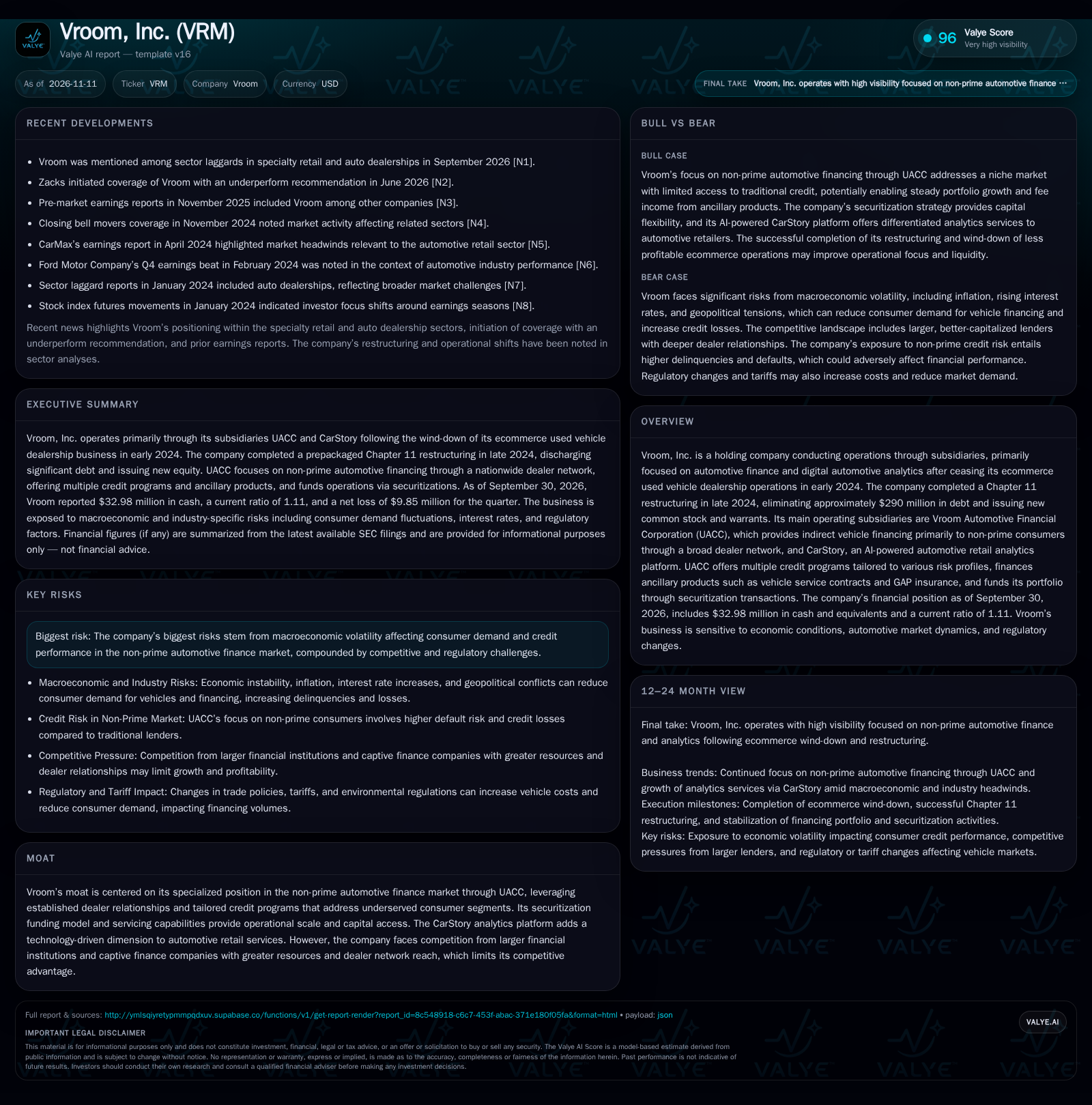
Vroom, Inc. fully exited its used-car ecommerce business in early 2024 and completed a Chapter 11 restructuring, eliminating $290 million in debt. Its future now rides on UACC, which offers non-prime auto financing via dealers, and CarStory, an automotive analytics platform. As of September 2026, Vroom reported $32.98 million in cash and a quarterly net loss, highlighting ongoing operational and credit risk challenges in a highly competitive and cyclical sector. The next phase depends on portfolio growth, credit performance, and successful securitization funding amid macroeconomic headwinds. [S1] [S2]
Vroom, Inc. represents a rare case of a public company that has fully pivoted its business model post-bankruptcy. After abandoning its unprofitable used-car ecommerce platform in early 2024, Vroom emerged from Chapter 11 with a clean balance sheet and a laser focus on two remaining assets: UACC, a non-prime auto finance platform, and CarStory, an analytics provider for auto retailers. The company’s future now depends on navigating credit risk, competitive pressure, and capital markets discipline in a sector highly sensitive to broader economic swings. The question for investors is whether this streamlined portfolio can deliver sustainable returns—or whether structural challenges in non-prime auto finance will continue to weigh on performance.
Restructured Vroom: From Used-Car Retail to Auto Finance and Analytics
Vroom, Inc. has undergone a major strategic and financial transformation since early 2024. The company exited its ecommerce used vehicle dealership business, ceasing all sales and marketing activities, liquidating inventory, and paying down floorplan debt by March 2024. In late 2024, Vroom completed a prepackaged Chapter 11 restructuring, discharging approximately $290 million in debt and issuing new common stock and warrants. Trading of the new equity resumed in early 2025 [S1].
The surviving Vroom is now a holding company for two main businesses: UACC (Vroom Automotive Financial Corporation), which provides indirect vehicle financing to primarily non-prime consumers through a national dealer network, and CarStory, an AI-driven automotive analytics platform. As of December 31, 2025, UACC serviced approximately 76,000 retail installment contracts, with $950 million in principal outstanding [S1].
Financially, Vroom reported $32.98 million in cash and equivalents, a current ratio of 1.11, and a cash ratio of 0.04 as of September 30, 2026. The company posted a net loss of $9.85 million for the quarter, with basic and diluted EPS of -$2.01 [S2]. These results reflect both the costs of transition and ongoing challenges in scaling profitable lending and analytics operations.
How UACC and CarStory Could Drive Value—And Where the Economics Are Fragile
Vroom’s economic engine is now almost entirely UACC, which originates and services auto loans to non-prime borrowers through a network of franchise and independent dealers. UACC’s model is built around risk-based pricing, with multiple credit programs (Preferred, Bankruptcy, Commercial, Near-Prime) designed to manage a range of borrower profiles. The company also finances ancillary products like vehicle service contracts and GAP insurance, earning fees and commissions on these add-ons [S1].
Revenue drivers for UACC include loan origination volume, net interest margin (the spread between interest earned and funding cost), and fee income from ancillary products. UACC funds its operations primarily through securitization—selling pools of retail installment contracts to institutional investors while retaining servicing rights and associated fee streams [S1]. This structure provides balance sheet flexibility but exposes Vroom to capital markets volatility and ongoing servicing obligations.
The economics of non-prime auto lending are structurally high-risk/high-reward. Yield spreads are wider than in prime lending, but so are credit losses, delinquency rates, and servicing costs. Operating leverage may be achievable if loan origination volumes grow faster than fixed infrastructure and credit management costs, but adverse credit trends can quickly overwhelm margin gains. CarStory’s analytics business could provide incremental, higher-margin revenue, but its scale and direct contribution are not broken out, making it difficult to assess its standalone economics or its ability to counterbalance lending volatility.
Specialization Versus Scale: Vroom’s Niche Play in a Crowded Auto Finance Arena
UACC operates in the intensely competitive U.S. auto finance market, particularly in the non-prime segment. Large national banks, captive finance arms of automakers, and independent specialty lenders all compete for dealer relationships and borrower volume. Larger players benefit from lower funding costs, broader dealer networks, and more sophisticated risk analytics, often allowing them to price more aggressively or weather credit cycles more robustly.
UACC’s competitive edge lies in its focus on non-prime borrowers—consumers with limited or impaired credit who may not qualify for traditional bank loans. By offering a range of credit programs and leveraging both automated and manual underwriting, UACC seeks to serve a segment underserved by mainstream lenders [S1]. However, this specialization also exposes Vroom to disproportionate credit risk, especially in economic downturns when non-prime defaults typically spike.
CarStory introduces a technology-driven differentiator, providing AI-powered analytics to automotive retailers. While this could enhance dealer relationships and provide cross-sell opportunities, the analytics market is also crowded, with many DMS (dealer management system) and data providers vying for share. The depth of CarStory’s integration into UACC’s dealer base and its ability to drive retention or higher margins remains an open question.
How Smart Risk Management and Securitization Access Could Unlock Profitable Growth
A bullish outcome for Vroom would require UACC to grow its loan portfolio while tightly managing credit risk, leveraging its automated and manual underwriting to avoid outsized defaults even as the non-prime market expands. If UACC can maintain or improve net interest margins, successfully upsell ancillary products, and keep credit losses within modeled parameters, fee and interest income could outpace operating expenses, driving the company toward profitability.
Ready access to securitization markets is critical. If investor demand for non-prime auto loan ABS remains strong, UACC can recycle capital efficiently and fund further growth without overleveraging the balance sheet. CarStory, if it gains traction as a leading analytics provider, could generate incremental high-margin revenue and deepen dealer relationships, potentially providing some countercyclical stability.
Confirmation of this scenario would come from sequential growth in loan originations, stable or improving net charge-off rates, increasing securitization volumes at favorable spreads, and visible growth in CarStory’s customer base or revenue (if disclosed).
Navigating Credit Cycles: The Most Likely Course for Vroom’s Lean Portfolio
The most plausible outcome is that Vroom remains a niche player with moderate growth in its loan portfolio, matched by ongoing volatility in credit performance. UACC may continue to originate loans and maintain dealer relationships, but competition from larger lenders and cyclical headwinds could compress margins and periodically elevate credit losses.
The base case assumes Vroom will be able to access securitization markets, but not always on ideal terms, leading to some variability in funding costs and origination pace. CarStory’s analytics revenue is likely to be incremental rather than transformative absent a clear breakout in market share or product differentiation.
This scenario would be supported by relatively stable loan balances, credit losses that move in line with broader economic conditions, and a financial profile that is break-even or modestly loss-making but not acutely distressed. Evidence to the contrary would include sharp increases in delinquencies, inability to securitize new loans, or large, sustained operating losses without offsetting revenue growth.
When Non-Prime Credit Turns: How Macroeconomic Stress Could Derail Recovery
The bear case revolves around a deteriorating macro environment—rising unemployment, higher interest rates, or declining used car values—that triggers a spike in non-prime defaults and delinquencies. In this scenario, UACC would face rapidly rising credit losses, increased repossessions, and lower recovery rates, eroding net interest margins and potentially leading to negative operating leverage.
Concurrently, if securitization markets tighten—either due to higher risk aversion or investor pullback from non-prime auto ABS—UACC could struggle to fund new originations, forcing a contraction in the loan book and dealer presence. Increased competition for higher-quality borrowers could further compress yields or force a retreat to riskier segments.
The downside would be confirmed by a sharp uptick in net charge-off rates, declining origination volumes, inability to complete securitizations on acceptable terms, and worsening quarterly losses. Prolonged stress could raise questions about Vroom’s long-term viability, especially if CarStory is unable to offset lending losses with material analytics revenue.
Signals That Will Determine If Vroom’s Risk/Reward Tradeoff Pays Off
Quarterly trends in UACC’s loan origination volumes—growth or contraction, and the mix across credit programs—would help gauge market competitiveness and dealer traction.
Reported net charge-off and delinquency rates are critical for assessing credit quality and the effectiveness of UACC’s underwriting and collection strategies.
Details on securitization activity—such as transaction size, coupon rates, investor demand, and advance rates—would illuminate funding access and cost of capital.
Fee and commission income from ancillary products (service contracts, GAP insurance) would signal cross-sell success and revenue diversification, if disclosed.
Segment-level financials or growth metrics for CarStory would help evaluate the analytics platform’s contribution and scalability.
Shifts in the competitive landscape—such as new entrants, dealer defections, or pricing changes by larger lenders—could pressure margins or origination volumes.
Macroeconomic data on non-prime auto loan performance, used car prices, and consumer credit conditions would provide context for UACC’s risk exposure.
Disclaimer: This is research-only, informational analysis and not investment advice. It may include AI-generated interpretation and general industry context. Always verify important details using primary sources.

Comments