
Context Therapeutics Refocuses Pipeline on TCE Bispecifics Amid Funding and Clinical Inflection Points
With the discontinuation of CT-95 and strategic pivot to CTIM-76 and CT-202, Context Therapeutics enters a critical phase: early clinical progress and differentiated antibody platforms must now translate into proof-of-concept data and financial runway extension, as capital constraints and Nasdaq compliance risks intensify.
Context Therapeutics has concentrated its resources on two T cell engaging bispecific antibody programs for solid tumors after discontinuing CT-95, leaving the company reliant on the clinical and partnering success of CTIM-76 and CT-202. While early clinical signals and FDA Fast Track designation for CTIM-76 are promising, the company’s ability to secure new funding is crucial, given its explicit going concern warning and Nasdaq listing risk. The next 12 months will likely determine whether Context can convert scientific progress into strategic partnerships or face operational retrenchment.
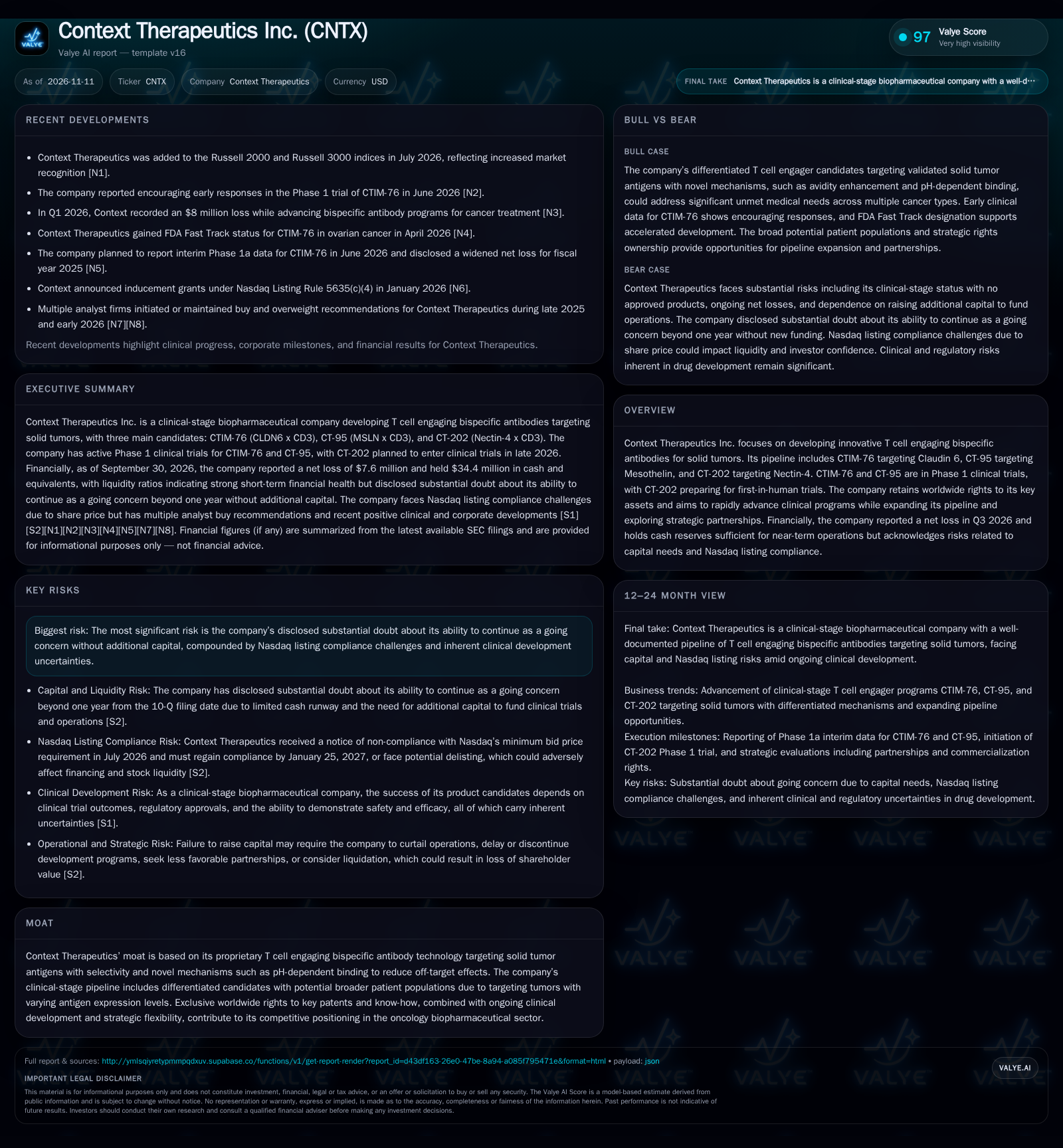
Context Therapeutics Inc., a clinical-stage biopharma specializing in T cell engaging bispecific antibodies for solid tumors, has narrowed its focus to two core programs—CTIM-76 and CT-202—after discontinuing CT-95. This strategic refocus comes as the company faces explicit capital constraints, a disclosed going concern risk, and the challenge of Nasdaq listing compliance. With interim Phase 1 data for CTIM-76 showing early promise and CT-202 preparing for clinical entry, Context’s future now hinges on the clinical progress and commercial potential of these lead assets, as well as its ability to secure new funding or strategic partnerships in the coming year.
Strategic Pipeline Prioritization and Financial Uncertainty Define Context’s Present
The most consequential recent development for Context Therapeutics is the discontinuation of internal development for CT-95, its Mesothelin-targeting TCE, in August 2026. This move reflects a portfolio prioritization and capital allocation strategy, consolidating resources behind CTIM-76 (CLDN6 x CD3) and CT-202 (Nectin-4 x CD3), both of which remain in early clinical or preclinical stages [S2].
CTIM-76 stands as the company’s lead asset, having progressed into Phase 1 trials with interim data described as encouraging and bolstered by FDA Fast Track status for ovarian cancer [S1] [N2] [N4]. Meanwhile, CT-202 is positioned to enter first-in-human trials, with an application submitted to the Australian Bellberry Human Research Ethics Committee and dosing planned for Q3 2026 [S1].
Financially, Context reported $34.4 million in cash as of September 30, 2026, but has issued a clear warning: it does not expect these resources to fund operations for 12 months past its latest 10-Q, resulting in substantial doubt about its ability to continue as a going concern [S2]. Compounding this, Context received notice of non-compliance with Nasdaq’s minimum bid price rule and faces a January 2027 deadline to remedy or risk delisting [S2].
How Context’s Value Creation Hinges on Clinical Milestones and Strategic Optionality
Context’s business model, like many clinical-stage biopharmas, is predicated on advancing differentiated assets through early clinical milestones to unlock value inflection points: either through lucrative partnerships, out-licensing deals, or—less commonly—by retaining rights and eventually commercializing in-house if late-stage success is achieved. The company retains full worldwide rights to both CTIM-76 and CT-202, maximizing its theoretical upside but also its capital intensity and risk exposure [S1].
Absent any approved products or recurring revenue, Context’s economics are currently defined by R&D outflows and, potentially, milestone or upfront payments from future strategic deals. Fixed costs are relatively low compared to commercial-stage peers, but variable expenses rise sharply with clinical trial progression and expansion. This creates a dynamic where operating leverage is negative until a partnering event or clinical readout materially de-risks the pipeline.
Capital needs are acute: Context’s own disclosures indicate its cash is insufficient for full development of either lead asset, making the timing and outcome of clinical data releases critical for negotiating future funding or partnership terms. The company’s going concern warning underscores that, without new capital or strategic transactions, the business may need to curtail operations or halt development [S2].
Differentiation Through Target Selection and Mechanism, but Intense Sector Rivalry Persists
Context operates in the highly competitive field of T cell engaging bispecific antibodies for solid tumors, where major pharmaceutical and biotechnology firms are investing heavily. Its lead asset, CTIM-76, targets Claudin 6—a protein with restricted expression in healthy adult tissues but upregulated in multiple tumor types—potentially offering a safety and efficacy edge over less selective targets [S1]. CT-202’s pH-dependent binding is designed to mitigate dermatologic side effects seen with other Nectin-4 targeting drugs, aiming to expand the therapeutic window and patient eligibility [S1].
The company’s decision to discontinue CT-95 reflects both capital constraints and a strategic calculus about differentiation: the Mesothelin space is crowded, with several established and emerging players. By focusing on CLDN6 and Nectin-4 with novel mechanisms (avidity enhancement, pH selectivity), Context seeks to carve out a niche, but must demonstrate that these innovations translate into superior clinical outcomes.
Switching costs for prescribers and payers in oncology are high if a therapy demonstrates clear clinical benefit, but initial adoption is slow and data-driven. Context’s exclusive control over its intellectual property could be valuable if its programs show compelling efficacy and safety, making them attractive for potential partners or acquirers. However, the competitive landscape is dynamic, with many companies pursuing similar modalities and targets.
Proof-of-Concept Data and Partnering Catalyze a Funding and Valuation Reversal
The most favorable outcome for Context would involve positive interim data from the CTIM-76 Phase 1 trial—particularly in ovarian cancer, where FDA Fast Track status can accelerate regulatory timelines [N4]. If CTIM-76 demonstrates a compelling safety and efficacy profile (e.g., durable tumor responses, manageable toxicity), the company could attract a strategic partnership or out-licensing deal, which may provide upfront cash, milestone payments, and validation of its platform.
A successful initiation and early signals from CT-202’s first-in-human trial would further diversify Context’s pipeline and increase its negotiating leverage. In this scenario, analyst buy recommendations could be validated, and the risk of Nasdaq delisting would diminish if positive news drives share price recovery [N7] [N8].
Evidence that would confirm this scenario includes: robust and durable responses in CTIM-76’s interim data, initiation of a partnership or licensing agreement with a larger oncology company, and successful completion of CT-202 first patient dosing on schedule. A significant capital raise or non-dilutive funding event following positive data would further support this trajectory.
Clinical Progress but Persistent Funding Gaps and Share Price Volatility
The most plausible near-term trajectory is one where Context achieves incremental clinical progress—such as completion of CTIM-76 Phase 1a and CT-202 first-in-human dosing—but without a transformative partnership or funding event in the immediate term. In this situation, the company continues to report early safety and efficacy data, but still faces a narrowing cash runway and ongoing Nasdaq compliance risk.
Context may seek to raise additional capital via equity offerings, potentially at depressed valuations if the share price remains below the Nasdaq minimum bid threshold. The company could also pursue smaller, indication-specific partnerships or grants, but these may not fully address its capital requirements.
This scenario would be confirmed by steady clinical enrollment, timely data releases, but a continued going concern warning and periodic capital raises. A failure to regain Nasdaq compliance by January 2027—absent a major catalyst—would also fit this moderate case.
Funding Shortfall and Delisting Force Pipeline Retrenchment or Liquidation
In a negative scenario, Context fails to deliver sufficiently positive or differentiated clinical data from CTIM-76 or faces delays in CT-202’s clinical entry. Coupled with an inability to secure new funding or strategic partners, this would trigger operational retrenchment: the company may be forced to halt or suspend development, reduce headcount, or consider asset sales.
If the share price does not recover and Nasdaq delisting occurs, investor confidence and liquidity could deteriorate, further constraining the company’s ability to access capital markets or execute on strategic options. In an extreme case, Context could pursue liquidation or bankruptcy if it cannot secure sufficient funding to meet obligations.
Evidence for this scenario would include missed clinical milestones, negative or inconclusive data releases, worsening financial disclosures (e.g., further cash burn with no offsetting inflows), and delisting from Nasdaq without an alternative listing solution.
Milestones That Will Determine Context’s Clinical and Financial Viability
Interim safety and efficacy data from the CTIM-76 Phase 1 trial—particularly in the ovarian cancer cohort—will be crucial for external validation and potential partnering interest.
Initiation and progress of CT-202’s first-in-human trial (including timely patient dosing and early tolerability signals) will test the company’s ability to diversify its pipeline and deliver on its mechanistic promise.
Disclosure of any new partnerships, licensing deals, or non-dilutive funding events would help confirm Context’s ability to monetize its pipeline and extend its runway.
Updates on cash runway (if disclosed in future filings) and management’s guidance on operational adjustments in response to funding constraints will signal the company’s financial adaptability.
Progress toward regaining compliance with Nasdaq’s minimum bid price requirement—through share price recovery or other corporate actions—will affect capital market access and investor confidence.
Clinical trial enrollment rates and protocol amendments (if any) would indicate the feasibility of timely data readouts and ongoing program viability.
Announcement of strategic reviews, asset sales, or consideration of alternative listing venues would suggest a pivot in response to persistent capital or compliance challenges.
Disclaimer: This is research-only, informational analysis and not investment advice. It may include AI-generated interpretation and general industry context. Always verify important details using primary sources.

Comments