
Achieve Life Sciences: Financial Strength Meets Regulatory Hurdles in the Pursuit of Smoking Cessation Leadership
A recent FDA Complete Response Letter citing manufacturing concerns adds complexity, delaying commercialization and increasing execution risk.
A recent FDA Complete Response Letter citing manufacturing concerns adds complexity, delaying commercialization and increasing execution risk. The company’s ability to resolve regulatory issues and transition to revenue generation will determine its long-term viability and market impact. [S2] [N8]
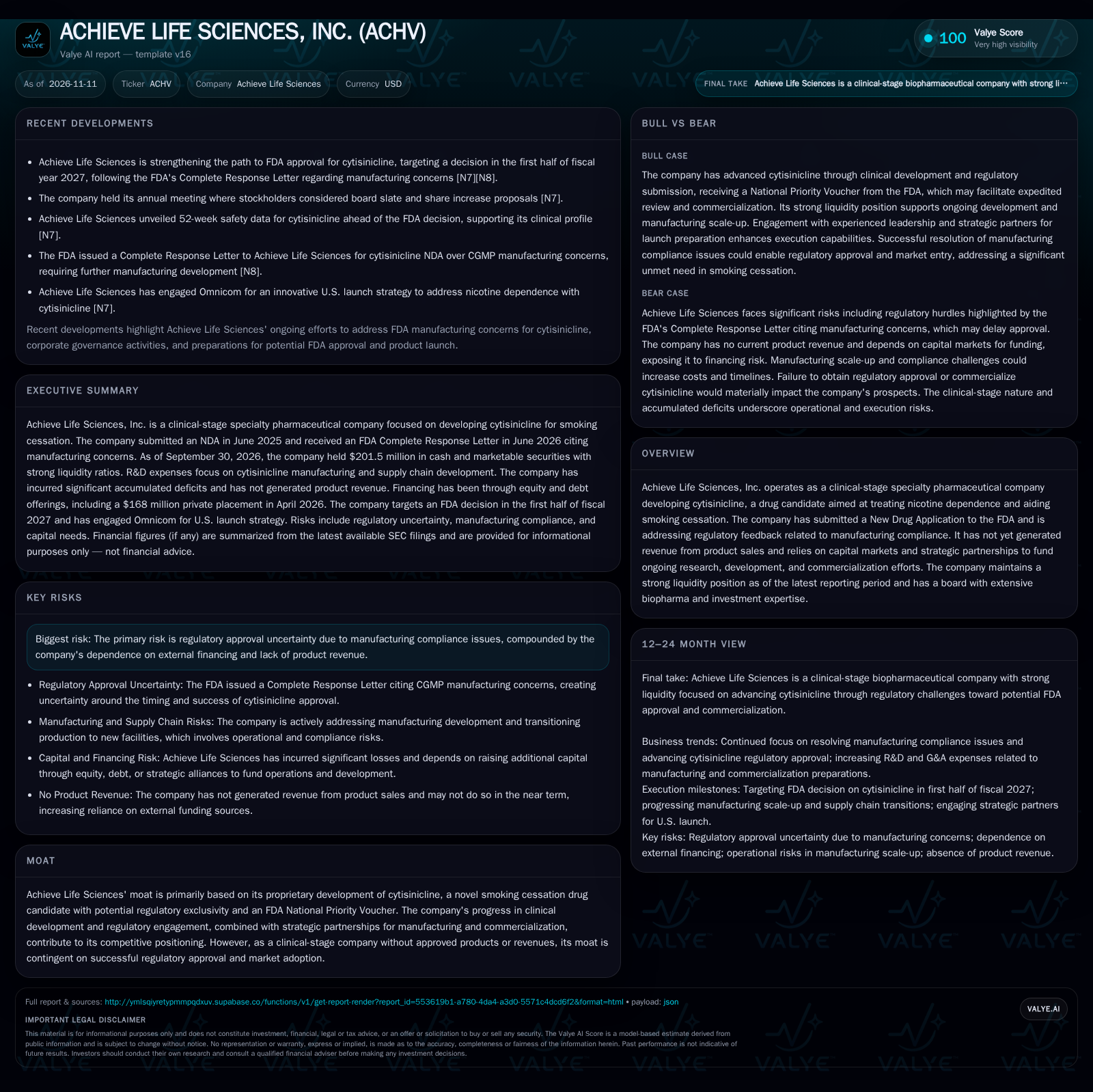
Achieve Life Sciences is at a crossroads: its lead asset, cytisinicline, targets the significant unmet need in smoking cessation, and the company boasts a formidable liquidity cushion from recent financings. Yet, the FDA’s rejection of its initial NDA due to manufacturing compliance issues spotlights the persistent risks facing clinical-stage biopharma firms. With no product revenue and an accumulated deficit exceeding $350 million, Achieve’s trajectory will hinge on its ability to resolve regulatory setbacks, control costs, and successfully transition from development to commercialization.
Recent Developments: Capital Resilience and Regulatory Setbacks Shape the Outlook
Achieve Life Sciences’ cash, cash equivalents, and marketable securities stood at $201.5 million as of September 30, 2026, with a current ratio of 10.49 and a cash ratio of 10.39, reflecting a reported liquidity position. This financial strength follows a $168 million private placement in April 2026 and a $45 million public offering in June 2025, which together have provided runway for ongoing operations and development. However, the company’s lead program, cytisinicline for smoking cessation, received a Complete Response Letter (CRL) from the FDA in June 2026 due to concerns over current Good Manufacturing Practice (CGMP) compliance, delaying potential market entry and requiring further manufacturing improvements. Achieve has also engaged Omnicom to prepare for a U.S. launch strategy, signaling commercial intent once regulatory issues are addressed. The company continues to operate without product sales revenue, and its accumulated deficit reached $357.3 million by September 30, 2026. [S2] [N7] [N8]
The company must balance ongoing manufacturing remediation expenses with investments in commercial infrastructure, which could strain resources if regulatory delays persist. Additionally, the timing and scale of future fundraising efforts will depend heavily on the market’s perception of progress in addressing FDA concerns and the perceived viability of cytisinicline as a competitive therapy. This dynamic introduces a layer of execution risk that could affect operational flexibility and strategic decision-making.
Commercialization Economics: Funding, Fixed Costs, and the Path to Revenue
Achieve Life Sciences’ business model is classic late-stage biopharma: heavy upfront investment in research, clinical development, and regulatory approval, with the prospect of significant recurring revenue if cytisinicline reaches market. The company’s cost base is currently dominated by R&D—particularly manufacturing scale-up and supply chain development for cytisinicline—and increased general and administrative spending (notably stock-based compensation and legal costs).
If approved, cytisinicline’s economics would depend on pricing (likely benchmarked against existing smoking cessation therapies), potential for formulary access, and the size of the addressable population—tens of millions of smokers in the U.S. alone. Commercial success would require significant investment in sales, marketing, and distribution, with the potential for operating leverage as fixed costs are spread across growing revenue. However, manufacturing setbacks could inflate cost of goods sold and delay gross margin expansion, particularly if additional investments in CGMP compliance and inventory are needed.
The pathway to profitability for Achieve hinges not only on regulatory approval but also on the efficiency of scaling manufacturing processes to meet commercial demand at acceptable cost levels. Manufacturing scale-up in biopharma often involves complex supply chain coordination and quality assurance challenges that can significantly impact cost of goods sold (COGS). If Achieve encounters persistent manufacturing inefficiencies or quality control issues, these could erode gross margins and delay the breakeven point. Furthermore, the company’s ability to negotiate favorable pricing and reimbursement terms will be influenced by the competitive landscape and payer perceptions of cytisinicline’s clinical value relative to existing therapies, which in turn affects revenue projections and investment returns.
Regulatory Barriers and Market Dynamics in Smoking Cessation
Cytisinicline targets a large and persistent market: smoking cessation remains a major public health goal, with limited pharmacological options (e.g., varenicline, bupropion, nicotine replacement therapies) that have mixed efficacy and significant side effect profiles. Achieve aims to differentiate cytisinicline with a novel mechanism and potentially improved tolerability. However, the competitive landscape is shaped less by direct rivals and more by regulatory, payer, and prescriber adoption barriers.
The recent FDA CRL exposes Achieve to time-to-market risk, which could allow entrenched therapies or generics to maintain share. Furthermore, the company’s lack of commercial infrastructure (prior to Omnicom engagement) could slow uptake if and when approval is secured. If cytisinicline demonstrates meaningful clinical and economic advantages, Achieve could achieve favorable formulary positioning and rapid uptake, but it must first clear regulatory and manufacturing hurdles that larger, diversified competitors may be better equipped to navigate.
The regulatory environment for smoking cessation therapies is particularly stringent, given the public health implications and the need to demonstrate both efficacy and safety over existing options. Achieve’s success will depend on its capacity to navigate complex FDA requirements while differentiating cytisinicline through clinical data that convincingly addresses efficacy and tolerability. Additionally, payer adoption is contingent upon pharmacoeconomic evidence demonstrating cost-effectiveness and patient adherence benefits, which may require extensive real-world data collection post-launch. The company’s relatively limited commercial experience compared to larger incumbents could pose challenges in rapidly establishing market presence, especially if prescriber education and patient engagement programs are not sufficiently robust.
Overcoming Regulatory Barriers and Capturing First-Mover Momentum
In the upside scenario, Achieve rapidly addresses the FDA’s CGMP concerns—potentially by upgrading manufacturing processes, enhancing quality controls, and securing compliant third-party suppliers. A successful resubmission and subsequent approval of cytisinicline could enable a rapid commercial launch, leveraging the Omnicom partnership for targeted U.S. marketing and payer engagement. If Achieve secures favorable reimbursement and demonstrates strong physician and patient uptake, it could quickly transition to positive cash flow, particularly if manufacturing scale delivers margin expansion.
Confirmation would come from public disclosure of regulatory progress (e.g., FDA acceptance of a resubmitted NDA), manufacturing remediation milestones, and early commercial partnerships or formulary wins. Rapid revenue ramp and evidence of operating leverage—such as declining SG&A as a percentage of sales—would further validate the upside case.
Navigating Prolonged Regulatory Remediation and Gradual Commercial Build-Out
The most plausible scenario sees Achieve spending several quarters addressing the FDA’s manufacturing concerns, with additional costs and potential delays in cytisinicline approval.
In this scenario, cytisinicline eventually gains approval, but commercialization is gradual—constrained by initial payer skepticism, prescriber inertia, and the need to build out sales infrastructure. Revenue growth may be modest at first, with operating leverage delayed until the product gains broader acceptance. Evidence supporting this scenario would include ongoing cash burn, incremental regulatory updates rather than a swift turnaround, and measured hiring or partnership activity in commercial functions.
Extended Delays or Failure to Achieve Approval Compound Funding Risk
The bear case materializes if Achieve is unable to resolve manufacturing compliance issues to the FDA’s satisfaction—leading to prolonged delays, additional CRLs, or even ultimate rejection of cytisinicline. In this scenario, cash reserves are depleted by ongoing R&D, remediation, and SG&A costs without the offset of product revenue. The company may be forced to pursue dilutive financings, asset sales, or strategic alternatives, especially if capital markets tighten or investor appetite wanes.
Confirmation would come from repeated regulatory setbacks, lack of progress updates, accelerating cash burn, or management signaling the need for additional financing rounds. Any public disclosure of failed remediation efforts or partner withdrawals would further tilt the business toward this downside outcome.
Milestones That Will Determine Achieve Life Sciences’ Transition to Commercialization
Progress updates on FDA interactions regarding cytisinicline’s manufacturing remediation, including resubmission and potential acceptance of a revised NDA.
Disclosure of concrete manufacturing upgrades, facility validations, or new third-party manufacturing partnerships that address CGMP concerns.
Cash burn rate and operating expense trends as remediation and launch preparation continue; a useful metric would be quarterly net cash used in operations, if disclosed.
Announcements of commercial partnerships, distribution agreements, or early formulary wins that signal market readiness.
Changes in the company’s financing strategy or new equity/debt offerings, which could indicate runway risk or confidence in approaching commercialization.
Pipeline updates, including any new indications or clinical data for cytisinicline or other assets that could diversify risk.
Turnover or expansion in executive or board leadership, especially in regulatory, manufacturing, or commercial roles, as a proxy for organizational readiness.
Monitoring changes in operational efficiency during the remediation phase will be essential to assess Achieve’s capacity to manage cash flow and extend its runway. Metrics such as burn multiple—cash spent relative to progress milestones achieved—would provide insight into capital effectiveness. Additionally, observing the evolution of manufacturing partnerships and the integration of quality management systems will help gauge the likelihood of regulatory approval. On the commercial front, early signals from payer negotiations, formulary placements, and prescriber feedback can serve as leading indicators of market acceptance. Lastly, shifts in organizational structure, particularly the recruitment of experienced regulatory and commercial professionals, may reflect strategic adjustments aimed at mitigating identified risks and accelerating time to market.
Disclaimer: This is research-only, informational analysis and not investment advice. It may include AI-generated interpretation and general industry context. Always verify important details using primary sources.

Comments