
Carlsmed’s Cervical Platform Launch and Leadership Reset: Innovation and Profitability at a Strategic Crossroads
Carlsmed’s recent launch of the Aprevo Cervical Platform and a leadership reshuffle underscore its push for growth in personalized spine surgery.
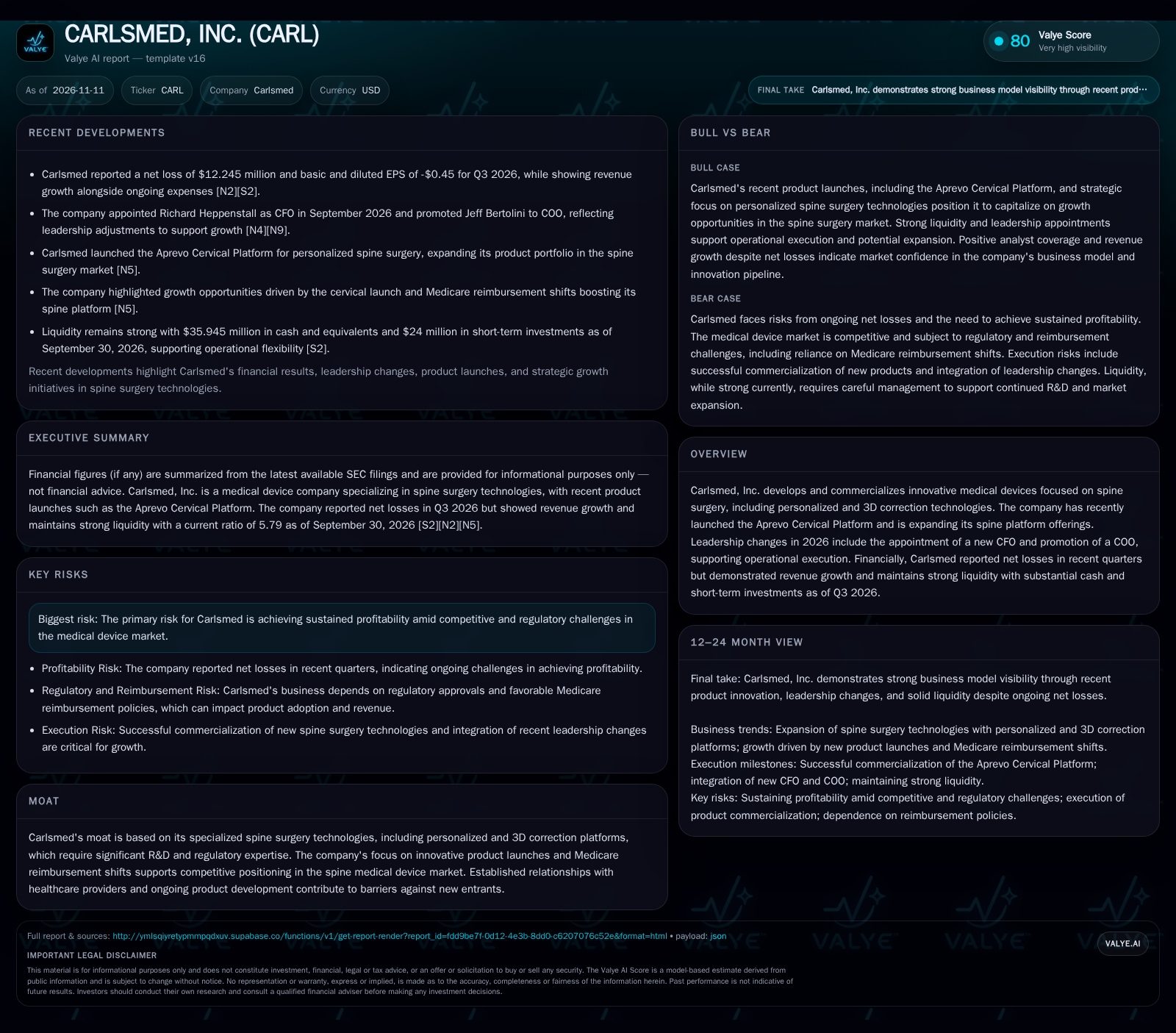
Carlsmed, Inc. is pursuing growth through the launch of its personalized cervical spine surgery platform and strategic leadership changes. Success hinges on commercializing new products, capitalizing on Medicare reimbursement shifts, and integrating new executives—all in a competitive, regulation-heavy medical device landscape. The sustainability of revenue growth and the transition to profitability remain key uncertainties. [S2] [N2] [N4] [N5]
Carlsmed, Inc. is at a pivotal moment as it leverages a reported liquidity position to drive growth initiatives in the competitive spine surgery device market. With the launch of its Aprevo Cervical Platform and new executive appointments, Carlsmed aims to capitalize on the shift toward personalized, 3D-enabled surgical solutions. However, persistent net losses and reliance on external reimbursement dynamics raise pressing questions about the company’s ability to scale profitably and defend its market position over the long term. The next phase will test whether Carlsmed’s innovation engine and operational reset can translate into sustainable commercial success.
Strategic Pivot and Growth Ambitions Mark Recent Developments
Carlsmed’s Q3 2026 financials highlight a company in investment mode: a net loss of $12.245 million was reported, even as revenue grew compared to prior periods [N2] [S2]. This continued willingness to absorb losses reflects a prioritization of market expansion and R&D over near-term profitability. The appointment of Richard Heppenstall as CFO and Jeff Bertolini as COO in September 2026 represents a deliberate refresh of the executive team, likely aimed at improving operational execution and scaling commercial efforts [N4]. The recent launch of the Aprevo Cervical Platform marks a significant product milestone, expanding Carlsmed’s presence in personalized spine surgery and potentially unlocking new revenue streams [N5].
Economic Value Potential of Carlsmed’s Spine Technology
Carlsmed’s core business model is anchored in developing and commercializing personalized, 3D-enabled medical devices for spine surgery. Revenue is likely driven by the sale or placement of proprietary implants and instrumentation, potentially supplemented by enabling software or digital planning tools. In the current spine surgery market, device pricing can be robust—especially for novel, patient-specific solutions—though payor pressure and hospital procurement practices often compress margins over time.
The addition of the Aprevo Cervical Platform may improve Carlsmed’s revenue mix by tapping into the sizeable cervical spine segment, which is characterized by both high procedure volumes and demand for improved outcomes. The company’s cost structure is likely heavy on R&D, regulatory, and clinical trial expenses, with commercial-scale manufacturing introducing additional fixed costs as volumes grow. Operating leverage could improve if adoption accelerates: high-margin incremental sales from a fixed manufacturing base would support gross margin expansion, provided pricing holds up.
However, the company’s ongoing net losses signal that fixed and variable costs, including salesforce expansion and clinical support, currently outpace revenue. Sustained investment will be required to drive adoption and compete with larger incumbents, raising the stakes for efficient capital allocation and eventual gross-to-operating margin improvement.
Competitive Landscape and Challenges in Personalized Spine Devices
Carlsmed operates in a highly competitive field dominated by established spine device companies, diversified medtech giants, and a growing cohort of venture-backed innovators focused on patient-specific implants and digital surgical planning. Potential advantages for Carlsmed include its focus on personalized, 3D correction technologies—a segment with clinical appeal due to the promise of better anatomical fit and surgical outcomes.
Barriers to entry are meaningful: regulatory approvals, clinical validation, and the need for deep relationships with surgeons and hospitals create friction for new entrants. However, larger incumbents possess scale, entrenched distribution, and the ability to bundle products, which could limit Carlsmed’s pricing power or slow its penetration.
Switching costs may exist for surgeons who become accustomed to Carlsmed’s planning and implant workflow, but these are not insurmountable if competitive platforms offer integration or superior economics. The Medicare reimbursement environment is a double-edged sword: favorable coverage can accelerate adoption, but policy shifts or rate cuts could quickly undermine Carlsmed’s commercial momentum.
Clinical and Reimbursement Factors Could Accelerate Platform Adoption
A favorable scenario unfolds if the Aprevo Cervical Platform gains rapid clinical acceptance, leading to accelerated sales growth across both new and existing accounts. Key drivers would include compelling clinical evidence of superior patient outcomes, surgeon advocacy, and streamlined integration into hospital procurement processes. If Medicare reimbursement dynamics continue to shift positively—expanding coverage or payment rates for personalized spine implants—Carlsmed could see a step-change in utilization and pricing realization [N5].
Operating leverage would materialize as fixed costs are absorbed by higher volumes, narrowing net losses and setting the stage for eventual profitability. Evidence supporting this scenario would include sequential acceleration in revenue growth, growing order backlogs (if disclosed), improved gross margins, and positive commentary from management and clinicians regarding product adoption and outcomes.
Growth Trajectory Faces Competition and Gradual Market Penetration
The most plausible trajectory is one of gradual adoption: Carlsmed’s cervical platform and legacy products continue to win business in select centers, but market penetration is tempered by entrenched competitors and cautious hospital purchasing. Revenue continues to grow, but at a pace that requires ongoing investment in sales, support, and clinical validation.
Margins may improve modestly as sales volumes increase, but the pace of operating leverage is constrained by the need to fund field support and R&D. Medicare reimbursement remains supportive but does not provide a transformative lift. Leadership changes help streamline execution but do not fully offset the challenge of scaling in a mature, highly scrutinized market.
Indicators confirming this scenario would be steady, single-digit sequential revenue growth, persistent but narrowing net losses, and continued cash burn offset by a still-reported liquidity position buffer.
Risks from Commercialization Delays and Reimbursement Uncertainty
In a less favorable scenario, Carlsmed encounters slower-than-expected uptake of its new cervical platform due to surgeon inertia, procurement hurdles, or insufficient clinical evidence differentiating its products. If Medicare reimbursement policies tighten or fail to expand as anticipated, hospitals may deprioritize adoption of higher-priced personalized implants, compressing both volume and pricing.
Fixed costs remain high while revenue growth stalls, leading to persistent operating losses and accelerated cash burn. Competitive responses—such as price cuts or bundled offerings from larger players—could further erode Carlsmed’s position. Confirmation of this scenario would include flat or declining sequential revenues, stagnating gross margins, negative shifts in management guidance, or the need to raise additional capital sooner than anticipated.
Growth Milestones That Will Shape Carlsmed’s Future Prospects
Sequential revenue growth rates for the cervical platform and total company sales, providing evidence of market adoption and product mix evolution (if disclosed).
Gross margin trends, as improvements would indicate pricing strength and manufacturing scale advantages (if disclosed).
Net loss trajectory and operating cash flow, to assess how quickly investments are translating into improved profitability.
Updates on Medicare and private payor reimbursement coverage for personalized spine implants, as policy shifts can materially impact adoption rates.
Surgeon adoption metrics or case volume growth for Aprevo Cervical (if disclosed), providing insight into clinical traction.
Integration effectiveness of new CFO and COO, as measured by operational execution, cost control, or commercial milestones discussed in future disclosures.
Any signals of competitive responses—such as new launches or price adjustments from incumbents—that may affect Carlsmed’s market share or pricing power.
Disclaimer: This is research-only, informational analysis and not investment advice. It may include AI-generated interpretation and general industry context. Always verify important details using primary sources.

Comments