
QumulusAI: Scaling GPU Infrastructure Amid Liquidity Pressure and Contract Realization Risk
QumulusAI is rapidly expanding its GPU-as-a-service footprint with multi-year customer agreements and long-term data center leases.
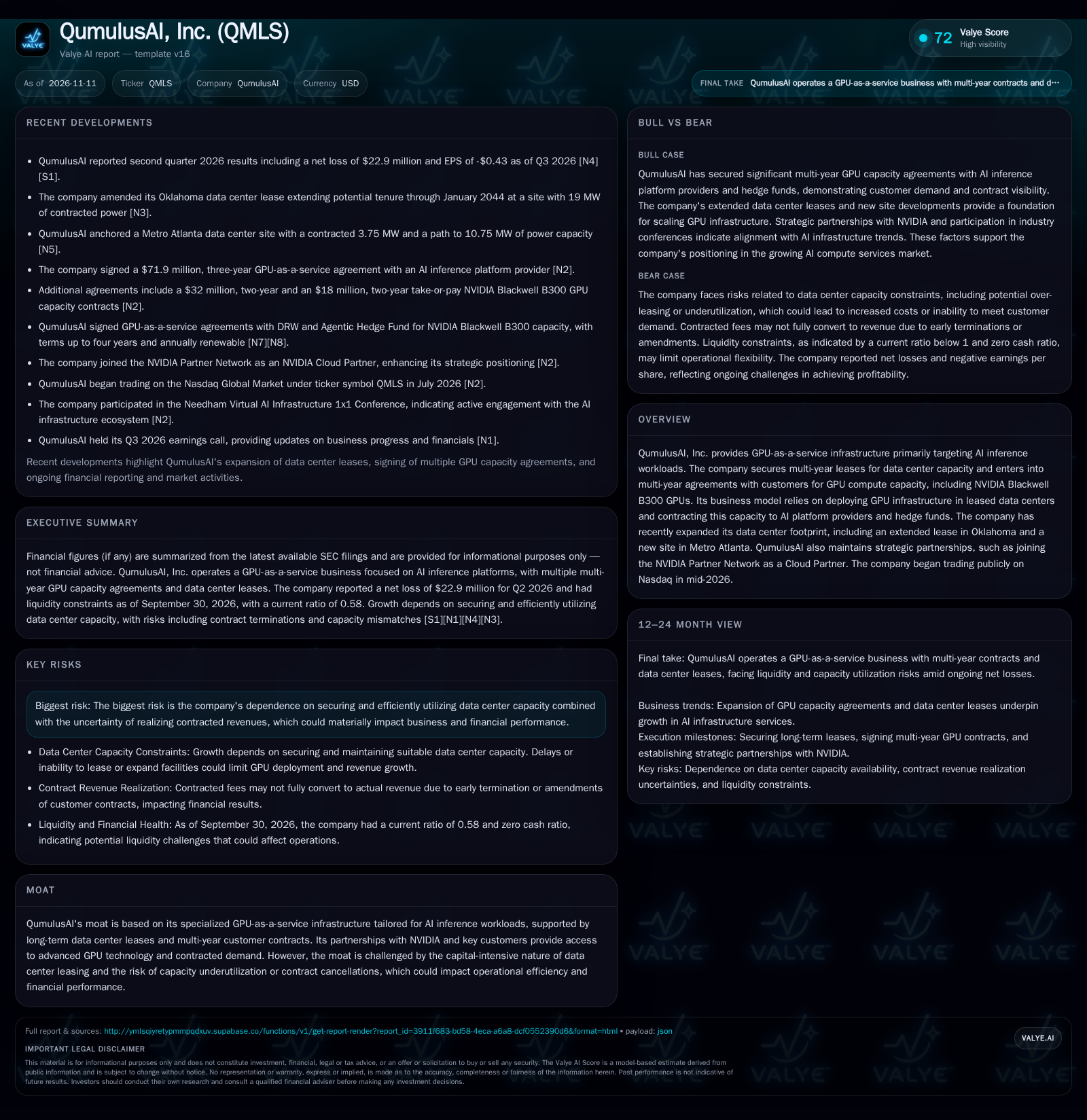
QumulusAI is building a GPU-as-a-service business targeting AI inference workloads, underpinned by long-term data center leases and multi-year customer contracts for NVIDIA Blackwell B300 GPUs. The central challenge remains: can QumulusAI turn booked capacity and contracts into durable, profitable cash flow before capital tightens further? [S1] [N1] [N2] [N3] [N4] [N5] [N7] [N8]
QumulusAI is positioning itself as a critical enabler of AI inference by providing GPU compute infrastructure as a service to platform providers and sophisticated trading firms. With multi-year customer contracts and aggressive expansion of its data center footprint, QumulusAI has staked its future on the secular growth of AI workloads and the value of high-performance NVIDIA GPUs. Success will hinge on matching capacity with demand and maintaining potential financial flexibility in a fast-evolving, competitive landscape.
Recent Contracts and Expansion Moves Set the Stage—But Liquidity and Revenue Conversion Risks Loom
QumulusAI has signed multiple multi-year GPU-as-a-service agreements, including a $71.9 million three-year contract and several additional deals totaling tens of millions of dollars, primarily for NVIDIA Blackwell B300 GPU capacity. These agreements anchor demand for QumulusAI’s infrastructure and represent tangible customer commitments to its platform. The company has also amended its Oklahoma data center lease, extending potential tenure through January 2044 at a site with 19 MW of contracted power, and secured a new site in Metro Atlanta with a contracted 3.75 MW and a path to 10.75 MW of power capacity. These expansions give QumulusAI a foundation for future scaling. The company has explicitly disclosed risks around underutilization or over-leasing of data center capacity, as well as contract amendments or early terminations that could prevent contracted fees from converting to realized revenue. [S1] [N2] [N3] [N4] [N5] [N7] [N8]
How QumulusAI’s Asset-Heavy Model Could Scale—Or Strain—Profitability
QumulusAI’s economics are driven by the spread between long-term, largely fixed data center (and GPU hardware) costs and variable, contract-based revenues from customers. The company leases data center space and power in multi-year increments, then deploys high-end GPUs (notably NVIDIA Blackwell B300s), and sells capacity—often in multi-year, take-or-pay, or annually renewable agreements. In this model, high fixed costs (leases, power, hardware depreciation) create operating leverage: if capacity utilization is high and contracted, incremental revenue could flow through at attractive margins after covering fixed costs. Conversely, underutilization or contract churn can quickly turn fixed obligations into a drag on cash flow and profitability.
Revenue mix and contract structure are critical. Take-or-pay and multi-year agreements may provide some revenue visibility, but early termination clauses or amendments could undermine this. Pricing is likely indexed to prevailing GPU demand and supply constraints, which have been elevated in the AI boom, but could compress if supply catches up or competition intensifies. Capital intensity is high: ongoing investments in GPUs and data center capacity require significant upfront (and often recurring) cash outlays, making access to financing and efficient asset utilization essential for scaling without balance-sheet stress.
The business requires careful matching of lease commitments to contracted revenue, as over-leasing or slow customer ramp could result in negative cash conversion. The model’s success hinges on durable demand, high utilization, and the ability to negotiate favorable terms with both customers and data center providers. [S1] [N3] [N4] [N5]
Positioning in a Crowded GPU Compute Market: Advantages and Counterforces
QumulusAI’s principal competitive advantage is its early access to advanced NVIDIA GPU capacity, underpinned by membership in the NVIDIA Partner Network and an ability to secure long-term data center leases. This positions the company as a credible provider of high-performance GPU compute for AI inference—a market segment with strong secular tailwinds, as generative AI and real-time inference workloads proliferate.
However, barriers to entry are moderate: while securing new NVIDIA GPUs and long-term, cost-effective data center power is challenging, other well-capitalized players (including hyperscale cloud providers, specialized GPU hosting firms, and diversified infrastructure REITs) compete aggressively on price, scale, and reliability. QumulusAI’s differentiation partly depends on its ability to guarantee access to the latest GPU hardware and to offer flexible, customer-aligned contract structures. The company’s relationships with trading firms and AI platforms suggest early traction in high-value, latency-sensitive workloads, but these customers may also be price-sensitive and quick to switch if better terms or newer technology become available elsewhere.
Switching costs for customers are likely moderate—porting AI workloads between providers can be non-trivial but is increasingly streamlined as cloud-native architectures proliferate. QumulusAI’s long-term leases and customer contracts give some revenue visibility, but do not fully insulate it from competitive pricing pressure, technological substitution (e.g., more efficient chips, on-premise AI hardware), or contract churn.
If AI Compute Demand Surges and Contracts Hold, Operating Leverage Could Drive Rapid Margin Expansion
The most favorable scenario for QumulusAI is one where demand for GPU compute—especially for AI inference—continues to grow rapidly, driven by new generative AI applications and the scaling of real-time workloads. In this environment, the company’s existing multi-year contracts (including take-or-pay structures) convert fully to revenue, and new customers emerge to fill any incremental capacity. High utilization rates and contracted pricing allow QumulusAI to cover its fixed costs and achieve positive operating leverage, with incremental revenue flowing through to the bottom line. Strategic partnerships with NVIDIA provide preferred access to next-generation hardware, further enhancing differentiation.
Confirmation of this scenario would include: sustained growth in contracted backlog, minimal contract churn or amendments, high utilization rates (if disclosed), and evidence of pricing discipline or premium pricing relative to commodity cloud providers. Additional long-term customer wins, continued expansion of data center capacity, and improved operating cash flow would further validate the thesis. A meaningful improvement in the current ratio and positive cash flow from operations would signal that the business is scaling sustainably.
Falsification would come from persistent underutilization, contract amendments that reduce realized revenue, or a stall in new contract wins despite expanded capacity.
Navigating Capacity Utilization and Financial Constraints Amid Mixed Execution
The most plausible scenario is one where QumulusAI manages to keep capacity utilization reasonably high, but faces periodic contract churn, some underutilization, and ongoing price competition. The company’s long-term leases and customer contracts provide partial revenue visibility, but realized revenue lags contracted fees due to amendments or early terminations. Liquidity remains tight, with the company needing either improved cash flow from operations or external financing to bridge the gap between investment and cash generation.
In this scenario, QumulusAI achieves modest growth, but profitability remains elusive as fixed costs and periodic underutilization offset incremental revenue gains. The company may need to renegotiate some lease terms or pursue additional capital raises to fund expansion and working capital. Execution risk is centered on matching data center expansion with real customer demand and minimizing revenue leakage from contract amendments.
This scenario would be confirmed by stable but not accelerating contract wins, continued net losses, and a current ratio that remains below 1. Falsification would involve either a sharp improvement in utilization and cash flow (moving toward the upside) or a sustained deterioration in contract realization and liquidity (moving toward the downside).
Liquidity Squeeze and Contract Churn Create a Vicious Cycle
In a negative scenario, QumulusAI faces a combination of customer contract amendments, early terminations, and underutilization of leased data center capacity. This results in a widening gap between contracted and realized revenue, while fixed lease and infrastructure costs remain. In the worst case, QumulusAI could be forced to renegotiate leases at unfavorable terms, seek emergency financing, or curtail operations.
Downward pressure would be confirmed by an increase in contract amendments or terminations, a declining or stagnant backlog of contracted revenue, and further deterioration of the current ratio and operating cash flow. Customer concentration risk could compound these effects if a large customer amends or exits a contract. Evidence of delays or difficulties in securing new customers for expanded capacity, or the need to sublease or mothball data center space, would also signal that the downside is materializing.
Signals That Will Shape QumulusAI’s Ability to Turn Capacity into Durable Profits
The net change in contracted GPU capacity (MW and dollar value) quarter-over-quarter, and the proportion under take-or-pay or firm commitments, would help gauge demand durability.
Actual realized revenue versus contracted fees—especially the frequency and dollar impact of contract amendments or early terminations—would clarify revenue conversion risk.
Capacity utilization rates by data center site (if disclosed), and trends in idle versus utilized GPU infrastructure, would illustrate operational efficiency.
Operating cash flow and changes in current ratio, especially in the context of net losses, will indicate whether the business is moving toward self-sufficiency or deeper liquidity stress.
Customer concentration metrics—such as the percentage of revenue from the top three customers—could foreshadow contract risk and revenue volatility.
New customer signings and renewal rates, particularly for multi-year or take-or-pay agreements, would confirm ongoing demand and pricing power.
Any material changes in data center lease terms, power pricing, or expansion timelines could signal either improved economics or increased risk.
If disclosed, average contract duration and renewal rates would help test the visibility and stickiness of QumulusAI’s revenue base.
Disclaimer: This is research-only, informational analysis and not investment advice. It may include AI-generated interpretation and general industry context. Always verify important details using primary sources.

Comments