
Gain Therapeutics: Clinical Execution and Platform Promise in Parkinson’s Disease Therapeutics
Gain Therapeutics advances its lead candidate GT-02287 for Parkinson’s disease with Phase 1b data due in late 2026, leveraging a proprietary allosteric drug discovery platform and maintaining a reported liquidity position cushion. The company’s value hinges on clinical success, platform validation, and its ability to navigate legal and financial risks common to clinical-stage biotech.
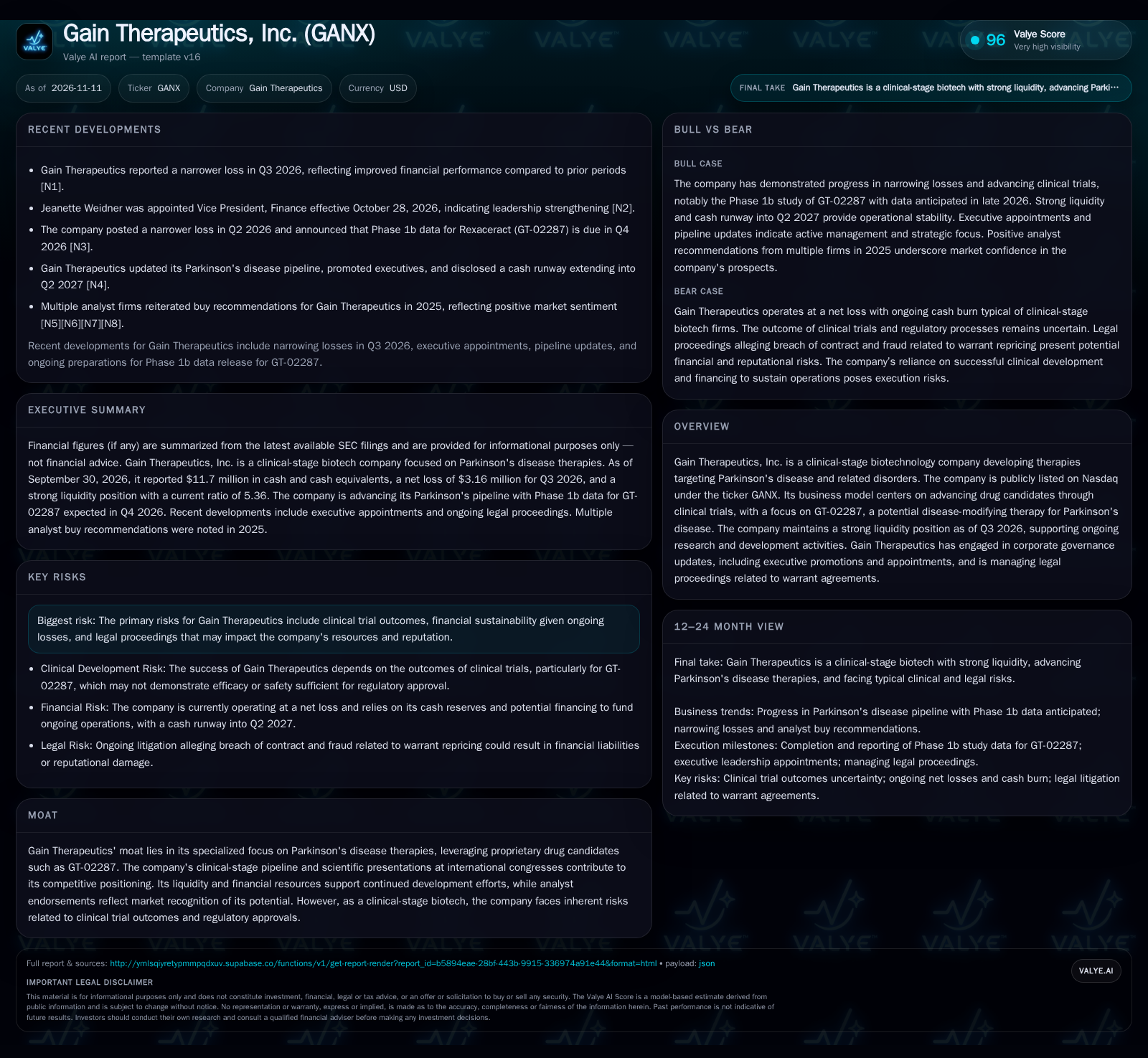
Gain Therapeutics is a clinical-stage biotech focused on Parkinson’s disease, with Phase 1b data for GT-02287 expected in Q4 2026. The Magellan™ platform could provide a differentiated edge if clinical data validate its approach.
Gain Therapeutics, Inc. sits at a pivotal moment as it approaches Phase 1b data for its lead Parkinson’s disease candidate, GT-02287, due in late 2026. However, as with any clinical-stage biotech, the path forward is shaped by the unpredictable outcomes of human trials, ongoing legal proceedings, and the ultimate test of whether its proprietary Magellan™ drug discovery platform can deliver differentiated, disease-modifying therapies. The next 12 months will be decisive in determining whether Gain’s platform can transition from promise to proof—and whether its capital and leadership are sufficient to capitalize on a successful readout.
Approaching a Clinical Inflection Point with Reported Liquidity Position
Gain Therapeutics is preparing to release Phase 1b clinical data for its lead Parkinson’s disease candidate, GT-02287, in Q4 2026 [N3] [N4]. This is a critical milestone, as positive results could validate both the target and the company’s proprietary drug discovery platform, Magellan™. The company reported cash and liquidity metrics for the period; these figures do not by themselves establish operating runway, investment capacity, financial flexibility, or financing capacity. [S2] [N4] The company narrowed its net loss to $3.16 million in Q3 2026, indicating improved financial discipline [N1]. These factors collectively position the company to sustain operations through the upcoming clinical catalyst, but the outcome of the trial—and its downstream effects on capital needs and strategy—remains uncertain.
Beyond the immediate liquidity and operational runway considerations, it is critical to evaluate how Gain Therapeutics’ capital allocation strategy aligns with its clinical development timeline. The sequencing of clinical milestones, such as dose escalation and biomarker readouts, will influence near-term cash burn and potential inflection points for financing decisions. If the Phase 1b data reveal promising signals, the company may prioritize accelerated enrollment or expanded cohorts to bolster data robustness, which could increase short-term expenditures but improve long-term value creation. Conversely, a conservative approach to spending might preserve runway but delay critical data generation, impacting investor sentiment and partnership discussions.
Biotech Model Dynamics: High Fixed Costs, Binary Value Events
Gain Therapeutics operates a classic clinical-stage biotech model, where value creation is tied to advancing drug candidates through costly and lengthy clinical trials. The business is characterized by high fixed R&D costs, negligible revenue, and periodic capital raises to fund operations. The company’s lead asset, GT-02287, is aimed at Parkinson’s disease, a large and underserved market—suggesting significant potential if the candidate proves effective. However, revenue realization is contingent on successful trial outcomes, regulatory approval, and eventual commercialization, which could be years away.
Gain’s Magellan™ platform is designed to discover allosteric binding sites and modulate protein function for harder-to-drug targets. If clinical data validate this approach, the platform could be monetized through out-licensing, partnerships, or downstream royalties. Until then, operating leverage is negative: incremental spending is required to drive the pipeline forward, and any expansion into additional indications or programs would increase capital needs. Typical of the sector, future funding rounds—possibly via equity or partnership deals—are likely if the pipeline advances but is not yet self-funding.
The high fixed cost structure typical of clinical-stage biotechs like Gain Therapeutics necessitates a delicate balance between advancing clinical programs and managing dilution risks. Each clinical phase transition represents a binary event with asymmetric value outcomes, where positive results can lead to substantial valuation uplifts while negative data often trigger sharp de-ratings. This dynamic underscores the importance of milestone-based financing strategies and staged investment to optimize capital efficiency. Furthermore, the platform’s potential to generate multiple candidates could diversify risk; however, without demonstrated clinical validation, expanding the pipeline might exacerbate capital demands without commensurate increases in valuation.
Platform Differentiation and the Race for Disease Modification in Parkinson’s
Gain Therapeutics positions itself by targeting allosteric binding sites via its Magellan™ platform, aiming to deliver disease-modifying therapies for Parkinson’s disease—a field where most approved drugs only address symptoms. The ability to restore glucocerebrosidase (GCase) function and impact alpha-synuclein pathology, as suggested by preclinical data, could provide a therapeutic edge if replicated in humans [S2].
The competitive landscape includes established pharmaceutical companies developing both symptomatic and disease-modifying agents, as well as newer biotechs leveraging gene therapy, protein degradation, or other novel mechanisms. Platform differentiation hinges on demonstrating clinical efficacy, safety, and the ability to address patient subgroups not served by existing therapies. If Magellan™ can repeatedly generate viable leads for difficult CNS targets, this could create a scalable competitive moat—though this remains to be proven in later clinical stages.
The ability of the Magellan™ platform to identify allosteric modulators for CNS targets introduces a nuanced competitive edge, particularly in a therapeutic area where traditional orthosteric approaches have faced challenges. Allosteric modulation can offer advantages such as improved selectivity and reduced off-target effects, potentially translating into better safety profiles and patient tolerability. However, the complexity of CNS diseases and blood-brain barrier penetration remain significant hurdles. Demonstrating that the platform can consistently yield drug-like candidates with favorable pharmacokinetics and target engagement in humans would be a critical validation step, differentiating Gain from competitors reliant on more conventional modalities or emerging gene therapies with distinct risk profiles.
Clinical Validation Unlocks Platform and Partnership Potential
If the Phase 1b study of GT-02287 demonstrates a favorable safety profile and early signs of disease-modifying efficacy, Gain Therapeutics could experience a step-change in perceived value. Such data would not only validate the lead asset but also de-risk the underlying Magellan™ platform, making it more attractive for strategic partnerships or licensing deals. This scenario could accelerate non-dilutive funding, pipeline expansion, and potentially position Gain as a takeout candidate for larger pharmaceutical companies seeking CNS innovation.
Evidence that would confirm this scenario includes positive Phase 1b clinical results with biomarker or functional improvement, new collaborations or licensing agreements, and the ability to initiate or expand additional Magellan™-discovered programs. Analyst upgrades and increased investor interest would likely follow. Conversely, inconclusive or negative clinical data, or a lack of external interest post-readout, would falsify the bullish thesis.
Navigating Clinical Uncertainty and Funding Needs through 2027
The most plausible outcome is that Gain Therapeutics reports mixed or early-stage results from its Phase 1b trial—sufficient to warrant further development, but not definitive enough to trigger immediate partnerships or a major rerating. The company uses its current cash runway to complete the trial, initiate additional studies, and maintain operational continuity through Q2 2027. Additional funding, likely via equity issuance or milestone-driven partnerships, is sought as the pipeline advances.
Confirmation of this scenario would include: timely reporting of Phase 1b data, continued R&D discipline, and proactive communication of next steps. Falsification would occur if the company fails to deliver data on schedule, faces regulatory setbacks, or is unable to secure necessary funding before exhausting its cash runway.
Adverse Trial Outcomes or Legal/Financial Shocks Derail Progress
In a negative scenario, Phase 1b data for GT-02287 show insufficient efficacy or unexpected safety issues, undermining confidence in both the asset and the Magellan™ platform. This would severely limit the company’s ability to attract partners or investors, forcing cost cuts, pipeline reprioritization, or even a strategic review. Compounding this, an unfavorable outcome in the ongoing legal proceeding related to warrant repricing could result in financial liabilities or reputational harm, further constraining strategic options.
Falsification of the downside case would require clear, positive clinical data, successful resolution of legal proceedings with minimal impact, and evidence of continued operational execution. Confirmation would come from missed clinical endpoints, legal or regulatory setbacks, and cash burn without clear progress toward partnership or funding.
Milestones and External Factors That Will Shape Gain Therapeutics’ Trajectory
Timely release and quality of Phase 1b data for GT-02287 in Q4 2026, including safety and early efficacy signals.
Cash burn rate and updated guidance on runway, especially as the company approaches late 2026 and early 2027 reporting periods.
Progress on resolving or containing the legal proceeding related to warrant repricing and any associated financial impact.
Evidence of pipeline progress beyond GT-02287, such as new candidates entering the clinic or expansion into other CNS or metabolic indications.
Announcements of new partnerships, licensing deals, or non-dilutive funding that would validate the Magellan™ platform’s value.
Executive team stability and ability to attract or retain key technical and operational leadership.
If disclosed, data on patient enrollment rates and trial retention for ongoing and future clinical studies would help test operational execution.
Disclaimer: This is research-only, informational analysis and not investment advice. It may include AI-generated interpretation and general industry context. Always verify important details using primary sources.

Comments