
iBio’s Antibody Ambition: Liquidity, Preclinical Progress, and the Test of Translational Value
iBio, Inc. is advancing preclinical antibody programs targeting muscle preservation and metabolic diseases, anchored by promising Activin E inhibition data and a substantial liquidity buffer. As the company leverages licensing agreements and recent capital raises, the core thesis hinges on successful clinical translation and the durability of its scientific edge.
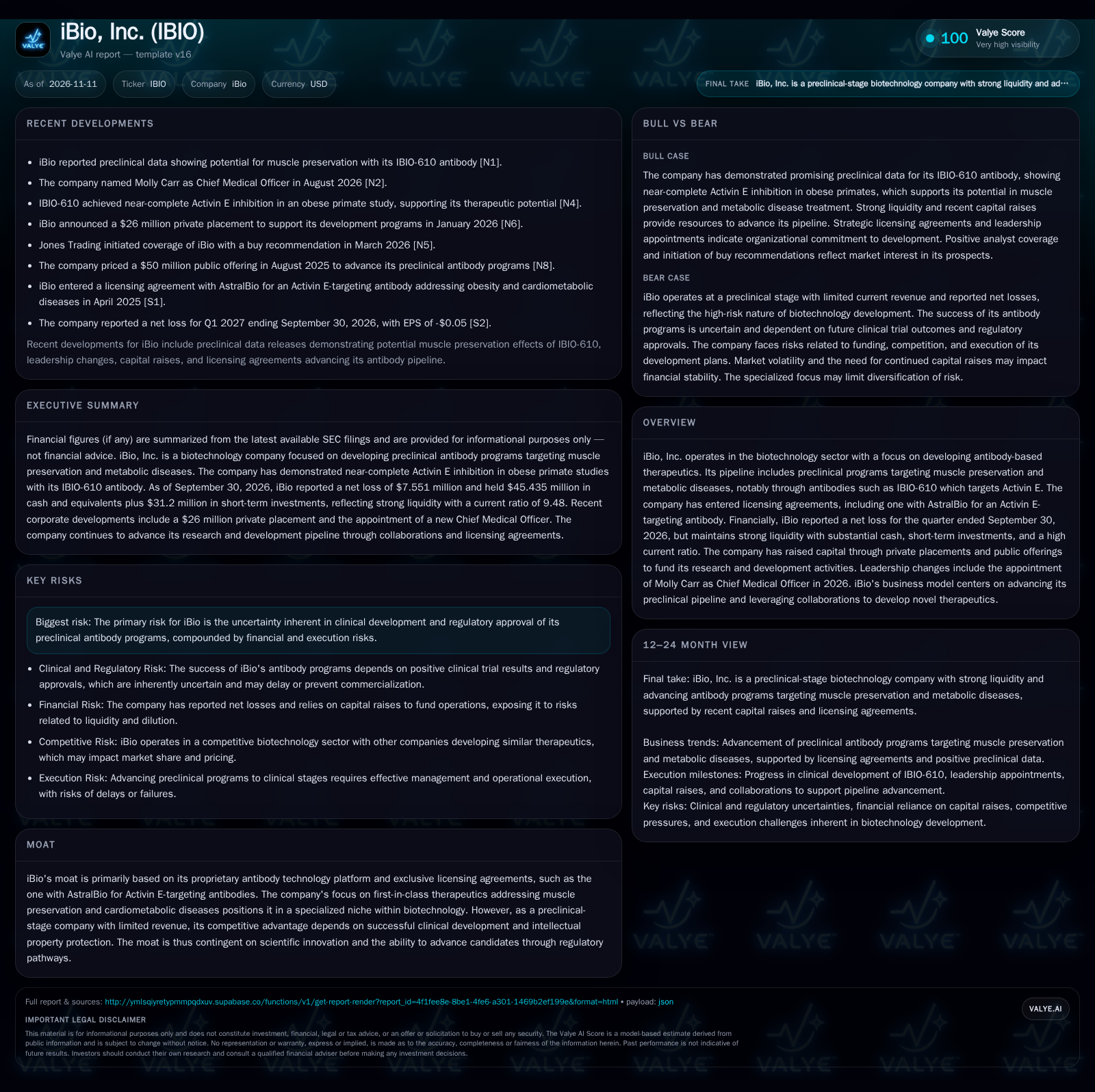
iBio, Inc. is a preclinical-stage biotech focused on antibody therapeutics for muscle and metabolic disorders. Recent primate data support its lead candidate, IBIO-610, and the company maintains over $76 million in liquid assets. [S2] [N4] [S1]
iBio, Inc. stands at a critical inflection point as a preclinical-stage biotech with a focus on antibody therapeutics for muscle preservation and metabolic diseases. The company’s recent demonstration of near-complete Activin E inhibition in obese primate models underpins the scientific rationale for its lead asset, IBIO-610, and validates its licensing partnership with AstralBio. With over $76 million in cash and short-term investments as of September 2026, iBio is unusually well-capitalized for its stage, but it still faces the perennial biotech challenge: can scientific promise be efficiently translated into clinical and commercial success before the cash runs out? [S2] [N4] [S1]
Recent Data, Licensing Moves, and Capital Raises Shape iBio’s Strategic Position
iBio’s lead antibody, IBIO-610, has demonstrated near-complete inhibition of Activin E in obese primate studies, offering preclinical proof-of-concept for its muscle preservation and metabolic disease programs. This result is central to the company’s pipeline narrative, as it supports the potential for disease-modifying therapies in high-burden indications. [N4]
The company reported $76.6 million in liquid assets as of September 30, 2026, after a $26 million private placement in January 2026 and a $50 million public offering in August 2025. This liquidity profile is atypically strong for a preclinical biotech, enabling sustained R&D without immediate dilution or dependence on near-term partnering. [S2] [N6] [N8]
A licensing agreement with AstralBio for an Activin E-targeting antibody expands iBio’s technology footprint into obesity and cardiometabolic diseases, potentially increasing future addressable markets and partnership optionality. [S1]
Despite these strengths, iBio remains in a net loss position with minimal current revenue, underscoring that value creation is contingent on progressing to later clinical stages and ultimately achieving regulatory milestones. [S2]
Preclinical Biotech Economics: Capital Consumption, Value Inflection, and the Cost of Advancement
iBio’s business model is emblematic of high-risk, high-reward preclinical biotech: substantial upfront R&D spend is required to generate data packages that can unlock later-stage funding, partnerships, or acquisition interest. With $76.6 million in liquid assets and a reported net loss of $7.551 million for the September 2026 quarter, the company’s current burn rate suggests a multi-year runway before necessitating additional capital, assuming stable expenditure. [S2]
Revenues remain negligible—$50,000 for the quarter ended March 2024—so near-term value will not be driven by product sales but by milestone-driven value inflections such as clinical trial initiations, positive data, or out-licensing deals. Fixed costs are dominated by R&D personnel, laboratory operations, and regulatory preparation, while variable costs could scale with clinical trial progression.
Economically, the most critical lever is capital efficiency: the ability to generate compelling data per dollar spent, thereby increasing the probability of securing lucrative partnerships or advancing assets without excessive dilution. The model is inherently capital-intensive, with the promise of future high-margin therapeutics if candidates progress to approval. However, the timing and magnitude of such returns are highly uncertain until clinical efficacy is established.
Scientific Niche and Licensing: iBio’s Moat and Its Limits in the Antibody Arena
iBio’s competitive positioning rests on its proprietary antibody platform, preclinical data demonstrating potent Activin E inhibition, and its exclusive licensing agreement with AstralBio. This focus on muscle preservation and metabolic disease carves out a scientific niche that is less crowded than mainstream oncology or immunology antibody programs. [S1] [N4]
However, the broader landscape for metabolic and muscle-wasting diseases is highly competitive, with large pharmaceutical and mid-cap biotech companies investing heavily in antibody and biologic approaches. The company’s moat depends on its ability to demonstrate unique efficacy, safety, or delivery advantages in clinical trials, and on robust intellectual property protection.
Technology substitution risk remains: small molecules, gene therapies, or alternative biologics could address similar pathways, and larger players may have the resources to accelerate competing programs. iBio’s licensing-driven expansion increases its relevance but also exposes it to execution risk if partnering terms do not translate into downstream economics.
If Preclinical Promise Translates: The Path to High-Value Partnerships or Pipeline Monetization
The most favorable scenario for iBio is that its IBIO-610 antibody and partnered Activin E programs demonstrate robust safety and efficacy in early human trials, de-risking the asset for larger pharmaceutical partners or acquirers. Positive clinical data would validate the scientific rationale established in primate studies and could trigger milestone payments, co-development deals, or outright licensing transactions at significant premiums.
Confirmation of this scenario would come from successful IND (Investigational New Drug) filings, rapid advancement to Phase 1/2 studies, favorable safety/tolerability profiles, and early efficacy signals in target patient populations. Additional evidence would include new partnerships, non-dilutive funding, or up-front payments based on value inflection points.
Falsification would occur if initial human data fail to replicate preclinical results, if regulatory delays impede trial initiation, or if partnering interest does not materialize despite positive data.
Scientific Progress Continues, But Dilution and Execution Risks Remain
The most plausible base case is that iBio continues to advance its pipeline through preclinical and early clinical development, leveraging its liquidity to generate additional data but not yet achieving a transformative partnership or out-licensing event. The company may initiate first-in-human studies and publish incremental results, gradually de-risking its platform while incurring further net losses and capital consumption.
Evidence for this scenario would include ongoing R&D updates, completion of preclinical milestones, and the measured addition of clinical development staff or infrastructure. New capital raises may be required within a few years if no major partnership is secured. Modest increases in analyst coverage or investor interest could follow data releases, but valuation would remain sensitive to clinical timelines and dilution risk.
This scenario would be falsified by either a sudden, high-value partnership (moving to the upside case) or by clinical setbacks or funding shortfalls that accelerate value erosion (moving to the downside).
Clinical Setbacks or Capital Shortfalls Could Trigger Value Compression
The most adverse scenario is that iBio’s preclinical assets fail to demonstrate expected safety or efficacy in human studies, or that regulatory or operational delays extend timelines and increase burn. Absence of positive data or partnership traction could erode investor confidence, making subsequent capital raises more dilutive or even infeasible.
A further risk is that competitive advances by better-resourced rivals render iBio’s programs less commercially attractive, even if technically viable. In this scenario, the company may be forced to scale back development, seek distressed partnering terms, or pivot its focus, all of which could compress equity value.
This scenario would be confirmed by negative or inconclusive early clinical data, missed development milestones, withdrawal of analyst coverage, or evidence of distressed financing (e.g., highly dilutive offerings, warrant sweeteners, or convertible debt at punitive terms).
Milestones and External Developments That Will Pressure-Test iBio’s Investment Thesis
Progression of IBIO-610 and any partnered antibodies into IND-enabling studies or the filing of IND applications for first-in-human trials.
Release of initial human clinical data, particularly safety and early efficacy signals in muscle preservation or metabolic disease indications.
Updates on partnering activity, including new licensing agreements, co-development deals, or milestone payments from AstralBio or other collaborators.
Cash burn trends and updated guidance on runway, especially if disclosed in future filings or presentations.
Changes in competitive landscape, such as major advances by other antibody developers in the muscle or metabolic disease space.
Regulatory interactions or feedback, including acceptance of trial protocols or special designations (e.g., orphan drug, fast track).
Disclosure of intellectual property developments, such as new patents granted or IP challenges in key jurisdictions.
Disclaimer: This is research-only, informational analysis and not investment advice. It may include AI-generated interpretation and general industry context. Always verify important details using primary sources.

Comments