
Kopin’s Microdisplay Ambition: Defense Roots, Integration Strategy, and the MicroLED Bet
Kopin Corporation is deepening its focus on advanced microdisplay technologies—especially MicroLED and AI-enabled architectures—while shifting from component sales toward higher-value integrated solutions for defense and emerging AR/VR markets. The company’s recent defense wins and expanded business development resources signal strategic intent, but ongoing profitability challenges and reliance on government contracts create both opportunity and risk.
Kopin’s Q3 2026 results highlight its defense-driven revenue mix, persistent net losses, and accelerating R&D in MicroLED and AI-enabled displays. The company’s pivot to integrated headsets and subsystems, supported by a government-funded MicroLED initiative and nearly doubled sales resources, may unlock higher value capture if it can overcome development, margin, and contract volatility hurdles. Execution in defense, industrial, and AR/VR sectors, plus successful commercialization of NeuralDisplay™, will be critical to validating the strategic shift. [S1] [S2] [N4]
Kopin Corporation stands at a strategic crossroads: after decades as a component supplier to defense and industrial sectors, it’s now pursuing value-chain ascension by developing integrated headset and subsystem solutions built on its diverse microdisplay portfolio. Recent government funding for MicroLED research and expanded sales efforts underscore the company’s ambitions in defense and emerging AR/VR markets. Yet, persistent net losses and contract volatility highlight the tension between innovation, execution, and financial sustainability. The next phase will test whether Kopin can convert its technological breadth and government relationships into profitable, defensible market positions.
Recent Financials and Strategic Moves Reshape the Kopin Thesis
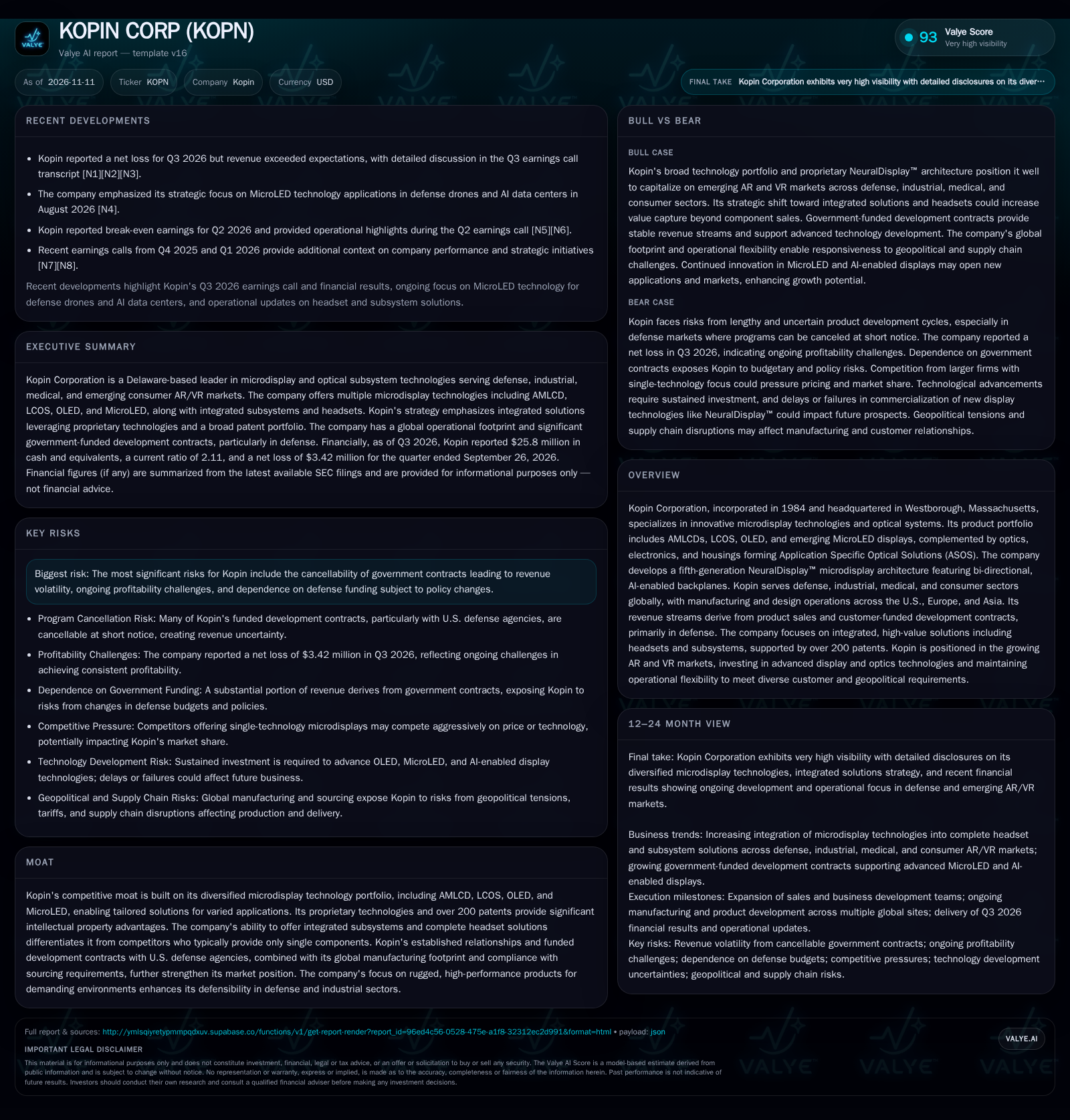
Kopin’s Q3 2026 financials show revenue of $1.27 million and a net loss of $3.42 million, with a reported cash balance of $25.8 million and a current ratio of 2.11 as of September 26, 2026. The company’s revenue mix remains heavily skewed toward defense, which accounted for $29.4 million out of $39.3 million in product revenues for fiscal 2025. [S1] [S2]
A notable development is Kopin’s receipt of a significant IBAS award in 2025 to advance color MicroLED technology for soldier-borne systems, positioning the company at the forefront of high-specification defense display innovation. [S1]
Strategically, Kopin has nearly doubled its sales and business development resources over the past year, aiming to broaden its customer base and reduce reliance on a few large defense contracts. The company is also emphasizing integrated solutions—headsets and subsystems—rather than selling only displays or optical components. [S1]
MicroLED and AI-enabled NeuralDisplay™ architectures are now central to Kopin’s R&D and commercialization roadmap, with recent news emphasizing applications in defense drones and AI data centers. [N4]
Revenue Mix, Margin Structure, and the Drive for Higher-Value Integration
Kopin’s business economics are shaped by its dual model: product sales (displays, optics, ASOS) and customer-funded development contracts, the latter primarily from U.S. defense agencies. The defense segment dominates revenues, but carries the risk of long, uncertain development cycles and contract cancellability. [S1]
Component sales—such as AMLCD, LCOS, and OLED microdisplays—tend to be lower-margin and vulnerable to commoditization, especially as larger competitors or Asian suppliers scale up. By contrast, integrated headset and subsystem solutions (combining displays, optics, electronics, and housings) may command higher average selling prices and margins, provided Kopin can demonstrate differentiated performance and meet stringent defense or industrial requirements.
R&D intensity is structurally high, as internally funded programs advance OLED, MicroLED, and AI-enabled architectures. While customer-funded R&D offsets some risk, these programs are often cancellable, creating revenue and margin uncertainty. [S1]
Operating leverage could improve if Kopin succeeds in shifting sales mix toward integrated solutions and recurring subsystem contracts, but this hinges on successful product qualification, customer adoption, and manufacturing scale. The company reported cash and liquidity metrics for the period; these figures do not by themselves establish operating runway, investment capacity, financial flexibility, or financing capacity. [S2]
Defensible Niches, Patent Assets, and the Challenge from Focused Rivals
Kopin’s competitive position relies on its breadth of microdisplay technologies (AMLCD, LCOS, OLED, MicroLED) and its ability to tailor integrated solutions for demanding defense and industrial customers. Over 200 patents and proprietary architectures—such as NeuralDisplay™—offer some protection against pure-play competitors and potential substitutes. [S1]
The company’s move into integrated headsets and subsystems differentiates it from single-component suppliers, potentially raising switching costs for customers and embedding Kopin more deeply into multi-year defense programs. However, this strategy also exposes Kopin to complex qualification hurdles, longer sales cycles, and the need for robust service and support infrastructure.
Competition is fierce: in defense and industrial markets, rivals may include both specialized microdisplay firms and vertically integrated electronics or optics companies. In AR/VR and medical, consumer electronics giants and Asian display manufacturers can exert price and technology pressure. Kopin’s geographic flexibility in sourcing and manufacturing is a partial offset to geopolitical and supply chain risk, but does not fully neutralize it. [S1]
The key question is whether Kopin’s technology and integration advantages will be sufficient to overcome scale disadvantages and the relentless margin pressure typical in display markets.
Integrated Solutions and MicroLED Success Could Unlock Durable Growth
A favorable scenario for Kopin envisions successful commercialization of its NeuralDisplay™ and MicroLED-based products, leading to adoption in next-generation defense headsets, drones, and high-value industrial systems. If Kopin can leverage its IBAS-funded MicroLED work into multi-year production contracts—especially for soldier-borne or autonomous systems—it could materially increase revenue visibility and margin capture. [S1] [N4]
Expansion into AR/VR and medical markets, powered by AI-enabled, bi-directional displays, could further diversify revenue and reduce dependence on defense cycles. The doubling of sales resources may accelerate new customer wins, especially if Kopin can offer unique subsystem integration or performance not available from larger, less nimble rivals.
Evidence supporting this upside would include: sizable new contract awards or production orders for integrated headsets/subsystems; public design wins in defense or industrial AR/VR; meaningful revenue contribution from MicroLED or NeuralDisplay™ products; and a shift in gross margins reflecting higher-value solution sales.
Continued Defense Focus with Incremental Progress in Integration and AR/VR
The most plausible trajectory for Kopin is continued reliance on U.S. and allied defense programs as the core revenue driver, with incremental progress in subsystem integration and AR/VR market penetration. Integrated headsets and subsystems may begin to account for a greater share of sales, but the pace will likely be gradual given lengthy qualification requirements and risk-averse customers.
Profitability remains patchy, with occasional breakeven quarters (as seen in Q2 2026) offset by ongoing losses, reflecting the high fixed cost of R&D and the lumpiness of development contract revenue. [S2] [N5]
Kopin’s doubled sales force may yield a more diversified customer base over time, but contract cycles and technology adoption in defense and industrial markets are slow. Success in the AR/VR sector could be limited by competition from larger consumer electronics and display firms, unless Kopin can carve out defensible, specialized niches.
Confirming this scenario would be steady but unspectacular revenue growth, continued dominance of defense in the sales mix, and only gradual improvement in gross margin or profitability. Falsification would require either a dramatic new contract win (upside) or a material contract cancellation or technology setback (downside).
Contract Volatility and Technology Delays Could Exacerbate Losses
The primary risk for Kopin is a combination of major defense contract cancellations and delays or failures in commercializing MicroLED or NeuralDisplay™ technologies. Because many development contracts are cancellable at short notice, a shift in U.S. or allied defense priorities could trigger sudden revenue shortfalls. [S1]
Fierce price competition—particularly from Asian display manufacturers—could compress margins on both legacy and new products.
A downside scenario would be confirmed by a sharp drop in funded contract revenue, rising quarterly losses, customer attrition, or public disclosure of program cancellations or failed product qualifications. Deterioration in cash position without a clear path to new contract wins or commercial product launches would further validate the bear case.
Milestones to Test Kopin’s Strategy in Microdisplay Integration and Defense AR/VR
Quarterly breakdown of revenue by segment (defense, industrial, medical, consumer) to assess progress in diversification and AR/VR penetration.
Gross margin trends, especially any sustained improvement that would indicate a shift toward higher-value integrated solutions.
Size, scope, and duration of new government or commercial contract awards—especially for MicroLED or NeuralDisplay™-based headsets and subsystems.
Execution on IBAS-funded MicroLED R&D milestones, including any movement from prototype to production or new customer adoption.
Evidence of recurring or multi-year subsystem contracts versus one-off component sales, as a sign of value-chain ascension.
Customer concentration metrics, such as top-five customer revenue share, to gauge risk exposure and success of the expanded sales effort.
Competitive disclosures or third-party validation of NeuralDisplay™ or MicroLED performance relative to peer products.
Disclaimer: This is research-only, informational analysis and not investment advice. It may include AI-generated interpretation and general industry context. Always verify important details using primary sources.

Comments