
Marathon Bancorp’s Post-Conversion Trajectory: Shareholder Tools, Profitability, and the Test of Sustainable Performance
Fresh from a pivotal conversion and stock offering, Marathon Bancorp, Inc. faces the challenge of turning its restructured capital and governance into lasting value. With limited financial disclosure but clear signals of profitability and active capital management, the next phase will hinge on execution, transparency, and adaptation in a competitive banking landscape.
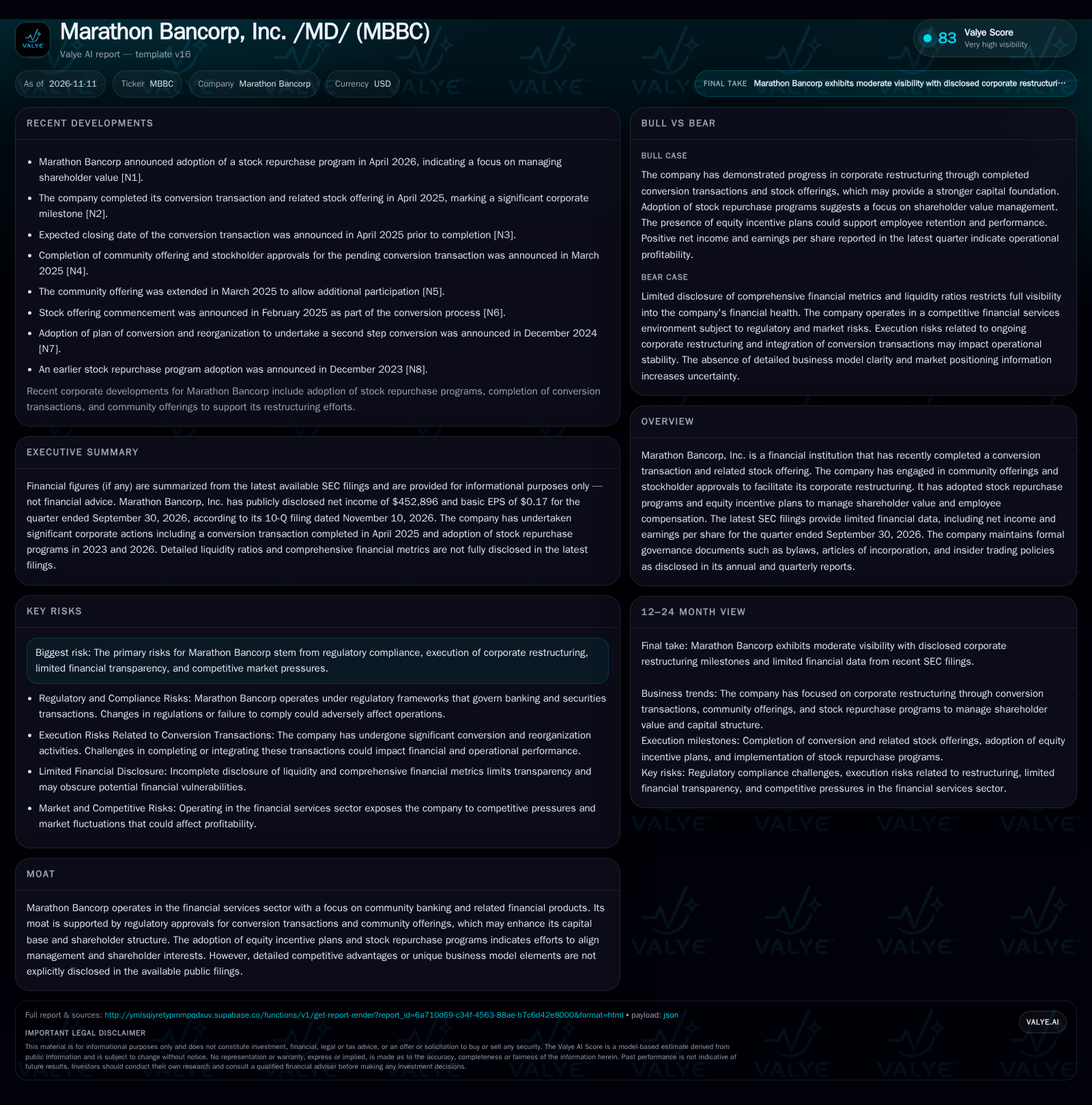
Marathon Bancorp has completed a major conversion transaction and stock offering, reported positive net income for the latest quarter, and initiated stock repurchase programs. While these steps suggest a focus on capital structure and shareholder value, limited visibility into its full financial picture and business model leaves crucial questions about long-term profitability and resilience unanswered. Execution on integration, loan growth, and risk management will determine the outcome.
Marathon Bancorp, Inc. stands at a crossroads after a transformative period, having completed a significant conversion and related stock offering in April 2025 and subsequently adopting stock repurchase programs. Recent quarterly results show positive net income, but the absence of detailed financial and operating disclosures complicates the assessment of the bank’s underlying health and strategic direction. The company’s ability to translate its restructured capital base and governance overhaul into sustainable, competitive performance remains the central question as it navigates the demands of its market and regulatory environment.
Conversion, Repurchase, and Profitability: The Latest Corporate Milestones
Marathon Bancorp, Inc. completed a pivotal conversion transaction and related stock offering in April 2025, culminating a multi-stage process involving community participation and stockholder approvals [N2]. This event reshaped the company's capital structure and set the stage for broader market engagement. Subsequently, the company adopted stock repurchase programs in both December 2023 and April 2026, reflecting an explicit focus on managing shareholder value and potentially optimizing capital allocation [N1] [N8]. For the quarter ended September 30, 2026, Marathon Bancorp reported net income of $452,896 and diluted earnings per share of $0.16, marking continued operational profitability following these changes [S2].
How Marathon Bancorp Could Generate Value Post-Conversion
As a community-oriented financial institution, Marathon Bancorp’s core earnings engine likely revolves around traditional net interest income—spreads between the yield on its loan book and the cost of funds from deposits—augmented by fee-based income from loan origination, account services, or ancillary financial products. The recent conversion and stock offering may have increased the company’s capital base, potentially enabling greater lending capacity and providing a buffer for regulatory compliance. Stock repurchase programs are a mechanism to deploy excess capital and return value to shareholders, but they also reduce share count and can amplify earnings per share if core profitability is maintained.
Operating leverage in community banking can be significant: incremental growth in assets under management and loan balances may drive profitability if costs are contained and credit quality remains robust. However, the sector is exposed to margin compression in competitive interest rate environments, rising regulatory costs, and credit cycle swings. Without granular disclosure on loan mix, deposit composition, non-interest income, or expense structure, it is difficult to assess Marathon Bancorp’s particular sensitivity to these variables. The adoption of equity incentive plans suggests alignment of management with long-term performance, but the impact will depend on actual execution and sustained growth.
Assessing Strategic Positioning in a Crowded Banking Landscape
Marathon Bancorp operates in a highly competitive regional and community banking sector, where differentiation is often driven by local market relationships, service quality, and the ability to offer tailored financial products. The company’s successful completion of a conversion transaction and related community offering indicates some level of community engagement and regulatory approval, which can be barriers to entry for new competitors [N2] [N4]. However, the absence of explicit disclosures on product differentiation, digital capabilities, or technology investments leaves open the question of how Marathon Bancorp stands out against both traditional regional banks and digital-first financial institutions.
Peer risks include pricing pressure on loans and deposits, potential customer attrition to larger or more technologically advanced competitors, and regulatory burdens that disproportionately impact smaller banks. If Marathon Bancorp can leverage its refreshed capital structure and stockholder base to invest in new products or technology, it could enhance its resilience. Otherwise, its competitive position will depend heavily on execution in core banking fundamentals and maintaining customer loyalty in its footprint.
When Capital Restructuring Catalyzes Sustainable Growth
The most favorable outcome for Marathon Bancorp would be if its recent conversion and stock offering provide the capital flexibility to expand its loan book, invest in technology, and prudently grow its customer base. In this scenario, the company leverages its stock repurchase programs to optimize capital structure while maintaining sufficient reserves to manage risk and regulatory requirements. Enhanced management alignment through equity incentive plans could drive operational improvements and foster a culture focused on profitability and innovation.
Evidence that would confirm this scenario includes: sustained growth in net interest income and non-interest revenue, stable or improving credit quality metrics (if disclosed), increased efficiency ratios, and continued positive net income with rising returns on equity. Additional disclosures around technology initiatives, new product launches, or successful deposit gathering campaigns would further support the case for durable competitive advantage and above-peer performance.
A Cautious Outlook: Incremental Gains Amid Ongoing Integration
The most plausible path forward is one of cautious, incremental progress as Marathon Bancorp digests its conversion and stock offering. The company is likely to focus on organic loan and deposit growth, maintaining profitability while optimizing its capital structure through measured share repurchases. Management may prioritize regulatory compliance, cost control, and risk management over aggressive expansion, given sector headwinds.
Confirmation of this scenario would come from continued modest profitability, stable or improving efficiency ratios (if disclosed), and periodic capital returns to shareholders without signs of stress. Falsification would be indicated by deteriorating credit quality, significant increases in non-performing assets, or a need for additional capital raises in the near term. The absence of new product or technology investment disclosures would reinforce the view of a steady, traditional community banking model rather than a rapidly evolving platform.
Execution Risks and Transparency Gaps Threaten Value Creation
The most adverse outcome would involve Marathon Bancorp struggling to integrate its restructured capital base into profitable operations, with execution missteps or deteriorating credit quality undermining performance. Limited disclosure of liquidity and risk metrics could mask emerging vulnerabilities, such as funding pressures, asset quality deterioration, or compliance failures. In this scenario, capital returned via repurchase programs could deplete reserves needed to weather shocks, forcing the company to raise additional capital under unfavorable terms.
Confirmation of downside risk would involve negative swings in quarterly earnings, regulatory enforcement actions, or public disclosures of credit losses and non-performing assets. If the company is forced to suspend repurchase programs or equity incentives due to capital constraints, or if there is a spike in loan delinquencies and charge-offs (if disclosed), it would indicate a faltering strategy and heightened risk for shareholders.
Testing the Post-Conversion Thesis: What Will Reveal Marathon Bancorp’s True Trajectory?
Quarterly net interest margin trends, if disclosed, would clarify the company’s ability to manage spread income in a changing rate environment.
Loan growth rates and loan portfolio composition data would help test whether the expanded capital base is translating into prudent lending expansion.
Non-performing asset ratios and credit loss provisions—if provided—would be essential for monitoring underlying credit risk.
Efficiency ratio disclosures would reveal cost discipline and potential for operating leverage.
Updates on the pace and scale of share repurchases, along with commentary on capital adequacy, would clarify the sustainability of capital return.
New product launches, technology investments, or digital banking initiatives—if announced—would indicate efforts to differentiate and future-proof the business.
Management discussion of regulatory developments and compliance status would help assess ongoing risk exposure and strategic flexibility.
Any disclosed changes to executive compensation or equity incentive plan participation could signal shifts in management alignment or risk appetite.
Disclaimer: This is research-only, informational analysis and not investment advice. It may include AI-generated interpretation and general industry context. Always verify important details using primary sources.

Comments