
Art Technology Acquisition Corp.: Blank Check Ambition Meets the Realities of SPAC Execution
With $253 million in trust and a management team experienced in both successful and failed blank check ventures, Art Technology Acquisition Corp. faces the classic SPAC challenge: converting potential financial flexibility and sector focus into a value-creating business combination before time and market appetite run out.
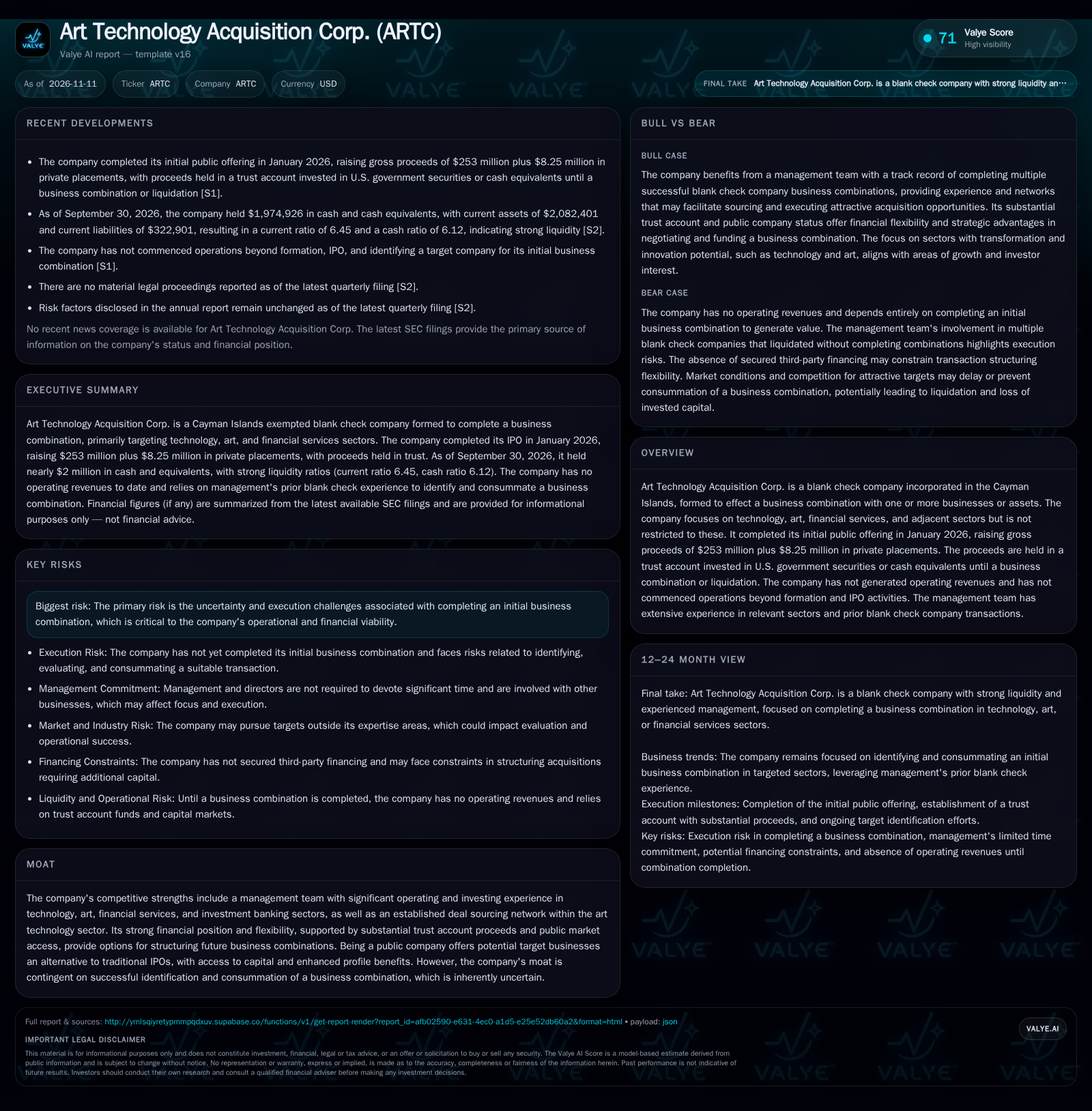
Art Technology Acquisition Corp. (ARTC) is a recently formed SPAC with $253 million in trust following its January 2026 IPO. The company has not commenced operations and is actively seeking a business combination, focusing on technology, art, and financial services. The next phase hinges on sourcing and executing a transaction in a competitive environment. [S1] [S2]
Art Technology Acquisition Corp. (ARTC) is the latest entrant in the blank check arena, having raised $253 million in a January 2026 IPO with the goal of acquiring a business in the technology, art, or financial services sectors. Despite a robust trust account and a management team with a mix of successful and unsuccessful SPAC transactions, the company stands at a familiar crossroads: the clock is ticking to secure and close a business combination that justifies investor capital. In a market environment where competition for quality targets is fierce and the SPAC model faces increasing scrutiny, ARTC’s next moves will be critical in determining whether it creates lasting value or joins the growing list of SPACs that ultimately liquidate. [S1] [S2]
IPO Proceeds, Trust Structure, and the Pre-Deal Holding Pattern
Art Technology Acquisition Corp. completed its IPO in January 2026, raising $253 million, supplemented by $8.25 million in private placement proceeds. These funds were placed in a trust account, invested in U.S. government securities or held as cash equivalents, in keeping with standard SPAC practice. As of September 30, 2026, the company reported $1,974,926 in cash and cash equivalents, with current assets of $2,082,401 and current liabilities of $322,901, resulting in a current ratio of 6.45 and a cash ratio of 6.12. The company has not commenced operations beyond its formation, IPO, and efforts to identify a target for business combination. No material legal proceedings or changes to risk disclosures were reported as of the latest quarterly filing. The company’s situation is typical for a newly listed SPAC: flush with cash but existentially reliant on executing a business combination before its window closes. [S1] [S2]
SPAC Economics: Trust Account, Sponsor Incentives, and the Deal Imperative
Art Technology Acquisition Corp. exemplifies the SPAC structure, where the business model is predicated on securing and closing a value-accretive acquisition. The company earns non-operating income from interest on the trust account, but this is immaterial compared to the capital at stake and does not represent a sustainable revenue stream. The operating cost base is modest, primarily consisting of public company compliance and due diligence expenses, until a deal is consummated. The economics for ARTC hinge on the successful identification and execution of a business combination: the trust proceeds can be deployed as cash consideration, or in combination with equity or debt, to acquire a target. Sponsor incentives typically align with deal completion, often via founder shares that convert to a substantial equity stake in the post-merger entity, but these incentives can also drive deals that may not maximize long-term shareholder value. If no deal is reached within the SPAC’s allotted timeframe (often 18-24 months post-IPO), the trust is returned to public shareholders, and the sponsor’s investment is lost, creating a binary outcome.
Competing for Targets: ARTC’s Edge and the Realities of the SPAC Market
The SPAC market remains crowded, with many blank check companies chasing a limited pool of attractive targets, especially in hot sectors like technology and financial services. ARTC’s management team boasts prior experience with both successful and unsuccessful SPACs, offering a valuable network and potential credibility with target companies. The company’s sector focus on technology, art, and financial services aligns with areas of innovation and investor interest, but it is not restricted to these industries, retaining flexibility. However, the absence of a pre-identified target and the lack of secured third-party financing may limit its ability to outbid or outmaneuver better-capitalized or more specialized competitors. Furthermore, the proliferation of SPACs and the normalization of de-SPAC mergers have diminished the uniqueness of the SPAC route, and some targets may prefer direct listings or traditional IPOs, especially if public market sentiment turns cautious.
Unlocking Value: What a Successful Business Combination Could Deliver
In a favorable scenario, ARTC leverages its management’s networks and sector expertise to identify a high-growth, underappreciated business in technology, art, or financial services. The trust proceeds and public market vehicle could offer the target an attractive alternative to a traditional IPO, potentially accelerating its growth and providing liquidity to legacy owners. If the chosen target is well-aligned with public market expectations and can demonstrate strong fundamentals and a compelling growth story, the post-merger entity could command a premium valuation, benefiting both SPAC shareholders and sponsors. Confirmation of this scenario would come with the announcement of a letter of intent or definitive agreement with a credible, growth-oriented target, followed by favorable market reaction, institutional investor support, and minimal redemption rates during the de-SPAC process. Falsification would be indicated by repeated delays, failure to announce a deal, or selection of a marginal or distressed target that struggles to gain investor support.
Navigating the Median SPAC Experience: Deal Execution and Shareholder Redemptions
The most plausible outcome for ARTC is a business combination with a mid-sized private company in its stated focus areas, most likely after an extended search process. The deal may involve additional PIPE (private investment in public equity) financing or renegotiated terms to accommodate market conditions. Shareholder redemptions could be significant, reflecting the broader trend of high redemption rates in SPAC transactions, which may reduce the funds available to the combined entity. The merged company could face a challenging first year as it integrates, seeks to meet public market expectations, and builds credibility with investors. Confirmation would include the announcement and closing of a transaction, moderate but not overwhelming redemptions, and the post-combination entity establishing a viable operating cadence. Falsification would include failure to close a deal within the SPAC’s timeframe or a deal that is met with very high redemptions and weak aftermarket trading.
Deal Failure and Liquidation: The Existential SPAC Risk
The adverse scenario for ARTC is a failure to identify or close a business combination within the prescribed timeframe, leading to liquidation and return of trust proceeds to shareholders. This outcome could result from a lack of attractive targets, inability to finalize terms, or adverse market conditions that dissuade private companies from pursuing the SPAC route. Sponsor investments would be lost, and public shareholders would receive their pro rata share of the trust, typically with minimal or no premium. Early warning signs would include repeated proxy extensions, lack of substantive deal updates, or public acknowledgment of challenges in sourcing or closing a transaction. Confirmation of this scenario would be an official liquidation filing or shareholder vote to wind up the company.
Milestones That Will Define ARTC’s Blank Check Outcome
Announcement of a letter of intent or definitive agreement with a credible target company, ideally in technology, art, or financial services.
Level of shareholder redemptions at the time of business combination approval—high redemption rates would signal skepticism and reduce available capital.
PIPE (private investment in public equity) participation or third-party financing commitments, if disclosed, indicating external investor confidence.
Time remaining until the SPAC’s deadline for completing a business combination, and any proxy votes for deadline extensions.
Management’s disclosed progress in target identification and negotiation updates—public filings or press releases that offer deal process transparency.
Disclosure of the proposed post-combination capital structure, including debt, equity, and sponsor economics, which would affect long-term value.
Post-deal trading performance and analyst coverage of the combined company, which would reflect market confidence in the transaction.
Disclaimer: This is research-only, informational analysis and not investment advice. It may include AI-generated interpretation and general industry context. Always verify important details using primary sources.

Comments