
Harvard Bioscience: Manufacturing Consolidation, Portfolio Rationalization, and the Push for Sustainable Profitability
Amid ongoing net losses and a major manufacturing overhaul, Harvard Bioscience is repositioning its product mix and operational footprint to capture higher-margin opportunities in life sciences research. The company’s future hinges on execution of Project Viking, expansion of consumables and software, and its ability to translate operational discipline into lasting margin improvement.
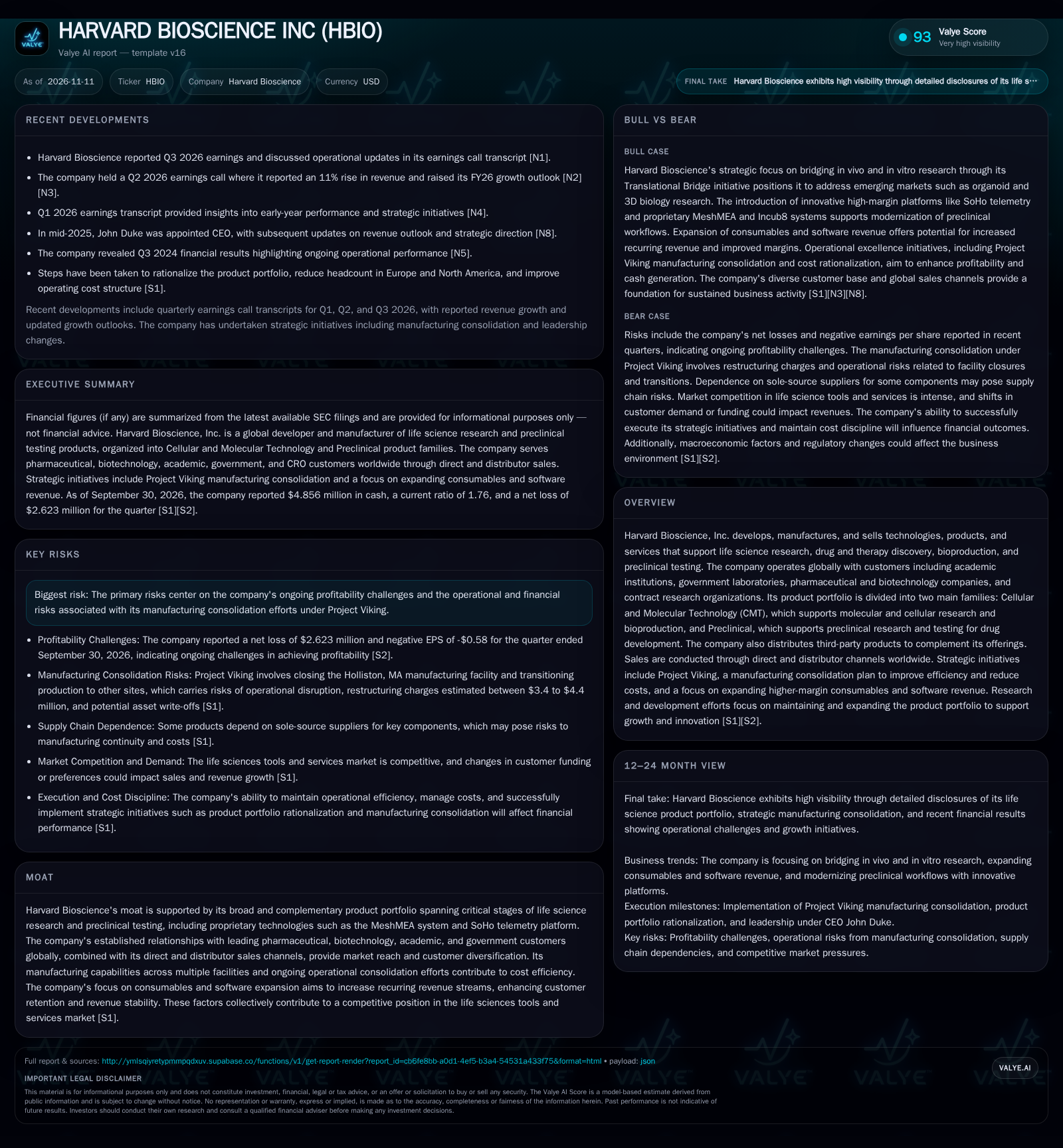
Harvard Bioscience is navigating a strategic transition: closing legacy manufacturing, rationalizing its product lines, and seeking to grow higher-margin recurring revenue. While recent revenue growth and a broadened customer base provide a foundation, persistent net losses and operational risks from Project Viking mean execution remains the crux of the investment case. Investors should watch for evidence of margin expansion, successful manufacturing transitions, and traction in consumables and software sales as the company seeks to move past its current profitability challenges.
Harvard Bioscience stands at an inflection point as it seeks to transition from a legacy manufacturer of scientific equipment to a more streamlined, margin-focused provider of life sciences tools and services. Project Viking—a sweeping manufacturing consolidation—and ongoing portfolio rationalization reflect management’s response to persistent profitability headwinds. With a broadly diversified customer base and recent revenue growth, the company’s ability to execute on operational improvements and grow recurring consumables and software revenue will determine whether it can achieve sustainable margin expansion or remain mired in low-margin, capital-intensive competition.
Recent Results and Restructuring Shape the Near-Term Outlook
As of Q3 2026, Harvard Bioscience reported a net loss of $2.623 million and basic and diluted EPS of -$0.58, underscoring ongoing profitability challenges. The company reported cash and liquidity metrics for the period; these figures do not by themselves establish operating runway, investment capacity, financial flexibility, or financing capacity. [S2] Project Viking, the company’s major manufacturing consolidation initiative, is underway—closing the Holliston, MA facility and shifting production to Minneapolis, MN and European sites, aiming to reduce costs and increase operational efficiency [S1]. In parallel, Harvard Bioscience has rationalized its product portfolio and reduced headcount in Europe and North America. These actions are intended to reshape the company’s cost structure and support a transition to higher-margin, recurring revenue streams.
How Recurring Revenue and Operating Leverage Could Reshape Margins
Harvard Bioscience’s revenue mix is split between Cellular and Molecular Technology (CMT, 46% of revenues in 2025) and Preclinical (54%) product families, with 13% coming from distribution of third-party products [S1]. The business model is traditionally hardware-centric, but management is actively pursuing expansion of consumables and software—categories that typically offer higher gross margins and more predictable, recurring revenue streams. This shift is critical: hardware sales are often lumpy, capital-intensive, and subject to intense price competition, whereas consumables and software (especially if tied to installed instruments) can provide sticky, high-margin annuity-like revenue.
Project Viking’s manufacturing consolidation is expected to reduce fixed costs, improve gross margins, and enhance operating leverage. If successful, this could allow incremental revenue growth to translate into outsized improvements in operating profit. However, these benefits are contingent on effective execution—any disruption or underestimation of transition costs could delay or dilute the intended margin gains. Meanwhile, the company’s R&D spend (approximately $8.8 million in 2025) reflects a continued commitment to product innovation, which is necessary to maintain relevance and pricing power in a rapidly evolving life sciences tools market [S1].
Product Breadth and Customer Relationships vs. Industry Counterforces
Harvard Bioscience’s broad product portfolio and longstanding relationships with major pharmaceutical, biotechnology, academic, and CRO customers provide meaningful sales diversification and help mitigate customer concentration risk [S1]. The company’s proprietary platforms—such as MeshMEA for organoid research and SoHo telemetry for preclinical studies—offer some degree of technical differentiation. However, the life sciences tools market is intensely competitive, with well-capitalized global players and specialized niche competitors alike. Price competition is fierce, and customers can be price-sensitive, especially as purchasing decisions are often tied to grant cycles and institutional budgets.
Switching costs may be moderate for instrument-based workflows, particularly if consumables or software are proprietary and integrated. However, unless Harvard Bioscience can successfully drive adoption of its platforms and embed itself deeply into customer workflows, it risks being outcompeted by larger vendors or leapfrogged by newer technologies. The company’s global sales model—61% direct, 39% distributor in 2025—enables reach but may also constrain pricing power in certain geographies [S1].
Margin Expansion and Recurring Revenue Drive a Profitable Turnaround
The bull case for Harvard Bioscience is predicated on the successful execution of Project Viking, resulting in meaningful cost savings and improved operational efficiency. If the company can transition manufacturing without major disruptions and realize targeted cost reductions, gross margin could expand significantly. Simultaneously, if management successfully grows consumables and software as a share of revenue—leveraging the installed base of proprietary platforms like MeshMEA and SoHo—overall margins and revenue visibility would improve.
A favorable scenario would be confirmed by a return to consistent profitability, a rising gross margin trend, and evidence of recurring revenue growth outpacing hardware sales. Additional validation would come from new product launches gaining traction, increased sales to existing top-tier customers, and positive operating cash flow. This outcome would position Harvard Bioscience as a differentiated, higher-margin life sciences platform rather than a traditional, low-margin equipment supplier.
Moderate Growth Continues, but Margin Gains Remain Elusive
The most plausible near-term outcome is that Harvard Bioscience achieves moderate revenue growth, driven by its diversified customer base and incremental gains in consumables and software sales. Manufacturing consolidation progresses, but cost savings are partially offset by restructuring charges and transition-related inefficiencies. As a result, the company narrows its net losses but does not achieve sustained profitability within the next 12-18 months.
Evidence supporting this scenario would include continued single-digit to low double-digit revenue growth, periodic gross margin improvement, but persistent quarterly net losses or only marginal positive EPS. If disclosed, a modest but steady increase in recurring revenue as a proportion of total sales would suggest progress, but not a step-change. This outcome would reflect the industry’s typical challenges: long sales cycles, variable capital spending, and ongoing competitive and pricing pressure.
Execution Missteps and Market Headwinds Prolong Losses
In the adverse scenario, Project Viking’s manufacturing consolidation encounters significant delays, cost overruns, or operational disruptions, resulting in unexpected charges and lost sales. The transition period exposes the company to supply chain vulnerabilities—especially given reliance on sole-source suppliers for some components—which could further erode gross margin or cause product backlogs.
If market demand softens due to macroeconomic pressures, funding constraints at key academic or government customers, or competitive displacement, revenue could stagnate or decline. In this scenario, continued net losses and negative cash flow would force Harvard Bioscience to seek external capital, potentially on dilutive terms. Confirmation would come from missed revenue or gross margin targets, increased restructuring or impairment charges, and further deterioration of the cash position.
Milestones That Will Determine If Harvard Bioscience Can Shift Toward Sustainable Profitability
Gross margin trend over the next four quarters, particularly as Project Viking’s consolidation is completed. A sustained increase would indicate operational benefits are being realized.
Breakdown of revenue by consumables and software—if disclosed—to assess progress toward higher-margin, recurring sales.
Progress and cost disclosures related to Project Viking, including whether the company stays within its estimated $3.4–4.4 million restructuring charge range.
Evidence of new product adoption, measured by growth in sales of proprietary platforms such as MeshMEA and SoHo telemetry systems.
Customer retention and repeat purchase rates, especially among top-tier pharmaceutical and CRO clients, to gauge embeddedness and switching friction—if disclosed.
Any changes in supply chain resilience, such as diversification of key component suppliers or inventory build-ups, that could mitigate operational risks.
Disclaimer: This is research-only, informational analysis and not investment advice. It may include AI-generated interpretation and general industry context. Always verify important details using primary sources.

Comments