
MaxCyte’s Platform Ambition: Engineering Cell Therapy’s Next Chapter with Flow Electroporation and Assay Expansion
MaxCyte sits at the intersection of next-generation cell and gene therapy demand, offering proprietary non-viral delivery technology and a growing suite of assay services. With a diversified revenue model and a substantial milestone pipeline, the company’s future hinges on customer program success, adoption of non-viral methods, and its ability to convert platform relationships into recurring, scalable economics.
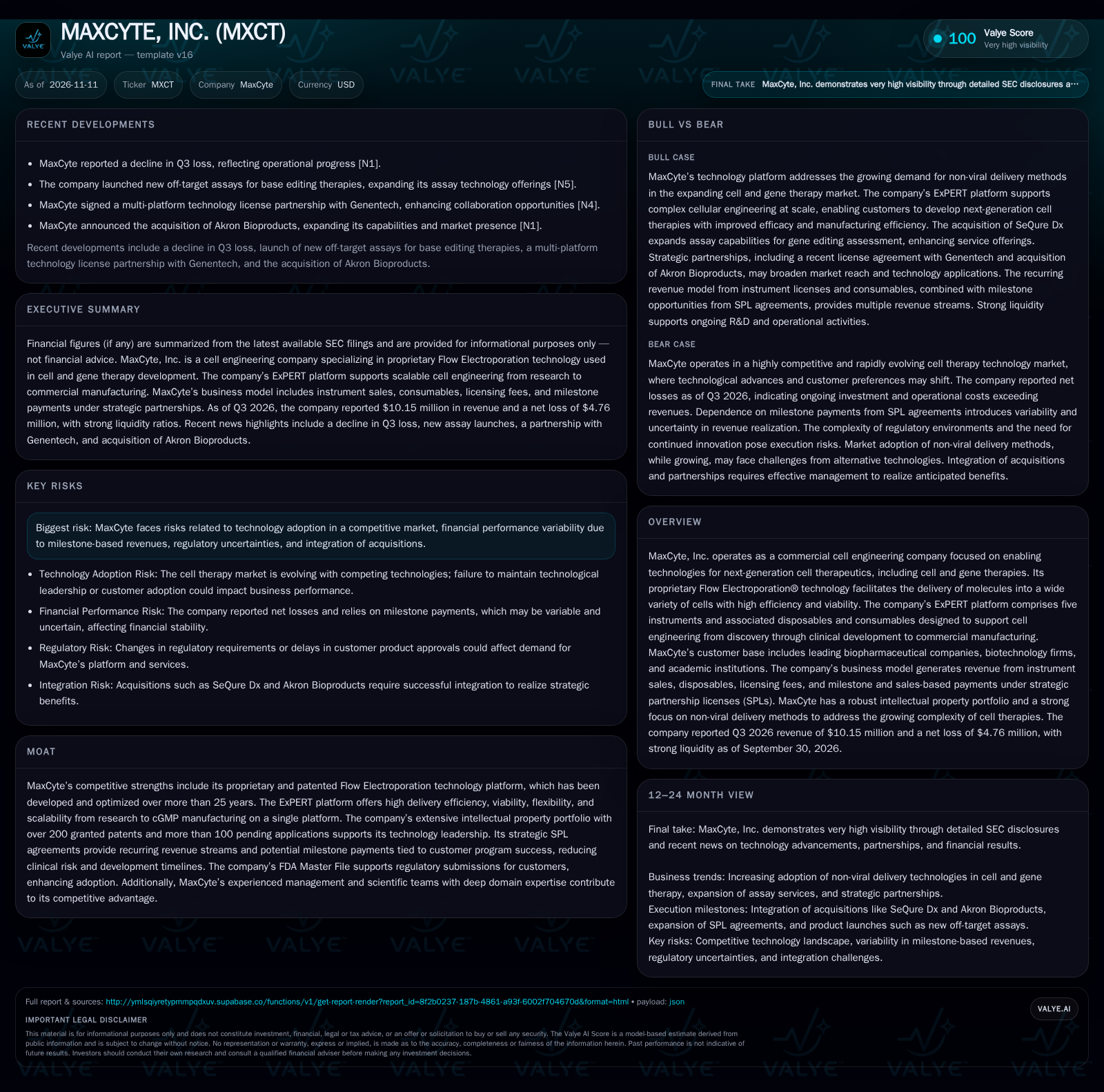
MaxCyte provides enabling cell engineering technology to biopharma, leveraging a mix of instrument sales, SPL agreements, and new assay services. Its Q3 2026 results show continued losses but reported liquidity position, while recent product launches and acquisition integration point to a broadened platform strategy. The company’s upside depends on customer clinical progress and broader adoption of non-viral delivery in cell therapy.
MaxCyte, Inc. is navigating the high-stakes world of next-generation cell and gene therapies by providing enabling technology that sits at the core of many biopharma R&D and manufacturing workflows. Its Flow Electroporation platform and growing assay suite support both research and commercial-scale cell engineering, positioning the company as a key infrastructure provider to innovators pursuing non-viral delivery and advanced gene editing. Recent financials show persistent net losses but reported liquidity position, while new product launches and the SeQure Dx acquisition underscore a strategic push to broaden its toolkit and deepen customer integration. The company’s future rests on the ability of its partners to advance clinical programs and on broader industry trends favoring non-viral, scalable cell engineering solutions.
Recent Performance, Expanding Capabilities, and the Milestone Pipeline
MaxCyte reported Q3 2026 revenue of $10.15 million and a net loss of $4.76 million, with cash and short-term investments totaling $101.28 million as of September 30, 2026 [S2]. The company reported cash and liquidity metrics for the period; these figures do not by themselves establish operating runway, investment capacity, financial flexibility, or financing capacity.
The acquisition of SeQure Dx in January 2025 and the recent launch of new off-target assays for base editing therapies in 2026 mark a deliberate expansion into gene editing analytics, broadening MaxCyte’s value proposition beyond core electroporation [S1] [N5].
Strategic partnership license (SPL) agreements remain central to MaxCyte’s business model. The company holds 32 SPLs with more than $2 billion in total pre-commercial milestone opportunities, though only $130 million is currently tied to 13 active clinical programs as of year-end 2025 [S1]. This highlights both the scale of potential upside and the contingent nature of milestone-driven revenue.
Revenue Streams and Economic Leverage in the Platform Model
MaxCyte’s revenue model is multifaceted: it encompasses instrument and consumables sales, annual license fees, and contingent milestone and sales-based payments under SPL agreements [S1]. Instruments and consumables provide an entry point and recurring usage revenue, while SPLs offer exposure to downstream program success and a potential for significant milestone and royalty-like payments.
The economics of instrument sales are typically characterized by moderate gross margins, with higher-margin recurring revenue from consumables and disposables as customer usage scales. The introduction of annual license fees and assay analytics services may further shift the mix toward higher-value, sticky revenue streams if adoption is robust.
Milestone payments under SPLs can be significant but are inherently lumpy and tied to the clinical and commercial advancement of partner programs. This introduces variability into revenue recognition and may delay profitability, especially as R&D and customer-support costs remain high.
MaxCyte’s capital needs are moderate relative to traditional biopharma, as the company does not bear the direct costs or risks of drug development. Instead, it is exposed to adoption risk and the success of customer pipelines—suggesting that long-term operating leverage is plausible if a critical mass of programs reach commercialization.
Platform Differentiation, Competitive Pressures, and Technology Substitution Risk
MaxCyte’s core differentiation lies in its proprietary Flow Electroporation technology, which promises high efficiency, viability, flexibility, and scalability from research to GMP manufacturing—all on a single platform [S1]. This technology underpins relationships with a majority of the top 25 pharma companies and has enabled the first FDA-approved ex-vivo cell therapy for an SPL customer [S1].
The competitive landscape is dynamic and crowded, with rival non-viral delivery technologies (e.g., lipid nanoparticles, microfluidic devices), legacy viral vector approaches, and emerging gene editing platforms all vying for share. While MaxCyte’s extensive IP portfolio and regulatory alignment (including an FDA Master File) provide barriers to entry, advances in alternative delivery methods or shifts in customer preference could erode its moat.
Switching costs for large-scale cell therapy manufacturing platforms can be significant due to process validation and regulatory filings. However, early-stage customers may be more willing to experiment, raising the importance of continually demonstrating superior performance and integration with evolving gene editing modalities.
Peer group comparisons include other cell engineering tool providers, specialized assay developers, and contract development organizations with integrated delivery capabilities. The question is whether MaxCyte can maintain a leadership position as the technological and regulatory landscape evolves.
If Customer Programs Succeed, MaxCyte Could Realize Leverage from SPL Milestones and Platform Expansion
In a favorable scenario, the continued adoption of non-viral delivery methods in cell and gene therapy drives increased demand for MaxCyte’s ExPERT platform and analytics services. As more SPL partners advance to late-stage clinical trials and commercial launches, milestone payments and sales-based royalties could scale meaningfully, providing operating leverage and a path to profitability.
Broader uptake of new assay offerings—especially those addressing regulatory concerns around off-target effects in gene editing—could further entrench MaxCyte’s role as an indispensable partner in the cell therapy workflow. Integration of SeQure Dx and expansion into analytics may increase customer stickiness and wallet share.
Evidence supporting this scenario would include a growing number of SPL partners reaching pivotal trial and commercial stages, increased milestone revenue recognized in financials, and accelerating adoption of new assay products. Public disclosures of additional FDA approvals leveraging MaxCyte’s platform would also be confirmatory.
Platform Maturity Brings Steady Growth, but Revenue Mix Remains Dependent on Milestone Timing
The most plausible trajectory is one in which MaxCyte continues to expand its installed base among leading biopharma and maintains a pipeline of SPL agreements, but the pace of customer program advancement remains uneven. Instrument and consumables sales provide a stable foundation, while milestone and sales-based payments contribute incremental but variable upside.
Assay and analytics expansion offer new growth vectors, but adoption is gradual as customers validate utility and integrate new workflows. Operating expenses remain elevated to support R&D and business development, delaying near-term profitability despite strong gross margins in consumables and services.
This scenario would be confirmed by moderate but consistent growth in core product revenue, periodic milestone recognition, and continued announcements of new SPL agreements and assay launches. A slow but steady increase in the number of active clinical and commercial programs among SPL partners would reinforce the base case.
If Partner Pipelines Stall or Technology Shifts, Milestone Revenue Could Disappoint
A negative outcome would stem from slow progress or clinical setbacks in SPL partner pipelines, reducing the realization of milestone payments and limiting the conversion of pre-commercial opportunity into actual revenue. Increased competition from alternative delivery technologies or a shift back toward viral vectors could erode MaxCyte’s platform adoption.
Integration missteps in recent acquisitions or underwhelming uptake of new assay offerings could further constrain growth and delay the transition to profitability. Regulatory changes or unforeseen safety signals in the broader gene editing field could also reduce demand for MaxCyte’s enabling technologies.
Evidence of this scenario would include a decline in the number of advancing SPL programs, missed or delayed milestone revenue, and stagnation or decline in instrument/consumable sales. Increased customer churn or a shift in industry preference toward alternative delivery methods would be further warning signs.
What Will Test Whether MaxCyte’s Platform Model Converts Opportunity into Durable Value?
The number and stage of active SPL partner programs; public updates on clinical progress and regulatory approvals would help test milestone realization potential.
Quarterly milestone and sales-based payments recognized; if disclosed, this would clarify the pace of conversion from pipeline to revenue.
Adoption rates for new assay and analytics offerings, particularly off-target detection products, as measured by customer count or revenue contribution (if disclosed).
Expansion of the installed base—new instrument placements and license renewals, especially among top-tier biopharma and gene editing companies.
Gross margin trends, especially as assay services and consumables mix evolves; margin expansion would suggest operating leverage is being realized.
Integration progress and revenue contribution from acquired businesses such as SeQure Dx; integration milestones and customer cross-sell activity would be useful indicators.
Any disclosure of customer churn, competitive wins/losses, or shifts in technology preference among key industry players.
Disclaimer: This is research-only, informational analysis and not investment advice. It may include AI-generated interpretation and general industry context. Always verify important details using primary sources.

Comments