
TOFUTTI BRANDS: Niche Plant-Based Pioneer Grapples With Liquidity, Competition, and the Challenge of Scale
The company's future hinges on operational efficiency, successful funding, and its ability to carve out defensible market share amid intensifying competition and margin volatility.
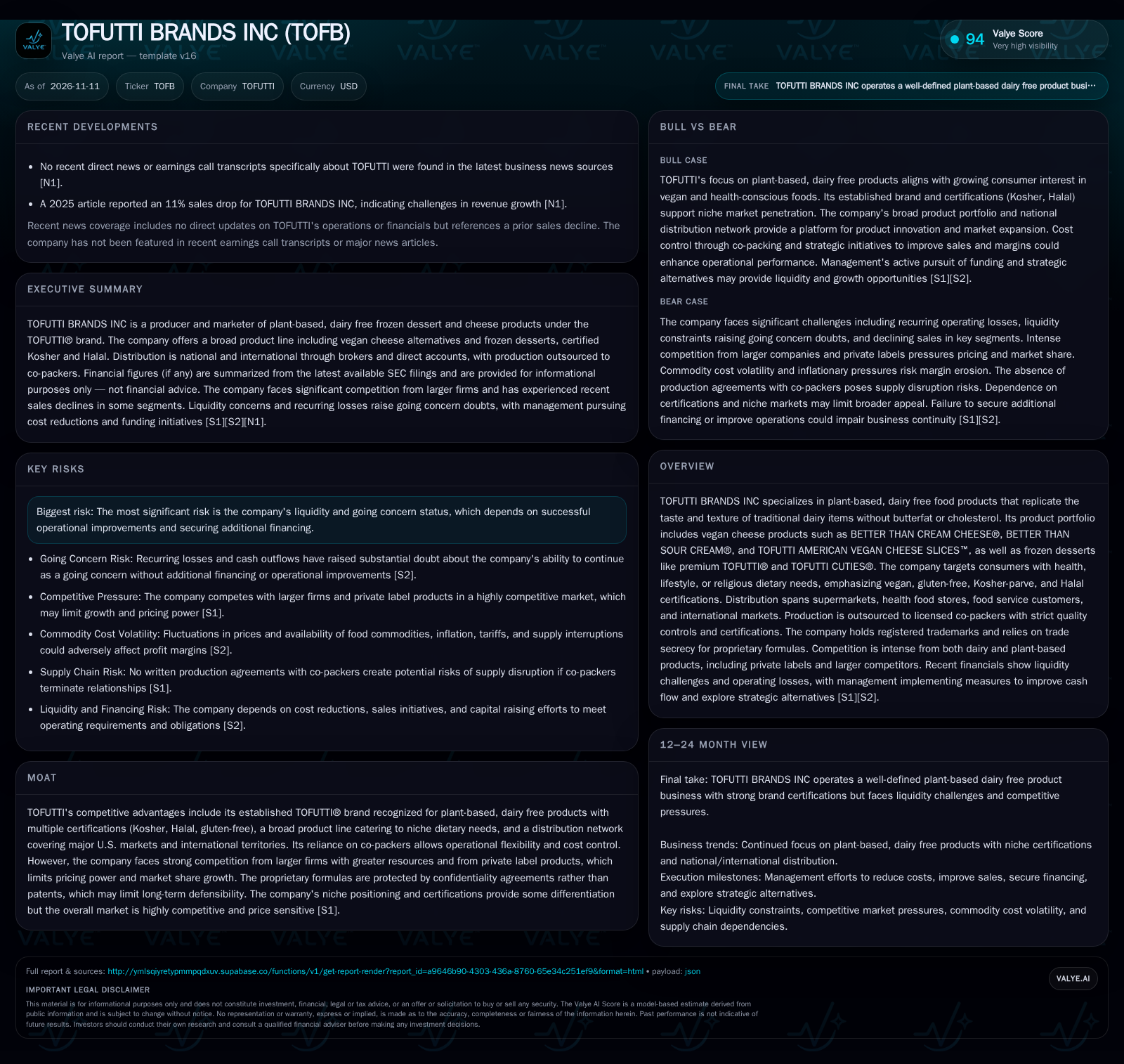
TOFUTTI BRANDS’ core strengths—brand heritage, vegan/Kosher/Halal certifications, and a diversified plant-based product portfolio—are offset by ongoing losses, cash depletion, and declining sales in key segments. The company’s reliance on co-packers without firm contracts, exposure to commodity price swings, and the need for external funding create an uncertain outlook, with management pursuing cost cuts and strategic alternatives to avert a going concern crisis. Success will depend on TOFUTTI’s ability to reinvigorate sales, stabilize margins, and secure new capital or partners in a crowded, price-sensitive market.
TOFUTTI BRANDS INC, a long-standing player in the plant-based dairy alternative space, finds itself at a pivotal crossroads. Despite a legacy of innovation and a product lineup catering to vegan, Kosher, and Halal consumers, the company is confronting acute financial distress: sales are falling in traditional channels, cash reserves have dwindled to a critical low, and management openly acknowledges substantial doubt about business continuity. The next year will test whether TOFUTTI can execute a turnaround through operational discipline, new sales strategies, and capital infusion—or whether it will cede ground to larger, better-capitalized competitors in an increasingly crowded market.
Liquidity Erosion and Sales Shifts Reshape TOFUTTI’s Immediate Outlook
By September 26, 2026, TOFUTTI’s cash and equivalents had dropped to just $138,000, with the company recording a net loss of $12,000 for Q3 and a current ratio of 3.46 [S2]. Management has issued a going concern warning, citing recurring losses and cash outflows as existential threats [S2].
Sales to health food accounts—a historically important channel—declined from $3.568 million in fiscal 2024 to $2.959 million in fiscal 2025, and international sales also slipped, while Kosher market sales increased [S1]. This pattern suggests both channel-specific weakness and demographic opportunity.
TOFUTTI’s production remains fully outsourced to four co-packers, but the absence of written supply agreements introduces potential supply chain fragility, offset only in part by confidentiality protections for proprietary formulas [S1].
Management is responding with cost reductions, deferred capital spending, new sales initiatives, and a search for additional funding or strategic alternatives, underscoring the urgency of the situation [S2].
Margin Pressure, Channel Mix, and the Economics of Plant-Based Scale
TOFUTTI’s business model centers on producing and selling plant-based cheese and dessert alternatives, with products distributed across U.S. supermarkets, health food stores, food service, and select international markets [S1]. Revenue is thus a function of volume, channel mix, and product portfolio breadth, with pricing power constrained by both private label and large branded competitors.
Production is outsourced, so TOFUTTI avoids heavy fixed manufacturing costs but is exposed to variable co-packing fees and commodity input volatility. The lack of written co-packer agreements may limit the company’s ability to negotiate favorable terms or guarantee supply, especially in times of demand spikes or inflationary stress.
Margins are acutely sensitive to commodity cost swings—soy, vegetable oils, and other inputs—a dynamic exacerbated by broader food inflation and the absence of long-term supply contracts [S2]. This creates unpredictable gross profit swings and complicates planning.
The company reported cash and liquidity metrics for the period; these figures do not by themselves establish operating runway, investment capacity, financial flexibility, or financing capacity. The business is thus caught between the need to invest for growth and the imperative to preserve cash.
Brand, Certifications, and Niche Focus: Can TOFUTTI Withstand Intensifying Competition?
TOFUTTI’s historic edge lies in its established brand and suite of certifications—vegan, Kosher-parve, Halal, gluten-free—that cater to a distinct but limited set of dietary needs [S1]. This differentiation has enabled the company to maintain shelf space in major U.S. metropolitan markets and certain international regions.
However, the plant-based segment has seen rapid influx of both large consumer packaged goods (CPG) players and private labels, dramatically increasing competition. These entrants often have greater marketing budgets, broader distribution, and more robust innovation pipelines.
TOFUTTI’s reliance on trade secrets (rather than patents) and absence of exclusive co-packer agreements further weakens its defensibility: proprietary formulas are protected, but switching costs for retailers and consumers are relatively low, and supply disruptions could quickly erode market presence.
The company’s ability to maintain a premium or defend share in its core channels will depend on continued product quality, brand trust, and responsiveness to evolving consumer preferences—especially as price competition intensifies.
A Turnaround Hinges on Niche Market Growth and Strategic Partnerships
A favorable outcome for TOFUTTI would require a confluence of operational discipline, successful sales revitalization, and external funding. If the company can leverage its certifications and brand heritage to deepen penetration in Kosher, Halal, and specialty vegan markets—segments less saturated by mainstream CPG competitors—there is potential for revenue stabilization or modest growth.
Securing new distribution partnerships, especially in underpenetrated regions or food service, could offset recent declines in health food channels. Strategic alliances—such as co-branding, licensing, or minority investments from larger food groups—could inject much-needed capital and marketing muscle, while also mitigating supply chain risk.
Confirmation of this scenario would include a reversal or stabilization of sales declines, improved gross margins despite commodity volatility, and disclosure of new funding or strategic partnerships. Evidence to the contrary would be continued sales erosion, lack of cost containment, or inability to secure financing.
Stabilization Depends on Expense Discipline and Modest Channel Realignment
The most likely outcome is a period of operational retrenchment as TOFUTTI cuts costs, defers nonessential spending, and focuses sales efforts on the most resilient, certification-driven niches. Modest sales growth in Kosher and specialty markets may partially offset further declines in broader health food and international channels.
Margins remain volatile given commodity exposure, and the absence of long-term co-packer agreements leaves the supply chain exposed to shocks. Cash conservation becomes paramount, limiting the company’s ability to invest in new product launches or aggressive marketing.
This scenario would be confirmed by ongoing, but smaller, operating losses; a gradual decline in cash outflows; and incremental progress in channel realignment or expense reduction. Falsification would include an abrupt loss of co-packer support, sharper-than-expected sales deterioration, or a failed funding effort precipitating insolvency.
Liquidity Exhaustion and Supply Disruption Threaten Business Continuity
The lack of written co-packer contracts exposes the company to abrupt supply interruptions, which could quickly erode shelf presence and brand equity.
Margin compression from commodity cost spikes or promotional pricing by competitors would accelerate cash burn, while the inability to secure new investment would leave management with limited options beyond asset sales or liquidation.
Early evidence of this scenario would include further rapid cash depletion, negative supplier or broker developments, public disclosure of missed payments, or the announcement of a formal restructuring process.
Milestones That Will Determine Whether TOFUTTI Can Regain Its Footing
Monthly or quarterly cash balance trends—does the company stabilize or continue to burn cash at an unsustainable rate?
Net sales performance by channel (health food, Kosher, international, food service)—is there evidence of stabilization or green shoots in targeted segments?
Gross margin percentage and margin volatility—can TOFUTTI manage input cost swings and maintain or improve profitability?
Status of co-packer relationships—do any key partners terminate, or are new written agreements secured to reduce supply risk?
Updates on new distribution partnerships or entry into new channels, especially those aligned with core certifications.
Announcement of new funding, credit facilities, or strategic alternatives such as M&A or minority investment.
Evidence of cost reductions translating into lower operating losses or improved cash flow.
Disclaimer: This is research-only, informational analysis and not investment advice. It may include AI-generated interpretation and general industry context. Always verify important details using primary sources.

Comments