
Seer, Inc.: Early-Stage Proteomics Commercialization, Scientific Partnerships, and the Test of Adoption Velocity
Seer’s Proteograph platform targets high-throughput proteomics for life sciences, aiming to capture value through scientific collaborations and early commercial traction.
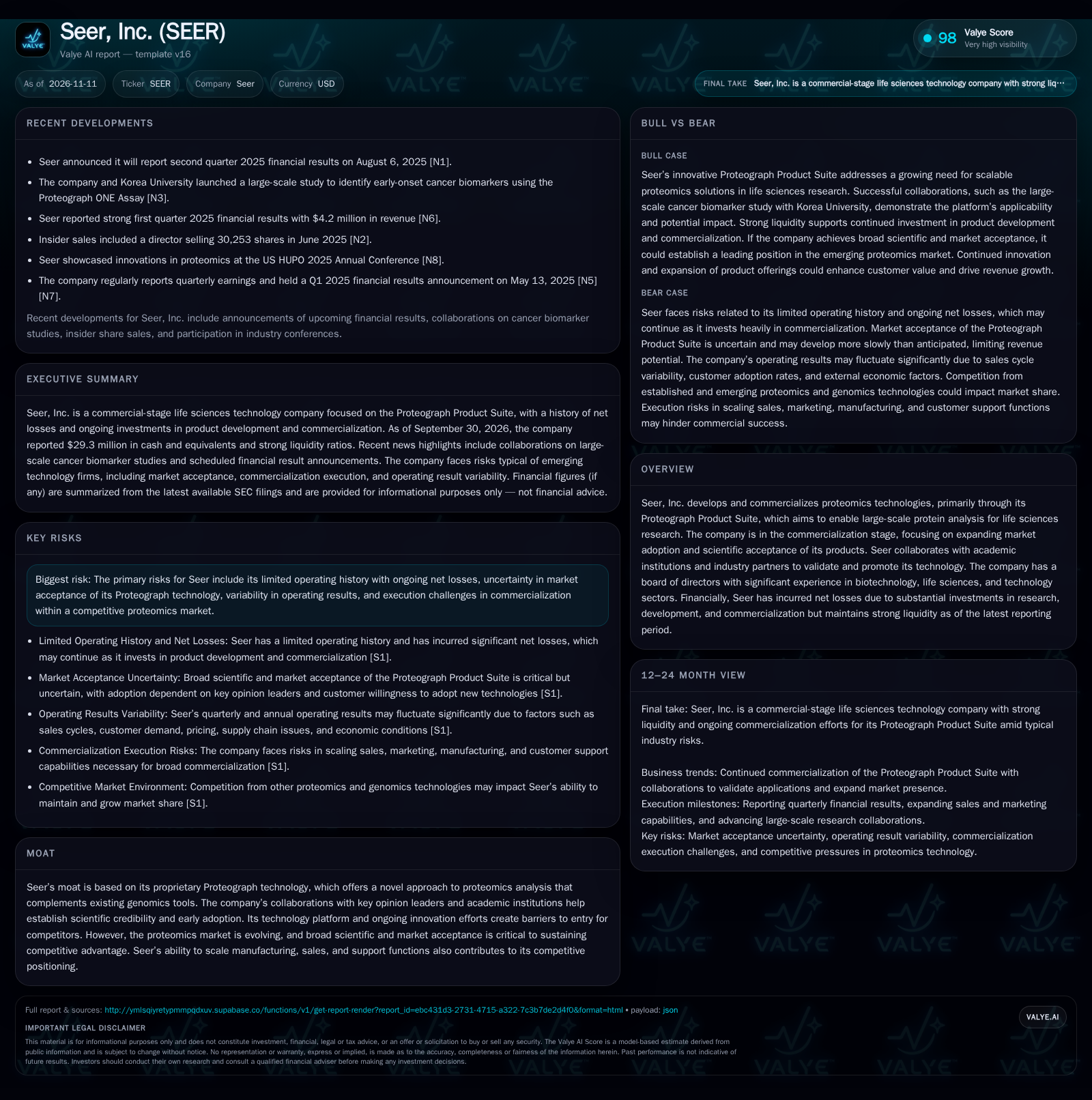
Seer, Inc. is pushing its Proteograph Product Suite into early commercial markets, supported by reported liquidity position and scientific collaborations such as its large-scale cancer biomarker study with Korea University. Despite a history of net losses and operating uncertainty, Seer’s strategy hinges on accelerating adoption and proving its platform’s value in proteomics—a field that could develop more slowly than genomics. Execution in sales, market education, and customer support will determine whether Seer’s investments translate into sustainable growth or prolonged losses.
Seer, Inc. stands at a critical juncture: its Proteograph Product Suite offers a novel approach to large-scale protein analysis, but the business remains deep in investment mode, with persistent net losses and a market that has yet to fully embrace proteomics at the scale seen in genomics. Recent scientific partnerships, such as the Korea University cancer biomarker study, offer valuable validation, but commercial traction remains in its infancy.
Recent Collaborations and Financial Standing Define Seer’s Near-Term Outlook
Seer, Inc. is currently focused on commercializing its Proteograph Product Suite—a platform designed to enable large-scale, high-throughput protein analysis for life sciences research [S1]. The company’s financials reflect its early-stage status: as of September 30, 2026, Seer reported $29.3 million in cash and cash equivalents, with current assets of $167.9 million against current liabilities of $9.9 million, resulting in a notably reported current ratio of 16.89 [S2]. However, the business continues to operate at a significant loss, with net losses of $47.5 million for the first nine months of 2026 and an accumulated deficit exceeding $500 million [S2].
On the commercial and scientific front, Seer’s collaboration with Korea University on a large-scale study to discover early-onset cancer biomarkers using its Proteograph ONE Assay is a material development [N3]. This partnership both tests real-world platform value and provides external validation—a critical factor for market adoption in the proteomics sector. Additionally, Seer continues to showcase its technology at major scientific conferences, reinforcing its commitment to building credibility and visibility within the scientific community [N8].
How Seer’s Proteograph Platform Could Capture Value—And Where the Economics Remain Unproven
Seer aims to generate revenue by selling or licensing its Proteograph Product Suite and related products and services to research institutions, biopharma companies, and potentially clinical labs. In Q1 2025, Seer reported $4.2 million in revenue, but the company remains loss-making as it invests heavily in R&D, commercialization, and market development [N6]. The platform’s economics likely combine instrument sales (potentially at low or negative margins early on) with higher-margin consumables and software—mirroring the classic razor/razorblade model seen in genomics and life sciences tools, though Seer’s specific contract and pricing structure are not disclosed.
The fundamental business lever is recurring revenue from consumables and potential software subscriptions, which, if adoption accelerates, could drive operating leverage over time. The company reported cash and liquidity metrics for the period; these figures do not by themselves establish operating runway, investment capacity, financial flexibility, or financing capacity. The timing and slope of adoption curves, as well as customer retention and expansion rates, will be critical in determining whether Seer can scale into profitability.
Competing for Proteomics Mindshare: Differentiation, Substitution, and Barriers to Entry
Seer’s competitive positioning rests on the novelty and scalability of its Proteograph technology, which aims to offer deeper, more comprehensive protein analysis compared to traditional mass spectrometry-based workflows [S1]. The company’s academic collaborations and presence at industry conferences are designed to establish scientific credibility and seed early adoption among key opinion leaders, a proven tactic in life sciences but not a guarantee of commercial success.
The main competitive threats stem from both established proteomics companies (offering mass spectrometry and related tools) and genomics players expanding into multi-omics. Substitution risk is significant: if proteomics workflows remain complex, costly, or slow to yield actionable insights, customers may delay adoption in favor of established genomics approaches or alternative biomarker discovery tools. Seer’s ability to could increase switching costs or network effects depends on embedding its platform into customer workflows and demonstrating unique, reproducible scientific value. The evolving nature of the proteomics market means that barriers to entry are more technical and scientific than commercial at this stage.
Accelerated Adoption Driven by Scientific Validation and Workflow Integration
The most favorable scenario for Seer is a virtuous cycle where successful scientific collaborations—such as the Korea University cancer biomarker study—produce high-profile publications and validation data, leading to broader adoption by research institutions and biopharma partners [N3]. As more key opinion leaders adopt the Proteograph platform, peer effects could accelerate market acceptance, driving demand for both instruments and recurring consumables.
Confirmation of this scenario would come from a material uptick in new customer wins, expansion of installed base, and evidence of repeat consumable/software purchases. Additional large-scale collaborations, regulatory milestones (if clinical applications emerge), or reference customer case studies would further validate the platform’s relevance. If Seer demonstrates sustained revenue growth, narrowing losses, and improved gross margins from recurring consumables, it would suggest the business model is reaching scale.
Early Adoption Remains Slow, Requiring Ongoing Investment and Market Education
The most plausible near-term outcome is that Seer continues to face a slow and uneven adoption curve, typical for new scientific platforms in life sciences. While the Proteograph Product Suite garners interest and secures high-value collaborations, broad market penetration remains limited by budget cycles, entrenched workflows, and the need for extensive scientific validation. Revenue grows modestly but remains insufficient to offset ongoing R&D and SG&A expenses, resulting in continued net losses.
Evidence for this scenario would include incremental but not exponential growth in revenue, persistent high cash burn, and the need for ongoing investments in sales, customer support, and scientific outreach. Periodic collaborations and conference presentations provide visibility but do not yet translate into a broad installed base or robust consumables pull-through.
Adoption Stalls as Market Shifts or Validation Lags, Forcing Strategic Retrenchment
In a negative scenario, Seer’s technology fails to achieve broad scientific or commercial acceptance within a reasonable timeframe. If key collaborations do not yield compelling results, or if competing platforms advance more rapidly, potential customers may remain on the sidelines. External headwinds—such as reduced research funding, economic downturns, or disruptive innovations from competitors—could further limit adoption and threaten the revenue base.
Indicators of this scenario would include flat or declining revenue, customer churn, reduced collaboration activity, and management guidance pointing to lower-than-expected demand. Persistent net losses and cash burn could force Seer to scale back R&D, reduce workforce, or seek additional dilutive financing. Ultimately, the company could risk strategic irrelevance if it cannot demonstrate differentiated value or achieve a self-sustaining customer base.
Milestones and Metrics to Test Seer’s Proteomics Commercialization Thesis
Quarterly revenue growth and the proportion attributable to recurring consumables and services, if disclosed, would help test the emergence of a scalable business model.
Customer adoption metrics such as the number of Proteograph systems placed, expansion within existing accounts, and breadth of customer segments would provide direct evidence of market traction.
Updates on the Korea University collaboration—including published results, follow-on studies, or third-party validation—would indicate the platform’s scientific impact and influence on adoption.
Gross margin trends and operating expense ratios, particularly as a function of revenue growth, would reveal progress toward operating leverage.
Disclosure of additional large-scale collaborations, reference customer testimonials, or regulatory milestones would signal growing acceptance and platform entrenchment.
Cash burn rates and updated runway projections are critical, given ongoing net losses and the need for sustained investment.
Any indications of competitive product launches, shifts in research funding, or changes in customer purchasing patterns would provide early warning of market headwinds or substitution risk.
Disclaimer: This is research-only, informational analysis and not investment advice. It may include AI-generated interpretation and general industry context. Always verify important details using primary sources.

Comments