
BridgeBio Oncology Therapeutics: Precision Oncology Ambition Meets Clinical-Stage Reality
BridgeBio Oncology Therapeutics is advancing a differentiated pipeline targeting RAS and PI3Kα mutations in hard-to-treat cancers, bolstered by reported liquidity position and recent FDA Fast Track recognition. Yet, with all assets still in Phase 1 and no revenue, the company’s future hinges on clinical proof, regulatory milestones, and the competitive landscape for next-generation targeted therapies.
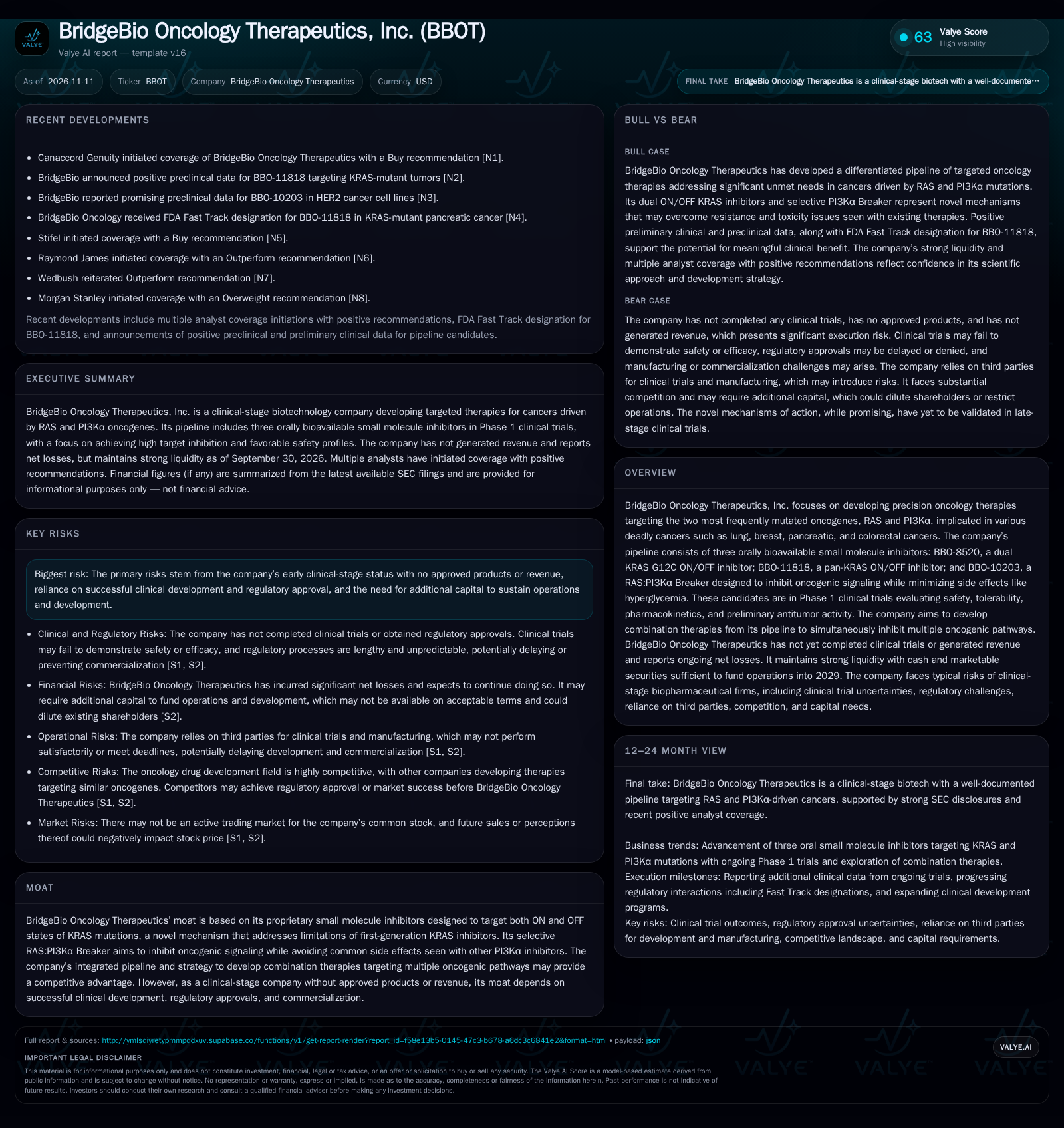
BridgeBio Oncology Therapeutics is a clinical-stage biotech developing three oral small molecule inhibitors for RAS and PI3Kα-driven cancers. While preclinical and early clinical signals are positive, the absence of late-stage data and commercialized products means execution risk remains high in a fiercely competitive oncology market. [S2] [N2] [N4]
BridgeBio Oncology Therapeutics, Inc. sits at the intersection of high scientific ambition and classic biotech risk. With a pipeline targeting some of the most prevalent and therapeutically challenging oncogenic drivers—RAS and PI3Kα—the company aims to deliver oral, highly selective inhibitors that could overcome the resistance and toxicity issues plaguing earlier generations. Recent recognition, including FDA Fast Track status for its KRAS-mutant pancreatic cancer candidate, and positive preclinical data have garnered analyst attention and market optimism. However, with all programs still in Phase 1 and no commercial revenue, the next two years will be defined by clinical readouts, regulatory progress, and the ability to differentiate in a crowded precision oncology field.
Recent Milestones: Early-Stage Pipeline, Fast Track Recognition, and Analyst Optimism
Multiple major analysts have initiated coverage with positive or outperform recommendations over the past year, reflecting market interest but not yet clinical or commercial validation. [S2] [N1] [N2] [N3] [N4] [N5] [N6] [N7] [N8]
Translating Targeted Oncology Innovation into Commercial Value
BridgeBio Oncology Therapeutics’ business model, like most clinical-stage biotechs, is currently non-revenue generating and centered on R&D investment with the aim of creating high-value, differentiated cancer therapies. The commercial potential rests on several levers: (1) targeting high-prevalence oncogenic mutations (RAS and PI3Kα) that drive a significant share of lung, colorectal, pancreatic, and breast cancers; (2) developing orally bioavailable small molecules, which could enable easier adoption and combination regimens compared to injectable biologics or less selective agents; and (3) pursuing combination therapy strategies, which, if successful, may command premium pricing and broader market penetration.
If any candidate achieves robust Phase 2/3 efficacy and a favorable safety profile, BridgeBio may monetize via out-licensing, partnerships, or direct commercialization. Pricing power in precision oncology can be strong for best-in-class or first-in-class therapies, especially in high-unmet-need tumor types, but is counterbalanced by payer scrutiny and competition. Fixed costs are dominated by R&D and clinical operations, while future commercial-stage cost structures would depend heavily on the go-to-market model—partnered versus standalone sales. Operating leverage could be significant if multiple indications or combination regimens are validated, but capital needs will remain high until clinical and regulatory inflection points are reached.
Navigating a Crowded Precision Oncology Landscape
BridgeBio Oncology enters a field marked by intense competition and rapid innovation. Multiple large pharmaceutical and biotech firms are pursuing KRAS and PI3Kα inhibitors, with some first-generation KRAS G12C agents already approved and in-market. The company’s approach—dual ON/OFF KRAS inhibition and selective RAS:PI3Kα signaling disruption—could offer differentiation if it delivers superior efficacy or safety, particularly in overcoming resistance or minimizing toxicities like hyperglycemia.
However, the barriers to entry are high, and the window for first-mover or best-in-class status is narrowing as competitors advance their own pipelines. Switching costs for oncologists and patients are primarily clinical and payer-driven: superior data, real-world outcomes, and guideline inclusion can drive adoption, but established products and entrenched relationships with major cancer centers may slow uptake. Without late-stage data, BridgeBio’s moat is currently theoretical, hinging on whether its mechanisms translate into clear clinical benefit and whether it can secure regulatory and reimbursement support ahead of competitors.
Breakthrough Clinical Results Could Catalyze Value Creation
The most favorable outcome for BridgeBio Oncology would see one or more pipeline assets—particularly BBO-11818, given its Fast Track status—demonstrate compelling safety and efficacy in Phase 1/2 trials, leading to rapid advancement into pivotal studies. Positive early clinical data, especially in hard-to-treat or resistant KRAS-mutant cancers, could attract strategic partnerships, non-dilutive funding, or even acquisition interest from larger oncology players.
Confirmation of this scenario would require: (1) robust, peer-reviewed clinical data showing substantial tumor response rates and manageable side effects; (2) expansion into additional indications or combination regimens with similarly positive results; and (3) clear regulatory engagement (e.g., Breakthrough Therapy designations, expedited review paths). Early signs—such as the FDA Fast Track for BBO-11818 and positive preclinical data—support this pathway, but late-stage validation will be essential. [N2] [N3] [N4]
Incremental Clinical Progress with Ongoing Uncertainty
The most likely near-term trajectory is a series of incremental readouts from Phase 1 trials, with some evidence of target engagement and safety but with efficacy data that remains immature or mixed. BridgeBio Oncology would continue to invest in its pipeline, potentially expanding Phase 1/2 cohorts or initiating combination studies, while seeking to extend its cash runway and manage dilution risk.
This scenario would be confirmed by: (1) continued reporting of early-stage data without major safety signals but also without clear breakthrough efficacy; (2) ongoing analyst support but little change in the risk profile; and (3) a focus on longer-term development timelines, with pivotal trial initiation still one or more years away. Any delays, setbacks, or mixed results in these early studies could prolong the path to value inflection and increase reliance on additional financing. [S2] [N1] [N5] [N6] [N7] [N8]
Clinical Setbacks or Competitive Advances Erode Prospects
A material adverse scenario would involve failure to demonstrate meaningful efficacy or safety in Phase 1/2 clinical trials, leading to discontinuation of one or more pipeline assets. Alternatively, a competitor could launch a superior or first-in-class therapy, capturing market share and rendering BridgeBio’s approach less relevant—especially if the company’s mechanisms do not show clear differentiation in real-world settings.
This downside would be confirmed by: (1) negative or inconclusive clinical updates, including dose-limiting toxicities or lack of tumor response; (2) regulatory setbacks, such as clinical holds or withdrawal of Fast Track status; (3) significant delays in trial enrollment or program progression; or (4) announcements of new approvals or positive late-stage data from direct competitors. In this environment, BridgeBio would likely face shrinking access to capital, increased dilution, and potentially a need to reprioritize or out-license pipeline assets at unfavorable terms. [S2] [N4]
Milestones and Metrics That Will Clarify BridgeBio Oncology’s Trajectory
Readouts from ongoing Phase 1 clinical trials for BBO-8520, BBO-11818, and BBO-10203, including safety, pharmacokinetics, and preliminary efficacy data, will be the most direct test of scientific and commercial potential. [S2]
Any updates or expansion of FDA regulatory designations (e.g., Breakthrough Therapy, additional Fast Track indications) would provide important signals about clinical promise and regulatory engagement. [N4]
Announcements of partnerships, licensing deals, or strategic collaborations would help validate commercial interest and provide non-dilutive funding opportunities, if disclosed.
Progression of pipeline assets into later-stage (Phase 2/3) trials, or initiation of combination therapy studies, would mark advancement toward value inflection.
Cash burn rates and updated liquidity projections, especially as clinical programs expand, would inform risk of future dilution or funding needs. [S2]
Disclosures of clinical trial enrollment rates and timelines, if provided, would help assess operational execution.
Comparative efficacy or safety data versus other KRAS or PI3Kα inhibitors (if available) would help clarify competitive positioning.
Peer-reviewed publication of clinical or translational data would support scientific credibility and market visibility.
Disclaimer: This is research-only, informational analysis and not investment advice. It may include AI-generated interpretation and general industry context. Always verify important details using primary sources.

Comments