
Janus International: Asset Impairments, Margin Pressures, and the Test of Integrated Solutions in a Fragmented Market
Janus International’s Q3 2026 net loss and goodwill impairments spotlight both the risks and the operational complexity of its self-storage and commercial door business. With over two-thirds of revenue tied to a fragmented, evolving storage market and proprietary technology as a potential differentiator, the company’s future hinges on its ability to defend margins, integrate acquisitions, and leverage its broad product suite amid volatile steel costs and intensifying competition.
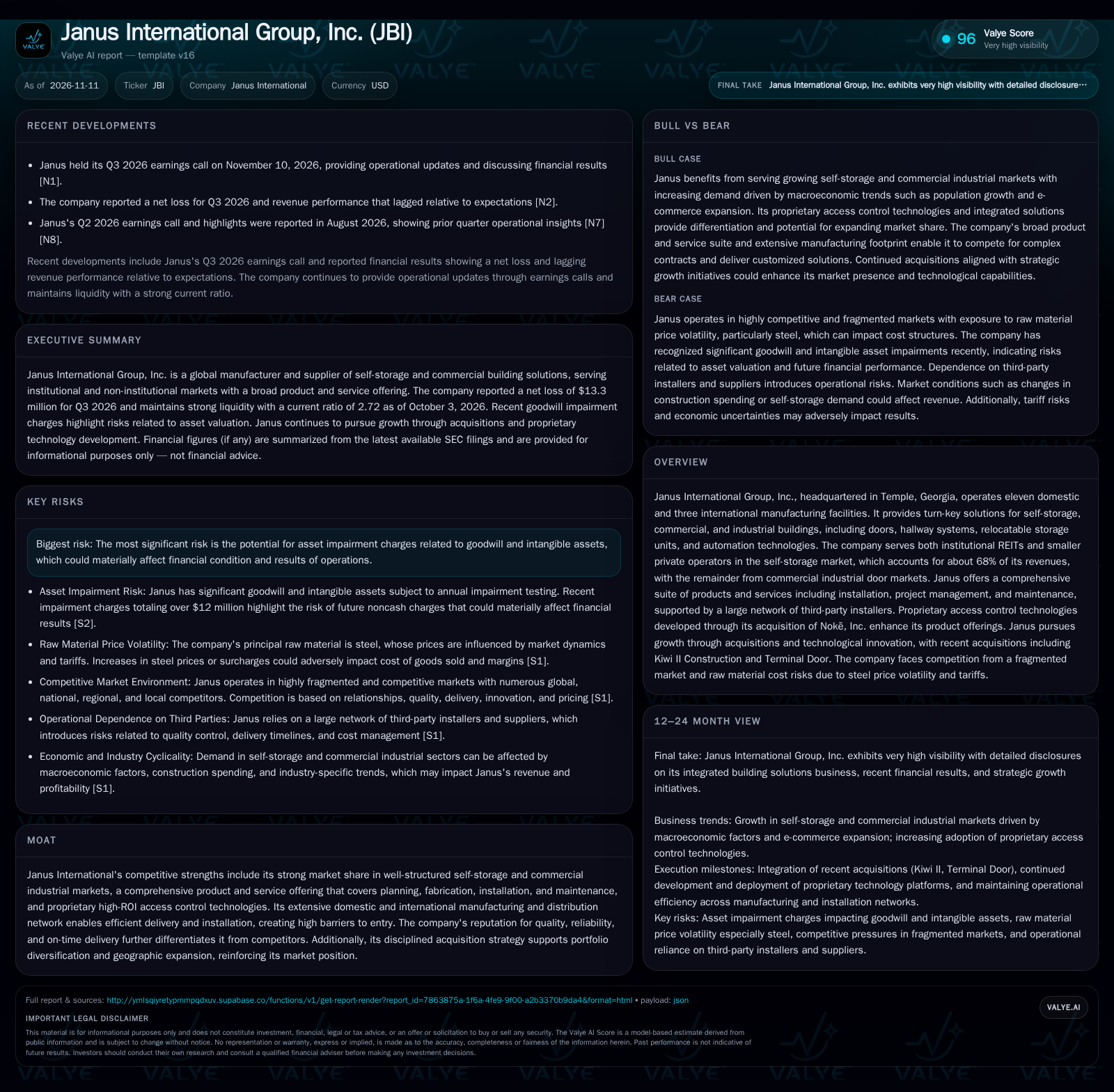
Janus International reported a $13.3 million net loss in Q3 2026, driven partly by $12.4 million in goodwill impairments, and lagged revenue expectations. About 68% of revenue comes from self-storage solutions—mainly to institutional REITs and private operators—while the rest is from commercial/industrial doors. Proprietary access-control tech and a wide service offering are potential strengths, but the company faces ongoing risks from steel price volatility, asset impairments, and heavy competition in fragmented markets. Integration of recent acquisitions and the ability to leverage its technology platform will be crucial for future margin expansion and growth [S1] [S2] [N2].
Janus International, a major supplier of self-storage and commercial door solutions, faces a pivotal period after reporting a Q3 2026 net loss and substantial goodwill impairments. With most revenue anchored in the highly fragmented self-storage sector—serving both institutional REITs and smaller operators—the company’s future will likely be shaped by its ability to integrate recent acquisitions, defend margins amid steel price swings, and exploit its proprietary access-control technology. As asset impairments raise questions about acquired businesses' value, Janus’s broad product suite and presence in both established and growth markets provide both opportunity and complexity.
Asset Impairments and Q3 Losses Signal Strategic and Operational Crossroads
Janus International reported a net loss of $13.3 million for the quarter ended October 3, 2026, with basic and diluted EPS of -$0.10 [S2]. This loss was driven in part by goodwill impairment charges totaling $12.4 million—$5.0 million for its BETCO reporting unit and $7.4 million for Kiwi II—highlighting the company’s vulnerability to asset valuation pressures after recent acquisitions [S2]. The company’s Q3 revenue and earnings lagged expectations, underscoring margin pressure and possible operational challenges [N2]. As of October 3, 2026, Janus had $102.1 million in cash and equivalents, a current ratio of 2.72, and a cash ratio of 0.83, providing a neutral snapshot of short-term liquidity [S2]. With 68% of revenues sourced from self-storage and 32% from commercial industrial doors, Janus’s performance is deeply tied to trends in these cyclical and fragmented markets [S1].
How Janus Makes—and Risks—Money in Self-Storage and Commercial Doors
Janus generates revenue by manufacturing and installing roll-up and swing doors, hallway systems, relocatable storage units, and facility automation technologies. Its value proposition centers on turnkey project delivery, including planning, construction, and post-installation services, supported by an extensive network of third-party installers [S1]. The company’s proprietary Nokē access-control technology may command premium pricing and enable cross-selling, but the extent of recurring revenue from software or cloud services is not disclosed and would be a key lever for future margin expansion if realized.
Revenue mix is weighted toward self-storage (68%), with the remainder from commercial and industrial doors (32%). The self-storage segment serves both institutional REITs—typically demanding multi-story, climate-controlled facilities—and smaller, non-institutional operators focused on single-story, lower-spec units [S1]. This diversity exposes Janus to a broad range of price sensitivities and project sizes, but also means that large institutional contracts can drive volume and operating leverage when construction cycles are favorable.
Steel coil is the principal raw material, making cost of goods sold highly sensitive to steel price volatility and tariffs [S1]. While vertical integration across design, fabrication, and installation can help manage costs and delivery times, Janus’s margins remain exposed if it cannot pass on input cost increases to customers. The company’s multi-factory footprint (eleven domestic, three international) supports scale and delivery speed but also entails significant fixed costs and integration complexity, especially following recent acquisitions.
Operating leverage is plausible in upcycles—when high facility buildout or renovation demand allows Janus to spread fixed costs over more projects—but can reverse quickly if demand softens or price competition intensifies. The recent goodwill impairments suggest that some acquired businesses are not meeting initial performance expectations, raising questions about acquisition discipline and the sustainability of inorganic growth.
Fragmented Markets, Technology Bets, and the Battle for Differentiation
Janus operates in highly fragmented markets for both self-storage and commercial doors, competing with global, national, regional, and local players [S1]. Key competitive factors include customer relationships, product quality, delivery speed, pricing, and innovation. The company’s broad portfolio—including proprietary access control and automation—offers a potential edge, especially for institutional clients seeking integrated solutions.
However, the self-storage market remains only partially consolidated: REITs account for about 35-40% of U.S. square footage, with the rest controlled by a long tail of smaller operators [S1]. This fragmentation can limit pricing power and makes customer acquisition costly and unpredictable. In commercial and industrial doors, Janus must contend with cyclical construction spending and a crowded field of suppliers, many of whom compete aggressively on price.
The Nokē acquisition positions Janus to benefit if the industry embraces smart security and automation at scale. If these technologies become table stakes or are commoditized by larger access-control players, Janus’s differentiation could erode. Meanwhile, the company’s reliance on third-party installers creates operational risk and can dilute control over quality and customer experience.
Recent acquisitions (Kiwi II Construction, Terminal Door) aim to broaden geographic reach and product scope, but also introduce integration risk, as reflected in the latest impairment charges. The company’s established reputation and manufacturing footprint are strengths, yet sustaining premium positioning will likely require continued innovation and successful integration of new capabilities.
Unlocking Margin Expansion Through Technology and Institutional Storage Growth
A favorable outcome for Janus would see institutional self-storage REITs and urban developers ramping up new facility construction and major renovations, driving demand for integrated, high-value solutions. If Janus can leverage its proprietary Nokē technology to secure premium contracts—bundling hardware, software, and ongoing service—it could boost average deal size and introduce a recurring revenue component, improving both margins and revenue visibility.
Successful integration of Kiwi II and Terminal Door could also expand Janus’s reach into new regions and customer segments, allowing for cross-selling and operational synergies. If steel prices stabilize or Janus demonstrates an ability to pass through cost increases, gross margins could recover. Evidence supporting this scenario would include rising contract wins with REITs, disclosed increases in recurring software/service revenue, and improved gross margins in subsequent quarters.
Confirmation would come from management commentary on pipeline strength, sustained growth in access-control adoption, and a reversal of impairment trends as acquired units meet or exceed performance targets.
Margin Recovery Hinges on Execution Amid Cyclical and Integration Pressures
The most likely outcome is a gradual recovery in core operating margins as Janus works through integration challenges and responds to steel price volatility. Self-storage and commercial door demand may remain steady but not accelerate meaningfully, with institutional REITs continuing to gain share but overall construction activity subject to macroeconomic headwinds.
Janus’s broad manufacturing footprint and full-service model should support retention of key clients, but pricing power will likely be limited by competition and customer fragmentation. The company may realize modest benefits from proprietary technology, but unless recurring revenue is disclosed and grows, most revenue will remain project-based and cyclical.
Evidence for this scenario would include stable or slowly improving gross margins, continued but smaller impairment charges, and muted top-line growth. Integration of recent acquisitions proceeds, but without transformative impact on margins or market share.
Further Impairments, Steel Price Spikes, and Project Delays Threaten Profitability
A negative scenario could materialize if steel prices spike again and Janus is unable to pass along costs, compressing gross margins. Additional goodwill or intangible asset impairments—especially if newly acquired units underperform—would further erode reported earnings and investor confidence.
Should construction activity in self-storage or commercial/industrial markets slow due to macroeconomic weakness, project volumes could fall, amplifying the impact of high fixed costs and reducing operating leverage. Increased competition, especially from larger or more technologically advanced rivals, could force Janus to cut prices or invest heavily in new features, further straining profitability.
Evidence for this scenario would include further impairment charges, declining gross margins, reduced project backlogs (if disclosed), and negative management commentary regarding demand or integration setbacks.
What Will Determine Whether Janus Delivers Sustainable Margin Expansion?
Gross margin trends, particularly in quarters following steel price changes, will be critical to assess the company’s ability to manage input cost volatility.
Disclosure (if provided) of recurring revenue from access-control software, cloud services, or maintenance contracts would clarify the potential for margin expansion and revenue stability.
Further goodwill or intangible asset impairment charges, especially related to recent acquisitions, would signal ongoing integration or performance issues.
Contract win rates with institutional REIT customers versus smaller operators would help gauge Janus’s competitive positioning and pricing power.
Updates on integration progress and realized synergies from acquisitions such as Kiwi II Construction and Terminal Door would indicate management’s execution effectiveness.
Volume and mix of self-storage versus commercial/industrial project revenues, if broken out, would reveal exposure to cyclical end-markets and potential growth drivers.
Management’s commentary on supply chain stability, third-party installer relationships, and delivery timelines would provide insight into operational risk management.
Any new product launches or technology upgrades in access control or automation that gain market traction would support the thesis of differentiation and premium pricing.
Disclaimer: This is research-only, informational analysis and not investment advice. It may include AI-generated interpretation and general industry context. Always verify important details using primary sources.

Comments